Basic HTML Version


Electrical protection and safety
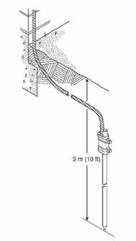
Ground rods [1]
Conclusion
The information contained in this article is based onmany years expe-
rience and exposure of the author in the field of electrical design and
lightning protection and legislation, as well as the review and study of
technical publications and other writers. While the statements purport
to be accurate, readers are responsible for their own interpretation.
Reference
[1] NFPA 780 Standard for the Installation of Lightning Protection
Systems, 2004. National Fire Protection Association.
[2] IEC 60325. 2002. Radiation protection instrumentation - Alpha,
beta and alpha/beta (beta energy >60 keV) contamination meters
and monitors.
Bibliography
[1] NFPA 70 National Electrical Code 2002. National Fire Protection
Association, 2002, Article 250.106.
[2] Top 101 Rules of Understanding the NEC 2005. Mike Holt Enter-
A
bout the author
Olof Bekker spent 25 years in the metals industry - at
Iscor and Columbus Stainless. He also spent 18 years in
engineering and design at PetroSA (Mossgas). He was
employed by Fluor as managing contractor for electrical
projects on the Secunda Growth Programme and his
present position at Fluor South Africa is Engineering Manager, Electrical
and Facilities. He is a Registered Professional Engineer (ECSA); he has a
BSc Eng as well as a degree in management leadership. Enquiries: Tel.
011 233 3714 or email olof.bekker@fluor.com.
Definitions pertaining to lightning
• LPC: Lightning Protection Code, NFPA-78.
• Protected structure: A building or structure that has been
provided with a lightning protection system or that, by its
construction and grounding, is self-protecting.
• Station ground: The generating station, station ground
system.
• Test sphere or 300 foot rolling ball criteria: A hypothetical
sphere 300 feet in diameter which is used to determine the
zone of protection provided by a protected structure. The
zone of protection is an area substantially immune to direct
lightning strokes.
• Air terminal: A strike termination device that is a receptor
for attachment of flashes to the lightning protection system
and is listed for the purpose.
• Ground terminal: The portion of a lightning protection sys-
tem, such as a ground rod, ground plate, or ground conduc-
tor, that is installed for the purpose of providing electrical
contact with the earth.
• Catenary lightning protection system: A lightning protection
system consisting of one or more overhead ground wires.
• Sideflash: An electrical spark, caused by differences of
potential, that occurs between conductive metal bodies or
between conductive metal bodies and a component of a
lightning protection system or ground.
• Strike termination device: A component of a lightning
protection system that intercepts lightning flashes and con-
nects them to a path to ground. Strike termination devices
include air terminals, metal masts, permanent metal parts of
structures, and overhead ground wires installed in catenary
lightning protection systems.
• Lightning flash to earth: Electrical discharge of atmospheric
origin between cloud and earth consisting of one or more
strokes.
3 m (10 ft)
4
4
5
5
1
1
2
2
3
3
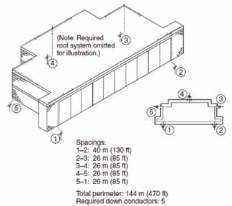
Note: Required roof
system omitted for
illustration.
Spacings:
1-2: 40 m (130 ft)
2-3: 26 m (85 ft)
3-4: 26 m (85 ft)
4-5: 26 m (85 ft)
5-1: 26 m (85 ft)
Total perimeter: 144 m (470 ft)
Required down conductors: 5
prises, Inc.
[3] Early, MW et al. National Electrical Code Handbook, 10
th
edition.
Massachusetts: National Fire Protection Association, Inc. 2005.
Acknowledgements
I hereby wish to express my thanks to Fluor for allowing me the
opportunity to publish and present this article. I also wish to thank
and give credit to all those in the industry who have kindly allowed
me the use of some of this information and for the many years of
assistance and dedication.
Electricity+Control
September ‘12
30