Basic HTML Version


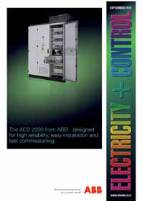
COVER STORY
FEATURES:
• Control systems and automation
• Electrical protection and safety
• Plant maintenance, test and measurement
• Sensors, switches and transducers
• Energy and enviroFiciency
E+C sep 2012 cover.indd 1
2012/08/29 03:18:32 PM
S
ixABB variable speed drives (VSDs) have replaced damper control
on induced draft fans and secondary air fans at Valorsul’s waste-
to-energy plant in Portugal. The result is an annual energy saving
approaching € 240 000 (*R2 523 648).
Valorsul operates a waste-to-energy plant, located some six kilo-
metres from Lisbon, which converts waste into electricity. It has three
blocks and a total capacity of 50 MW.The plant receives about 2 000
tons of waste per day and produces enough energy to supply a city
of 150 000 inhabitants. Emission control includes a bag house and
semi-dry scrubber. It incorporates the SNCR (Selective Non-Catalytic
Reduction) method for reducing nitrogen oxide emissions. An envi-
ronmental monitoring programme is implemented to evaluate the
impact of the plant.
Energy efficiency programme
Looking for ways to reduce the energy consumption and CO
2
emis-
sions of the plant, Valorsul identified six fans with a high energy
savings potential - three induced draft (ID) fans and three secondary
air fans.
Energy efficient control of fans
The control method employed has a major effect on the running cost.
Previously, the ID fans were controlled by dampers, which is the least
energy efficient control method. The performance of centrifugal fans is
controlled by a set of rules known as the affinity laws, which state that:
• Flow is proportional to speed
• Pressure is proportional to the square of the speed
• Power is proportional to the cube of the speed
Traditionally, the most common way of changing the operating point
is by using a damper which alters the system characteristic, increas-
ing the system losses. However, increasing or decreasing the fan
speed with variable speed drives will change the fan characteristic
itself without adding additional losses. The energy consumption can
be reduced significantly.
ABB supplied three ACS 2000 medium voltage drives for direct-to-line
connection; three ACS800 low voltage drives; and UniMix medium
voltage switchgear for line supply connection and back-up bypass
for the VSDs. The ACS 2000 variable speed drives, rated at 700 kW,
6,4 kV, can be directly connected to the line supply, not requiring an
input isolation transformer.
Benefits
The average daily energy consumption of the ID fans and secondary
air fans with damper control was 153,6 MWh. After the upgrade with
VSDs, the daily energy consumption was reduced by 9 MWh to 144
MWh. Multiplying it with the energy price of € 0,08 (*R0,84) per kWh
results in annual energy savings of about € 240 000 (*R2 523 648). The
daily energy savings of 9 MWh reduce the CO2 emissions by about 4,5
tons per day. With VSDs the flow can be controlled more accurately,
faster and more reliably than with dampers. With damper control
there is a risk that the dampers get stuck if they are not frequently
re-adjusted. If they are kept in the same position for too long it is no
longer possible to accurately position them which might result in an
unscheduled shut down of the process. The ACS 2000 direct-to-line
VSD does not require an input isolation transformer reducing capi-
tal expenditure. The three ACS 2000 drives were connected to one
transformer via a common ac bus. VSDs act as soft starters, gradu-
ally bringing fan speed up to operating conditions. Starting current
peaks are eliminated, reducing stress on the electrical equipment
and lowering maintenance costs. Due to the fact that the ACS 2000
can be operated without a transformer, less space is required in the
electrical room, freeing up valuable space.
* Conversion Euro - Rand as at 28 August 2012
Enquiries:
* Sarel Pelser (email sarel.pelser@za.abb.com)
* Jonathan Molepo (email jonathan.molepo@za.abb.com)
ABB drives reduce energy
consumption of fans at
waste-to-energy plant
41
September ‘12
Electricity+Control