Basic HTML Version



Sensors, switches and transducers
A
bout the author
The accuracy of digitally compensated pressure transmitters is also in
demand on engine and transmission test stands. Extreme temperature
fluctuations in the vicinity of the test stands are compensated for in
an optimumway and at 400 measurements per second, the transmit-
ters usually exceed the required dynamics by a considerable degree.
Measuring the pressure and temperature in the same location in
the pressure sensor makes digitally compensated pressure transmit-
ters suitable for measuring gas density, eg in high-voltage switches
that are filled with sulfur hexafluoride to avoid arcing. They are also
used in oxygen cylinders, for example, for measuring the filling level.
The integratedmicroprocessor with digital interface and therefore
access to the output signal parameters (depiction of measurements
on signal values) opens up completely different application areas).
These include filling level measurements in irregularly shaped tanks
and the depiction thereof in real quantity units (eg litres) instead of
the filling level.
The mass flow rate can also be displayed directly via the pressure
drop at a Venturi tube by using the root function and a connection to
a second pressure transmitter.
Conclusion
The digital compensation of mechanically and thermally influenced
measuring errors leads to extremely good measuring characteristics
in conjunction with an optimised mechanical design. Sensors with
extremely good long-term stability and an integrated temperature
sensor are the prerequisite for precision. The quasi decoupling of the
output signal from the measuring signal by the microprocessor used
provides new freedom for displaying application-specific characteris-
tic curves or measuring values. The pressure transmitters shown here
represent a quantum leap inmeasuring quality for many applications.
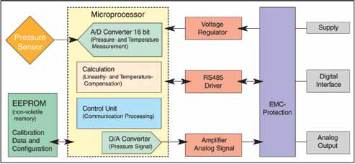
Block diagram of the digitally compensated pres-
sure transmitter. As well as digital compensation
using a microprocessor, the electric decoupling
of the measuring signal and the output signal in
particular provides completely new application
benefits.
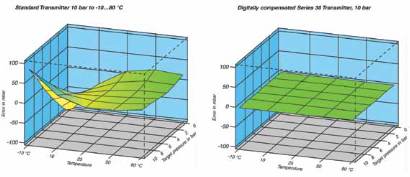
The 3D display of the measure-
ment error of a standard trans-
mitter and a digitally compen-
sated transmitter clearly shows
the considerably improved
suppression of temperature
influences.
Bernhard Vetterli, has a Diploma in Electrical Engineering,
and is one of the leading product specialists at Keller
AG, Switzerland - manufacturer of measuring technology
such as isolated pressure transducers and transmitters.
Vetterli’s area of specialisation is digital temperature
compensation and he has been involved in this area of
development from the beginnings of microprocessor technology. Enquiries:
Email info@keller-druck.com or Pieter Deysel. Instrotech. Tel. 011 462 1920
or email info@instrotech.co.za.
Electricity+Control
September ‘12
44