Basic HTML Version



Energy and EnviroFiciency
A
fter an energy audit revealed how the replacement of the uni-
versity’s conventional geysers with a solar powered system
could slash running costs, Monash commissioned the solar
systems integrator which the author represents to design and install
a solar water heating system that would supply hot water to all of its
residences. The massive savings in water heating costs as a result
of the solar powered installation, mean the university can amortise
initial installation costs within three years before tariff increases.
The Monash water heater project was completed in four phases.
Phases one and two make use of individual thermo siphon solar
geysers connected in pre-feed configuration to the existing electrical
geysers. Phases three and four make use of multiple 1 000 litre bulk
tank systems pre-feeding the old electrical centralised geysers. Each
phase was carefully designed specifically to application requirements
and optimal solar performance.
During phase two, geysers were placed on the roof in two rows
in order to distribute the weight evenly. Phase three proved to be a
challenge as the existing electrical geysers were not located near to
any north-facing slopes big enough to accommodate all the systems.
This required careful planning in the design phase.The fourth phase
also posed some challenges in the form of limited roof space. This
was overcome by placing four of the collectors on a flat roof section
between two of the buildings.This phase was completed successfully
and a comprehensive inspection proved that the energy is now being
transferred effectively from the collectors to the tanks.
Phase four consisted of 2 000 litres of water that the solar geysers
can provide and the 2 400 litres from the electrical geysers, which
is more than sufficient for the 72 students occupying the Monash
residence. The two systems installed each consist of 16 collectors.
An average of 250 kilowatt-hours of energy is collected per day.The
solar collectors have the capabilities to increase the 2000 litre hot
water system by about 100 degrees celsius or the total 4400 litre of
hot water by about 45ºC.
The company worked hard to ensure critical components could
be installed during the university holidays and to integrate its solar
system into Monash’s existing hot water arrangement with minimal
effects on the users.
Monash University receives ample sunlight to charge the solar
system, as do most areas in South Africa. The students can now be
assured of hot showers and the inconvenience of possible power
outages has been eliminated. The new system at Monash Univer-
sity includes a total of 128 solar thermal collectors, which allow the
system to generate the required 1,32 MWh of energy per day. Since
Monash no longer draws all of this energy from the grid, this equates
to a saving of about R1 320 per day. The solar systems integrator
has noticed a marked increase in the number of installations as
more and more commercial users of hot water become aware of the
advantages of turning to solar powered systems.The system carries
a 10 year warranty.
Conclusion
Monash management is satisfied with the installation and looks for-
ward to saving a great deal on operating costs as well as to making
a contribution towards reducing environmental damage.
Saving with solar
Ruimsig campus – case in point
By N von Hase, Solsquare
The Monash University campus in Ruimsig on Gauteng’s West Rand
(South Africa), is set to save approximately R400 000 in electricity
costs annually, thanks to the installation of a large scale solar water
heating system.
A
bout the author
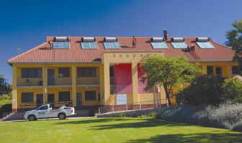
Monash University campus in Ruimsig, Gauteng, South Africa.
Niels von Hase is the managing director of Solsquare,
responsible for operational and financial processes as
well as the solar water heating business. He holds a
Master’s degree in Commerce and an Honours degree
in Business Science (UCT) and is a registered Chartered
Accountant (SA). Enquiries: Tel. 012 653 6016 or email
niels.vonhase@solsquare.com.
T
ake note
• Solar water heating can be used both domestically and commercially.
• Solar water heating can be integrated successfully into existing systems.
• Once the installation has been paid for, savings accrue on a daily basis.
Electricity+Control
September ‘12
50