mining news
10
06.13
DRA reports it is making good progress on
the construction of the Kibali gold project
in the DRC, which will be one of the largest
gold mines in Africa and which is due to pro-
duce its first gold in the fourth quarter of this
year. A joint venture between Randgold Re-
sources, AngloGold Ashanti and Congolese
parastatal SOKIMO, Kibali will build up to a
production of approximately 600 000 ounces
of gold per year.
Located 17 km from the town of Watsa
in the administrative district of Haut Uélé
in Province Orientale, the mine consists of
both open-pit and underground sections.
Total proven and probable mineral reserves
currently stand at 83 Mt at 4,10 g/t for 10,9
million ounces of gold. Some 44 Mt are des-
ignated to be open-pit mined and 39 Mt are
planned to be mined from underground.
Construction of the mine comprises the
design, procurement and construction of the
metallurgical facility, hydropower stations
and a back-up thermal power facility; con-
struction of the tailings storage facility; the
relocation of villages; open-pit mining; a de-
cline complex; a vertical shaft; and all shared
infrastructure.
DRA’s scope of work includes the design,
procurement, project management and con-
struction of the metallurgical plant, as well as
infrastructure including roads, dams, mine of-
fices, stores and laydown areas, and the first
phase tailings system (consisting of a 6,1 Mt
lined concentrate tailings dam and a 7,6 Mt
DRA reports good progress at Kibali site
float tailings dam). The company is also re-
sponsible for a 45 MVA backup power system
and a 22 MVA hydropower plant.
The mine will operate off 47 MVA gener-
ated by four hydro-electric power stations
designed by HPP from France with detail
engineering and construction management
by DRA of the intake weir, canal, penstocks
and hydropower house. The largest of these
hydropower stations is situated 30 km from
the mine at the confluence of the Nzoro and
Kibali rivers. There are three smaller stations
on the Kibali River. The 22 MVA station is a
run-of river scheme requiring the intake of the
river via a 4,5 km canal feeding two penstock
lines of 3,5 m diameter and 1,2 km length.
The hydro-electric power will be augment-
ed by a back-up power system during the
dry season and for start-up of high dynamic
demand systems such as the mill installa-
tion. The back-up system consists of thirty-
six 1,5 MVA (1,2 MW) diesel generators sup-
plied and installed by APS with the support
services engineered by DRA. The main fuel
farm with a capacity of 2 600 m
3
will supply
the generator farm including servicing mining
operations and the vehicle fleet. Two addi-
tional fuel farms, each with a 1 200 m
3
storage
capacity, will be built to service the opencast
and underground mining sections.
DRA’s scope of work on the processing
plant design will treat 3,6 Mt/a oxide ore (ini-
tially) through the oxide circuit and 3,6 Mt/a
sulphide ore through the sulphide circuit. The
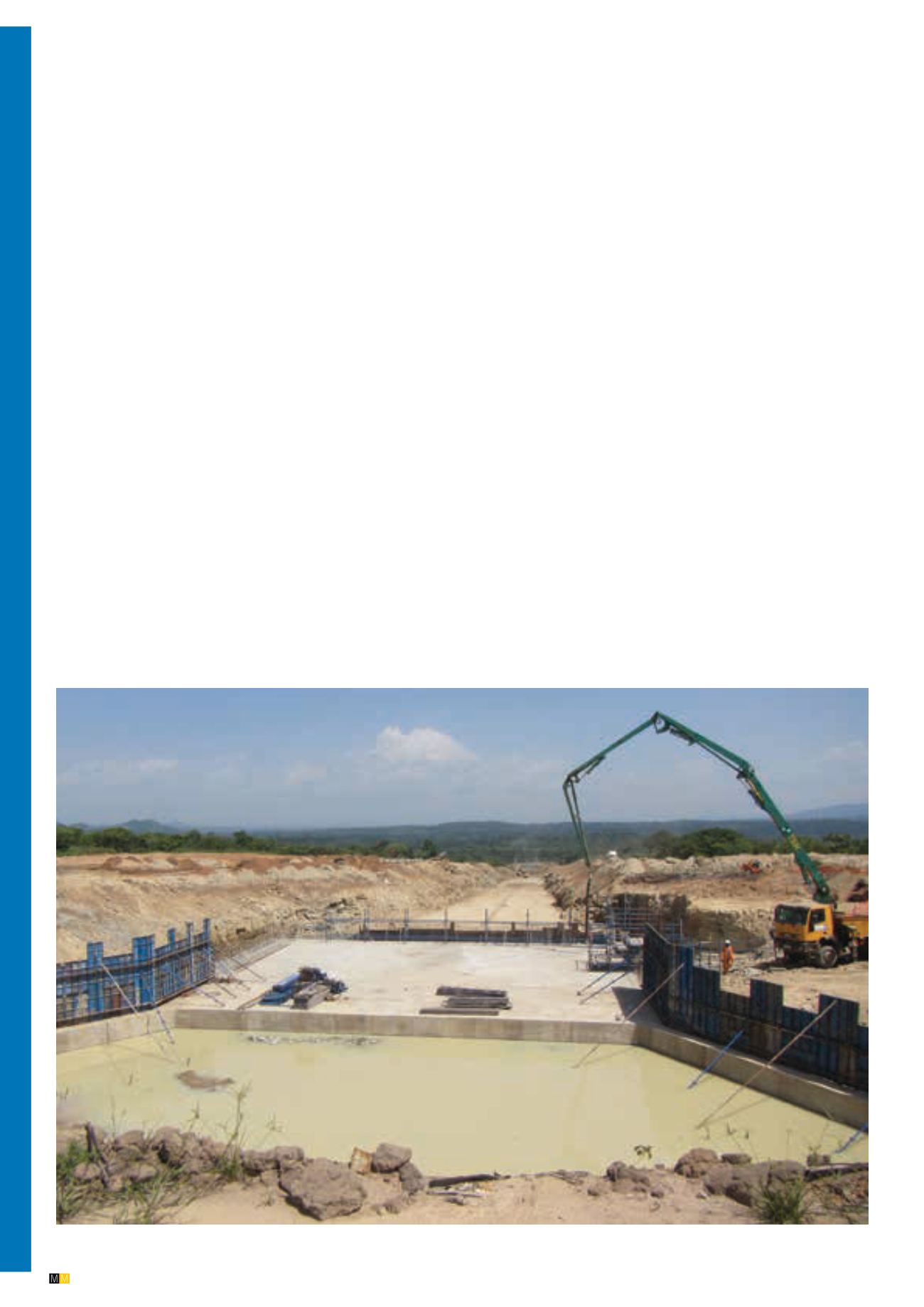
The hydropower plant under construction for the Kibali mine showing forebay and penstock route (photo: DRA).
oxide circuit will comprise the following sub
processes: primary crushing, milling, grav-
ity concentration, flash flotation, carbon in
leach (CIL), detox and tailings disposal. The
sub processes in the sulphide circuit consist
of primary and secondary crushing, milling,
gravity concentration, flash flotation, rougher
flotation, concentrate handling (thickening
and ultra-fine grinding), a pump cell circuit
and tailings disposal. The loaded carbon
from the pump cell and CIL circuits will be
batch treated separately in elution circuits
followed by electrowinning of gold eluate in
the gold room.
On completion of the Kibali open-pit mine
oxide reserves, the oxide stream will be uti-
lised as a dedicated sulphide stream (by
changing the hybrid sizer to a jaw crusher
installation) and will be added to the exist-
ing sulphide stream to enable the combined
treatment of sulphide ore at 7,2 Mt/a. Satellite
oxide reserves will be campaign treated in the
oxide circuit, when a suitable campaign vol-
ume is stockpiled.
According to DRA, project execution has
been challenging due to the remote loca-
tion, high rainfall for nine months of the year,
and the size and complexity of the plant.
Construction is ongoing with the CIL tank
farm plate work erection complete and the
primary crushing front end and mill installa-
tion (including the classification building) well
advanced. Structural steel and mechanical
erection is in progress on pipe gantries, the
elution building, the carbon regen building,
conveyors, generator farm and thickeners.


