By Luthando Makiwane, Marketing Manager, Industry Automation at Schneider Electric
Imagine a factory floor where humans and machines communicate instantly; issues flagged immediately, workflows adjusted smoothly, and downtime reduced to almost zero. This is not a scene from sci-fi but the reality unfolding across Africa as manufacturers adopt the next generation of intelligent signalling technologies.
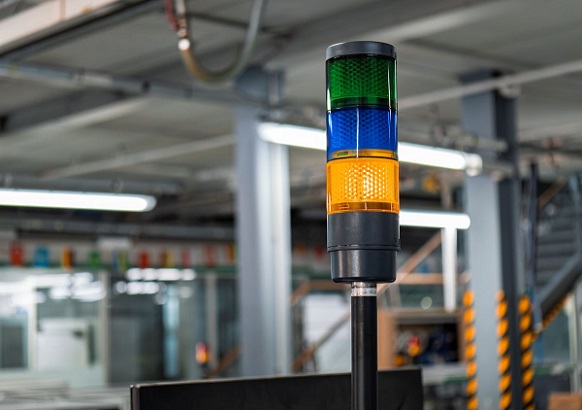
We are observing various industries such as automotive manufacturing and food-processing lines adopting smart tower lights and touch interfaces to enhance worker interaction with machines.
Indeed, these systems are becoming essential tools for improving safety, enhancing efficiency, and developing globally competitive African industries.
A lesson in history
But, like most things in life, we need to take a step back; signalling certainly has a storied history. From the 1800s to the early 1900s, signalling was manual and involved bells, whistles, flags, and mechanical indicators – all used to coordinate workers and machines.
For the next forty years (1920-1960), factories had indicator lights, control lights, and basic alarms; therefore, relay-based control systems allowed machines to automatically signal faults.
However, it was also during this period that we saw the birth of Andon, a visual alert system (usually stackable LED lights arranged in a tower) used in manufacturing to signal problems, needs, or status changes on a production line.
The 1980s marked the beginning of the digital control era, which included PLCs (Programmable Logic Controllers) enabling complex automated signalling.
Today and the future
Fast-forward to today, factories are adopting truly innovative signalling solutions, such as Schneider Electric’s Tower Lights, along with touch and push buttons, and IIoT-ready control modules, all of which have developed into interactive communication hubs.
Operators can input commands or flag process needs via touch buttons, triggering visual, audible, or tactile responses from tower lights. This establishes a closed-loop communication system where human actions and machine feedback continuously influence each other.
Next-generation signalling devices are designed for the future. Their key advantages include:
Scalable modularity - factories can customise systems to their needs by adding or adjusting components without significant downtime or expensive reconfiguration.
Remote monitoring allows supervisors to view machine status from anywhere, supporting multi-site operations and faster incident response.
Predictive maintenance - integrated diagnostics facilitate early identification of anomalies, allowing maintenance teams to intervene before failures happen.
Seamless integration - IIoT-ready devices communicate effortlessly with smart factory platforms, SCADA systems, and cloud-based analytics tools.
Multi-sensory alerts - visual, audible, and tactile notifications ensure workers receive critical information clearly, even in noisy or low-visibility environments.
Human–machine convergence
Highly intelligent smart signalling also depends on human input. It is this integration that is reshaping operational performance. By allowing operators to communicate needs instantly, and machines to respond with clear, actionable alerts, factories are removing guesswork.
This closed-loop communication system reduces misunderstandings, speeds up decision-making, and improves workflow clarity, which are essential for achieving reliable production in fast-paced environments.
The relevance
African manufacturers adopting intelligent signalling systems will undoubtedly gain a competitive edge. Predictive maintenance reduces unplanned downtime, advanced visibility enhances product consistency, and connected safety features help plants meet global safety and sustainability standards, all of which are crucial for entering demanding international supply chains.
The bottom line is that intelligent, connected communication has become the backbone of high‑performing factories, and the question is no longer if African industries should adopt smart signalling, but how quickly they can transition.
For more on Schneider Electric’s Tower Lights, click here.