While infrastructure remains one of Africa’s most compelling long-term investment themes, deployment has consistently lacked ambition. But the continent does not suffer from a lack of interest or capital, it faces a shortage of bankable, repeatable projects where risks are clearly understood and appropriately priced.
This is according to Lungile Mashele, Sector Specialist for Energy & Infrastructure at the Public Investment Corporation (PIC), who recently participated in a panel discussion at SAVCA’s Private Equity in Southern Africa Industry Conference. The engaging session explored why Africa’s infrastructure investment has struggled to move from promise to performance, despite strong underlying demand.
Mashele pointed to a fundamental disconnect in the market. “The promise has fallen short not because of one single issue, but a confluence of structural bottlenecks, largely linked to risk and reward,” she explained. “There’s a perception that there isn’t enough capital, but in reality, there’s significant capital available. The issue is that projects are not sufficiently bankable, and expectations around returns are often misaligned with the realities on the ground.”
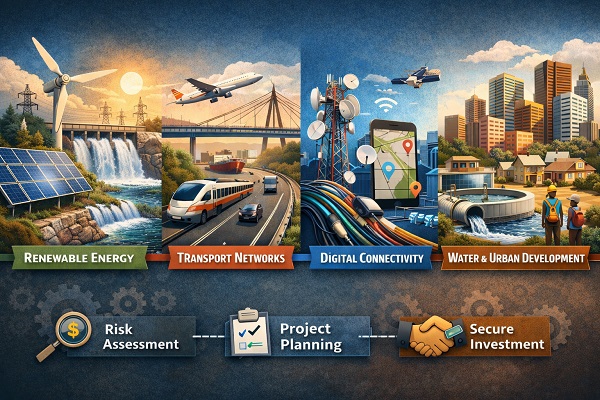
Against this backdrop, Mashele identified four infrastructure pillars that are set to define the next decade of investment on the continent – and where both investors and policymakers should be focusing their attention.
Digital infrastructure: Powering the data economy
“We are going to see hypergrowth in digital infrastructure, with capital requirements for data centres across Africa expected to double by 2030,” said Mashele. “And the capital requirement here is twofold, because as the demand for data centres accelerates, so too does the need for sufficient and reliable power to support it.”
She added that regulatory developments, particularly around data sovereignty and privacy, are likely to shift where this infrastructure is built. “We’ve traditionally seen a concentration of data centres in South Africa, Kenya and Nigeria, but as data and privacy laws tighten in these regions, we may see other emerging jurisdictions begin to attract investment.”
Transmission and distribution: Unlocking the grid
The second pillar is transmission and distribution – an area increasingly recognised as a key constraint in Africa’s energy transition.
“Transmission presents a significant opportunity,” said Mashele. “For the first time, we are seeing private transmission projects coming to market, with deals already closing in countries like Mozambique and Kenya, and strong interest in South Africa.”
This shift is critical to unlocking renewable energy capacity and addressing grid constraints, which have historically limited the ability to scale generation. The introduction of private capital into transmission marks a structural change in how infrastructure is funded and delivered, creating new avenues for investment.
Logistics and cross-border trade: Enabling movement at scale
Logistics and trade infrastructure form the third pillar, particularly as Africa seeks to deepen regional integration and improve the movement of goods across borders.
Mashele pointed to South Africa’s biker delivery boom as an example of how quickly infrastructure needs can shift and why investors need to remain adaptable. “If you had told me to invest in scooters back in March 2020, I would have laughed in your face and lost a lot of money.”
Beyond last-mile solutions, there is a broader need for investment in trade-enabling infrastructure, including ports, freight corridors and border facilities. These systems are essential for unlocking the full potential of intra-African trade but require coordinated investment and policy alignment.
Water, waste and social infrastructure: Back to basics
The final pillar lies in water, waste and social infrastructure – areas that are both foundational and increasingly urgent. “There is a significant amount of work to be done in water and waste infrastructure,” Mashele noted. “These are not just service delivery issues; they have direct economic implications and affect the functioning of entire cities and industries.”
From water treatment and sanitation to healthcare and municipal services, these sectors represent both a critical need and a major opportunity for private capital. However, they also require more innovative funding models, particularly where user-pay mechanisms are not viable.
Despite clear opportunities across these infrastructure frontiers, Mashele emphasised that unlocking meaningful investment will require a more pragmatic and disciplined approach.
“Private capital can play a catalytic role here, but if we are going to unlock infrastructure at scale, we need to be more honest about risk, more realistic about returns, and more deliberate in how we develop and prepare projects for investment,” she concluded.