South Africa’s ageing road infrastructure is under growing pressure - from material shortages and tightening budgets to rising traffic volumes and sustainability demands.
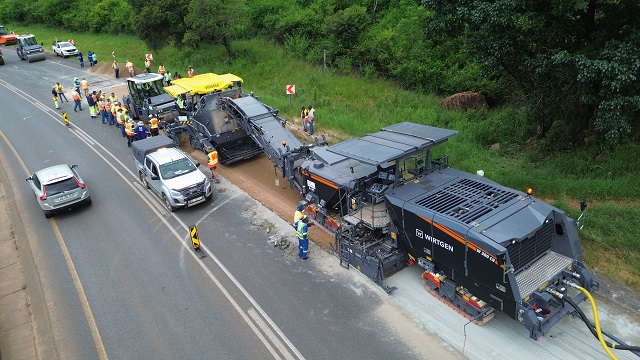
Against this backdrop, cold recycling is emerging as one of the most compelling solutions for long-term, cost-effective road rehabilitation. To explore how this technology is reshaping the industry, Juanita Pienaar spoke with Waylon Kukard, Sales Manager at Wirtgen SA, about the increasing role of cold recycling, the introduction of Africa’s first W380 CR cold recycling train, and what this could mean for the future of road construction and maintenance across the region.
Infrastructure under strain
According to Kukard, many of the challenges currently facing road rehabilitation projects in South Africa mirror those being experienced globally. Chief among them is the growing scarcity of raw materials.
“One of the major challenges most countries are facing is the scarcity of material,” he explains. “New quarries are becoming less and less, and environmental approvals are increasingly difficult to obtain. As a result, contractors are being forced to look at rehabilitating existing infrastructure while reusing as much of the material already in place as possible.”
Compounding this issue is the reality that many of South Africa’s roads were built decades ago using high-quality aggregates that are now difficult and costly to source.
“We’ve been building roads for a long time, and a lot of the good material has already been used,” Kukard says. “Those roads are now 30 years old, but they lasted because of the quality of the aggregates and asphalt used at the time. That material is still there - it just needs to be reused intelligently.”
Budgetary constraints add another layer of complexity. While countries once invested heavily in new road infrastructure, the focus has now shifted towards maintenance and rehabilitation.
“These large road networks now need to be maintained with limited budgets, while raw materials are becoming more expensive,” Kukard notes. “That’s why alternative rehabilitation methods are no longer optional - they’re essential.”
Why cold recycling matters
Cold recycling has been part of South Africa’s road construction landscape for more than two decades, but its relevance has increased significantly in recent years. The technology enables contractors to rehabilitate roads using materials already present in the existing structures.
“Cold recycling allows you to reuse material that’s already on the road,” says Kukard. “Those materials were originally manufactured to very tight specifications - high-quality crushed aggregates and asphalt - and instead of removing them and dumping them on stockpiles, they can be reprocessed and reused in situ.”
In practice, the process involves breaking up the existing road layers, adding stabilising agents such as cement, lime, water, or bitumen emulsion, and then remixing and relaying the material to form a new base course.
“In essence, you granulate the existing material, mix in rejuvenators, and place it back down,” Kukard explains. “You then finish it with a thin wearing course. It’s an incredibly effective way of rehabilitating roads while minimising waste.”
Wirtgen Group’s strength in this area lies in the breadth of its offering.
“We don’t believe in a one-size-fits-all approach,” Kukard says. “We offer in-place recycling as well as plant-based recycling options, depending on the severity of the road condition and the project requirements. That flexibility is one of the reasons Wirtgen is regarded as a global leader in cold recycling technology.”
A first for Africa: the W380 CR recycling train
The recent introduction of the W380 CR cold recycling train marks a major milestone - not only for Wirtgen SA, but for the African road construction industry as a whole.
“This is the first recycling train of its kind on the African continent,” Kukard says. “It represents the next evolution of cold recycling technology.”
What sets the W380 CR apart is its multifunctional capability. The machine can operate both as a conventional milling machine and as a cold recycler, depending on its direction of travel.
“When moving in one direction, it functions like a standard milling machine,” Kukard explains. “When working in the opposite direction, it becomes a cold recycler, with the ability to add water, bitumen emulsion, or foamed bitumen directly into the mixing chamber.”
The machine’s 3.8-metre working width is another key differentiator.
“Most cold recyclers work at around 2.4 metres, which means two passes are needed to complete a single lane,” says Kukard. “With the W380 CR, you can rehabilitate an entire lane in one pass.”
Perhaps most significantly, the recycled material is discharged directly into a Vögele S1900-5 X paver, which lays it back down to the correct width, depth, and crossfall in a single operation.
“This eliminates the need for a separate grader,” Kukard notes. “The paver places the material precisely, and compaction, done by 2x Hamm HD+120 tandem rollers and 2x Hamm HP280/24 Ton pneumatic rollers, follows immediately.”
Speed, safety, and productivity gains
The implications of this approach are substantial. Roads rehabilitated using the W380 CR train can be reopened to traffic almost immediately when bitumen-stabilised material is used.
“With conventional methods, lanes often have to remain closed for days while the bitumen breaks,” Kukard explains. “With this system, the road can be reopened to traffic straight away, which significantly reduces safety risks associated with long closures.”
From a productivity perspective, the figures are equally compelling.
“We’re talking about production rates of up to 800 tonnes per hour,” says Kukard. “It’s essentially a manufacturing plant on tracks.”
Under optimal conditions, the system can rehabilitate close to a kilometre of road per day.
“In a 10-hour shift, you can easily complete a kilometre,” he adds. “The limiting factor is usually logistics - supplying cement and bitumen at the same pace the machine consumes it.”
This speed also enables a more strategic approach to rehabilitation.
“Instead of patching potholes that reappear weeks later, you’re addressing the real problem - the failing base layers,” Kukard explains. “Potholes aren’t caused by the asphalt surface; they’re caused by the layers underneath being washed away.”
Quality through precision
Consistency and quality control are central to the W380 CR’s design. The machine uses fully automated, meter-controlled systems to regulate the addition of water and binder.
“The quantities are based on laboratory testing and engineering design,” Kukard explains. “The machine automatically adjusts, regardless of speed or milling depth, to ensure the correct proportions are added.”
Another distinguishing feature is the machine’s down-cutting drum design.“Most recyclers use an up-cut method,” says Kukard. “The W380 CR cuts from the top down, which creates a much finer and more uniform material.”
At over 50 tonnes, the machine’s weight enables it to maintain consistent penetration, even in hard pavement structures.
“That mass allows the drum to work effectively without the risk of the machine lifting or losing traction,” Kukard adds.
Sustainability and cost savings
Cold recycling’s environmental benefits are increasingly difficult to ignore. By reusing existing materials, the process dramatically reduces transport requirements.
“You’re transporting up to 90% less material,” Kukard says. “That alone results in CO₂ emission reductions of over 60%.”
Material usage is also optimised.
“You’re using 100% of what’s already there,” he explains. “You’re not paying to remove material, and you’re not paying to bring new material in.”
The financial implications are equally significant.
“Construction costs can be reduced by 50% or more,” Kukard notes. “And time savings translate directly into cost savings for contractors.”
Collaboration as a success factor
Introducing new technology at this scale requires close collaboration between all stakeholders.
“This project would not have been possible without alignment between the client, the engineer, and the contractor,” Kukard emphasises. “You need a client willing to trial the technology, an engineer prepared to design around it, and a contractor ready to invest.”
Wirtgen SA also played an active role beyond equipment supply.
“As the OEM, we understood that we needed to support this project fully,” Kukard says. “That included factory support, on-site commissioning, training, and structured commercial terms.”
Shaping the future of road rehabilitation
As material shortages intensify and maintenance backlogs grow, Kukard believes cold recycling will become a cornerstone of future road rehabilitation strategies.
“This isn’t a passing trend,” he says. “Cold recycling has proven itself globally as a viable, long-term solution.”
With multiple high-profile projects already underway and increasing uptake across Southern Africa, momentum is building.
“The future of road rehabilitation lies in technologies that are faster, more sustainable, and more cost-effective,” Kukard concludes. “Cold recycling ticks all those boxes - and we’re only just getting started.”