The foundation for Wacker Neuson's success story was laid by Johann Christian Wacker in 1848. Since then, the company has introduced innovations time and again, which have revolutionised work on the construction site.
 In 1930, Hermann Wacker set new standards in the construction industry of the time with an innovative electric rammer.
The vibratory rammers are used for soil compaction to this day. This was followed, among other things, by the internal vibrator for concrete consolidation, which captured the market from 1934 onwards, or the first reversible vibratory plate, which set a milestone in soil compaction.
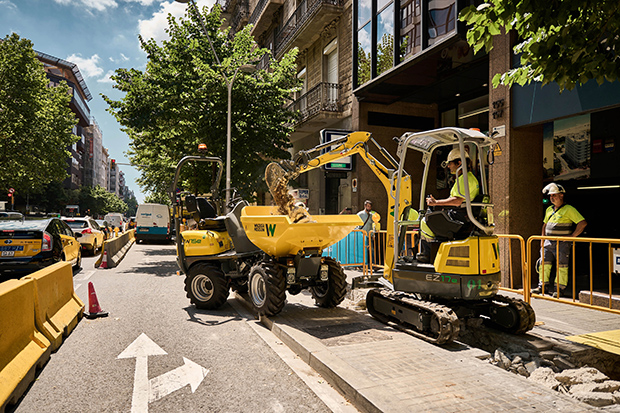
Wacker Neuson also kept coming up with new developments in the compact machines segment. The Vertical Digging System VDS is an innovation in the field of compact excavators. Since 1988, the VDS has made work more efficient, faster and more pleasant for the operator. This system, which tips up the superstructure, allows exact vertical digging even on uneven ground surfaces, on curbs and slopes.
Since 2005, articulated wheel loaders, and later even compact telehandlers have been part of Wacker Neuson’s portfolio, in order to offer customers everything from a single source. The first Dual View Dumper was also a real innovation in 2019 thanks to the wheel dumper's 180° rotating seat and control panel, the operator always keeps an overview, which ensures greater safety and flexibility on the construction site. This way, hazards are minimized on the construction site.
With the introduction of the zero-emission series, Wacker Neuson broke new ground in 2014 and took on a pioneering role once again by introducing the first electrically powered machines and equipment were two battery-powered rammers and the WL20e battery-powered electric wheel loader. Since then, the portfolio has been steadily expanded. It now includes electric vibratory plates, excavators, wheel and track dumpers, and in the near future also electric telehandlers. This means that, already today, a typical inner-city construction site can be operated without direct exhaust emissions and with extremely low noise levels.
With digital solutions, Wacker Neuson is bringing greater efficiency and transparency to the construction site. One example is the ConcreTec assistance system for concrete consolidation. It enables concrete components to be compacted easily and transparently and in high quality in a reproducible manner. In the service area, the mixed reality glasses "smart glasses" make work more efficient.
They have already been in use since the beginning of last year at Wacker Neuson in South Africa. Digitization also plays an important role in the development of machines. The new EW100 wheeled excavators include an intelligent Attachment Management System and a Human Machine Interface, which assist the operator in changing attachments via the 10-inch touchscreen display. In the future, Wacker Neuson will continue to focus on digitization. This will simplify, and make more efficient, work on construction sites and collaboration between all the parties involved through intelligent networking, digital solutions, products and business models.