Juanita Pienaar spoke with Rokbak senior product manager Scott Pollock about how the articulated hauler specialist designs for durability, maximises uptime, and supports customers operating in some of the world’s toughest conditions.
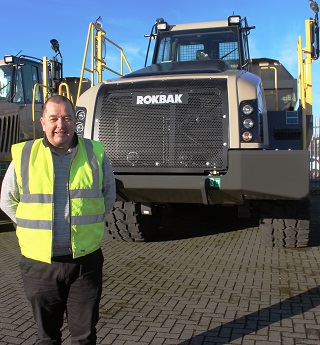 In high-production mining, quarrying, and construction environments, downtime is expensive. Every unplanned stop ripples through an operation, affecting productivity, costs, and project timelines. Rokbak, a manufacturer of articulated haulers headquartered in Motherwell, Scotland, treats uptime not as a single design metric, but as the outcome of an integrated philosophy that spans engineering, support, digital tools, and long-term customer partnerships.
According to Scott Pollock, senior product manager at Rokbak, the conversation around uptime must begin long before a truck ever turns a wheel on site. “Uptime starts with meeting the customer’s requirements for high-production environments,” he explains. “Rokbak trucks are designed, tested, and manufactured to meet those expectations.”
That emphasis on purpose-built design underpins the brand’s approach, but Pollock is quick to stress that even the most robust machine cannot operate in isolation. “What I always try to stress is that a truck is only as productive as the care it receives,” he says. “That’s why aftermarket preparation, maintenance planning, and correct operation are all critical.”
This whole-life mindset, from specification and manufacturing through to daily operation and long-term maintenance, is central to how Rokbak positions its RA30 and RA40 articulated haulers in demanding applications worldwide.
Designing for reliability, not recovery
At the core of Rokbak’s uptime strategy is a focus on preventing problems rather than reacting to them. Structurally, the trucks are designed for the duty cycles they are expected to endure, with robustness validated through extensive testing and real-world performance.
“From a design perspective, the foundation of our trucks is robust structures that are properly designed and thoroughly tested for their intended duty cycles,” says Pollock. “Rokbak trucks have been in the market for several years now, and their track record confirms their reliability and dependability.”
However, durability is not limited to steel thickness or frame design. Modern articulated haulers must also protect themselves from misuse or abnormal operating conditions that can accelerate wear or trigger failures. To address this, Rokbak incorporates safety devices and operational inhibitors that actively reduce risk.
“Beyond structure, we incorporate safety devices and operational inhibitors that protect the truck from out-of-condition operation,” Pollock explains. “As part of our automation journey, certain functions are designed to safeguard both the operator and the machine itself.”
By limiting component stress and preventing improper operation, these systems play a direct role in reducing unplanned downtime. Pollock adds that this is not a static process. “This continual development helps prevent misuse, reduce component stress, and avoid unplanned downtime,” he says, reinforcing that reliability is continually refined rather than fixed at launch.
A whole-machine approach to durability
In harsh mining and construction environments, long-term performance depends on more than individual components. Rokbak’s philosophy is rooted in what Pollock describes as a “whole-machine approach”.
“Long-term durability comes from a whole-machine approach,” he says. “Structural integrity isn’t just about the frame, it’s about how the entire truck works together in extreme conditions.”
To achieve this, Rokbak carefully selects suppliers and integrates proven components across the driveline, hydraulics, and powertrain. Engines, gearboxes, and axles are chosen for their established performance in demanding applications, but they are not simply installed and left to operate independently.
“These components are then validated as part of the complete truck to ensure they deliver both longevity and consistent performance,” Pollock explains.
This integration is particularly important when balancing fuel efficiency with durability and power output - a challenge faced by all heavy equipment manufacturers as customers seek lower operating costs without sacrificing productivity.
“Component integration is absolutely critical. Truck performance is a collaboration,” Pollock says. “Fuel efficiency, productivity, and durability are all influenced by how well the above elements work together.”
With fuel representing one of the highest operating costs for fleet owners, every design decision is scrutinised. “Fuel is one of the biggest costs for customers, so every design decision considers its impact on efficiency without compromising durability or productivity,” he adds.
Extending service intervals, extending value
Operational lifespan is another area where Rokbak has focused on delivering tangible benefits for customers. For the RA30 and RA40 models, this has translated into extended maintenance intervals that keep trucks working longer between scheduled stops.
“Operational lifespan is supported through robust design, proven components, and disciplined maintenance strategies,” Pollock explains. “We’ve extended maintenance intervals by using modern fluids and advanced filtration systems, which helps protect critical systems while reducing scheduled downtime.”
The figures are significant. “Transmission service intervals have been extended from 2 000 to 4 000 hours on the RA30 and up to 6,000 hours on the RA40, with 4 000-hour hydraulic service intervals,” he says.
For operators, this means fewer interruptions, improved productivity, and lower lifecycle costs. “These measures allow customers to keep their trucks working longer between stops, improving productivity and lowering lifecycle costs,” Pollock adds.
Consistent performance in extreme conditions
Rokbak haulers are deployed across a wide range of climates and applications, from freezing northern environments to hot, abrasive quarry operations. Designing for this diversity requires a clear understanding of how trucks are used in reality.
“Rokbak trucks are designed with the understanding that they will operate in extreme environments, moving heavy payloads and on challenging ground conditions,” Pollock says. “That means robust structures, proven driveline components, effective cooling systems, and traction control designed specifically for articulated hauler applications.”
While conditions vary globally, Pollock notes that the principles of success remain constant. “Rokbak trucks are operating around the world. Regardless of location, the same principles for success apply: correct specification, validated design, and proper support ensure consistent performance in demanding environments worldwide.”
Lowering total cost of ownership
From a customer perspective, uptime and durability ultimately translate into total cost of ownership (TCO). Rokbak’s strategy is explicitly focused on keeping this figure as low and predictable as possible.
“The customer is always at the centre of our requirements,” Pollock says. “Total cost of ownership is reduced through reliability, extended service intervals, fuel efficiency, and predictable maintenance planning.”
By reducing unplanned downtime, operators can move more material with fewer interruptions. “By keeping trucks productive for longer periods and reducing unplanned downtime, customers can move more material at a lower operational cost, which directly improves their margins,” he explains.
Extended service intervals again play a crucial role. “Using modern fluids and filtration systems allows longer service periods for transmissions and hydraulics, reducing both downtime and maintenance costs,” Pollock says. “The longer a truck can operate without scheduled stops, the more productive it becomes and the lower its lifecycle cost to the customer.”
Support that starts before the sale
For Rokbak, support is not an aftermarket add-on but an integral part of the uptime equation. Pollock emphasises that engagement begins well before a truck is delivered.
“Support starts before the truck is sold,” he says. “Pre-sales teams work with customers to understand job site conditions and ensure the correct specification is supplied.”
Once the truck is operational, that support continues through trained service partners, verified spare parts, and proactive maintenance planning. “Once the truck is in operation, trained service partners, correct tools, verified spare parts, and proactive maintenance planning ensure the truck remains productive,” Pollock explains. “It’s a continuous process that supports uptime throughout the truck’s life.”
Digital visibility and predictive maintenance
Digital tools are increasingly central to modern fleet management, and Rokbak’s Haul Track telematics system is designed to support predictive maintenance rather than reactive repairs.
“Rokbak’s Haul Track telematics system allows customers and dealers to monitor truck performance remotely,” Pollock says. “It tracks operating conditions, fault codes, temperatures, pressures, and upcoming maintenance intervals.”
This visibility enables early intervention. “This enables proactive intervention before issues escalate into failures,” he adds.
Beyond maintenance, Haul Track also delivers operational insights. “Haul Track also supports payload analysis and production tracking, giving customers clear insight into how much material is being moved and at what cost,” Pollock explains.
Importantly for mixed fleets, the system is designed to integrate seamlessly. “Haul Track is AEMP 2.0 compliant, allowing integration into mixed-fleet monitoring systems so customers can manage multiple OEM machines through a single platform,” he says.
Comfort, efficiency, and environmental responsibility
Recent innovations at Rokbak have also focused on the human element. “Recent developments include enhancements to operator comfort, such as improved HVAC systems and automated controls, recognising that a comfortable operator is a productive operator,” Pollock notes.
At the same time, environmental considerations are shaping design decisions. “Environmental responsibility is very important for Rokbak,” he says. “All Rokbak trucks are HVO-compliant, allowing customers to reduce CO₂ emissions immediately where fuel availability allows.”
Extended service intervals also deliver environmental benefits. “By extending maintenance intervals, we reduce the disposal of oils, fluids, and filters,” Pollock explains. “We’re not just waiting for future technologies. We’re already implementing practical solutions that deliver environmental benefits today.”
Proven performance in the field
Real-world performance ultimately defines any machine, and Pollock points to a recent aggregate operation in Alberta, Canada, as a clear example of the capabilities of Rokbak trucks.
“After purchasing their first RA40, the customer quickly added two more, a clear endorsement of the truck’s performance and reliability,” he says.
The trucks have accumulated significant hours in demanding conditions. “The trucks have each logged over 3 000 operating hours, consistently handling heavy loads, variable ground conditions, and harsh weather while maintaining strong uptime,” Pollock explains.
Operator feedback has been equally positive. “Operators report that the trucks are stable, comfortable, and easy to run throughout long shifts, supporting high production without disruption,” he says.
While this project stands out, Pollock emphasises that it is not unique. “We’re particularly proud of this project as it has highlighted how Rokbak haulers deliver dependable performance and durability in real-world, high-demand aggregate environments. But it’s not just in North America – we have many case studies like this across the globe.”
By aligning robust engineering, integrated components, digital tools, and comprehensive support, Rokbak continues to position its articulated haulers as trucks built not just to work hard, but to keep working. In an industry where uptime defines success, that philosophy resonates strongly with fleet owners looking for long-term value in the toughest conditions.