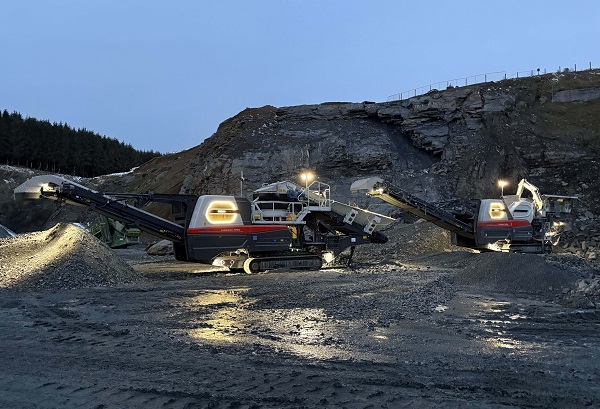
Juanita Pienaar spoke with Pilot Crushtec International sales and marketing director Francois Marais and Janne Lahtela, Product Manager, Lokotrack Quarry, at the South African launch of the Lokotrack LT400J. The event, hosted by Pilot Crushtec, marked the first introduction of Metso’s new-generation diesel-electric jaw crusher to the African market. This innovation blends performance, efficiency, and sustainability in a single, robust package.
A different kind of launch
In an industry not typically known for high-profile product reveals, Pilot Crushtec’s decision to host a dedicated launch event was deliberate. As Marais pointed out during his address, “Strictly speaking, doing an event like this is not common practice in this industry, but then again, I don’t think that anything that Pilot Crushtec does is anything like what anybody else does.”
The evening was as much about celebrating partnerships as it was about unveiling new technology. Marais took the opportunity to acknowledge customers, suppliers, and Metso representatives, noting the strength of a collaboration that continues to evolve. “It’s really a great partnership that we have with Metso, both of us trying to do things that are different, that are innovative, with the ultimate intention of making our customers’ operations more profitable, more reliable, and more stress-free.”
That philosophy underpins the introduction of the LT400J. This machine may not be the largest in the global Metso range, but it represents a significant milestone in how crushing equipment is designed and deployed.
Not only bigger but also smarter
While size often dominates discussions around heavy equipment, both Marais and Lahtela were quick to shift the focus.
“It’s not about it being big,” Marais explained. “You want to know what’s unique about it? It’s kind of a milestone in the Lokotrack range - the first of their EC range, which is dual-powered machinery, looking to help our contractors increase their production and save on their cost per ton.”
Weighing in at approximately 70 tonnes, the LT400J is undeniably substantial. However, its significance lies in its design philosophy rather than its footprint. Lahtela described it as “a big and robust machine for quarry operations,” but emphasised that its transport width of just three metres is “extremely narrow for this size class,” highlighting a balance between capacity and mobility.
With a nominal capacity of 250 to 450 tonnes per hour, “it can do more than that as well,” Lahtela added. The machine is engineered for high-output environments without compromising operational flexibility.
The electric advantage
At the core of the LT400J is its diesel-electric powertrain, a defining feature of Metso’s new EC range. Unlike traditional fully hydraulic systems, the LT400J relies on electric drives for the majority of its functions.
“The bulk, 95% of the machine runs off electric drives,” Marais noted. “There’s one or two components that are hydraulics, but everything else is electric.”
This shift delivers tangible benefits. According to Marais, “the fuel consumption on it is probably going to be 30 to 35% less than a straight diesel hydraulic engine.” For operators, this translates directly into reduced operating costs. This is particularly critical in markets where fuel prices and supply volatility can significantly impact margins.
Lahtela expanded on the advantages: “With the electric motor for the crusher, you have a lot of power, and it’s really fuel efficient. Basically, this LT400J has 30% less fuel consumption than the LT120 hydraulic jaw crusher.”
Beyond fuel savings, the electric configuration also reduces maintenance demands. “Having all the process functions electric means less downtime, more uptime, and fewer reliability issues,” he explained.
Built for flexibility and resilience
One of the standout features of the LT400J is its dual-power capability. This allows the machine to operate either via an onboard diesel generator or by connecting directly to the grid.
“You can run with the diesel if you want,” said Lahtela, “but then if the mains grid is available, of course, that’s the best idea, and if you have a power cut, you can just turn the switch and run with the diesel to always keep producing.”
This flexibility is particularly relevant in the African context, where grid reliability can vary. The ability to seamlessly switch between power sources ensures uninterrupted production, an essential requirement for high-volume quarry operations.
Additionally, the machine’s generator can power auxiliary equipment. “You can actually run a power take-off to power your diesel-electric mobile stacker,” Lahtela noted, effectively enabling multiple machines to operate from a single power source.
Engineering for efficiency
The LT400J’s design reflects a broader shift towards efficiency, not only in fuel consumption but also in maintenance and usability.
A key example is its reduced reliance on hydraulic systems. “Only 80 litres of hydraulic oil,” Lahtela highlighted, a significant reduction compared to conventional machines. “Typically, the more hydraulic oil you have, the more inefficiencies you have. Having all the process functions electric means less downtime.”
Accessibility has also been prioritised. “We really try to make sure that you would have the maximum amount of accessibility for all those daily maintenance tasks,” he said, pointing to features such as movable components and large service platforms.
Marais echoed this focus on practicality, noting that introducing a machine like this into a new market involves more than just shipping it in. “You need to equip all of your people. The technicians need to learn about the maintenance side, and you need to bring in enough spares so you can support it,” he explained. “It’s a whole long process.”
Digital control and operator safety
Digital integration is another cornerstone of the LT400J’s design. The machine includes Metso’s Remote IC system, allowing operators to adjust settings via a mobile app.
“You can actually change the setting and the feeder speed from the excavator,” Lahtela said. “Because you don’t have to walk, it becomes safer and improves production uptime.”
For sites where app connectivity may not be available, a handheld control device offers similar functionality, while a remote radio control enables operators to manoeuvre the machine and adjust key components from a safe distance.
“It’s fast and easy and safe,” Lahtela summarised - three attributes that increasingly define modern equipment requirements.
A long-term investment
Both Pilot Crushtec and Metso position the LT400J as more than just a new product. It is part of a broader evolution in crushing technology.
“With the Lokotrack EC range, we are aiming for four things,” Lahtela explained. “Reliable high performance, efficient and sustainable operations, easy and safe to use, and then lastly, it’s a long-term investment.”
This long-term perspective is particularly relevant as regulatory and environmental pressures continue to shape the industry. “Maybe some legislation might change in terms of emissions,” he said, “but with this kind of power transmission, you are good to go for years to come.”
Marais reinforced the commercial angle: “For customers at the end of the day, this should be a big saving on the fuel bill, and also on the amount of maintenance that they need to do.”
From Finland to Africa
The journey of the LT400J from concept to African deployment underscores the complexity behind modern equipment development.
“It took about four years from the start of the project to launch the machine,” Lahtela revealed. Even after its global debut in 2024, additional time was required to bring the machine to Africa. “We wanted to see it working overseas to make sure that it’s a proven piece of equipment,” Marais explained.
Now, with the first unit on the continent, future deliveries are expected to be significantly faster. “You probably look at around three months,” Marais said, noting that the groundwork - training, specification, and support infrastructure - has already been established.
More to come
The LT400J is just the beginning of Metso’s EC range expansion. Lahtela hinted at a pipeline of upcoming innovations, including new models and configurations designed to enhance flexibility and performance.
“Busy, busy times for us,” he said, pointing to developments such as new mobile cone and impactors, which will extend the diesel-electric concept into new applications, including heavy-duty recycling.
A shift in mindset
Ultimately, the launch of the LT400J represents more than a new machine; it reflects a broader shift in how the industry approaches performance, efficiency, and sustainability.
As Marais put it, “Both of us, Pilot Crushtec and Metso, are trying to do things that are different, that are innovative.” In a sector often defined by incremental change, the move towards diesel-electric technology signals a more fundamental transformation.
For African operators, the implications are clear: lower operating costs, improved reliability, and a pathway towards more sustainable operations - all without compromising on performance.
This is a shift that many are ready to embrace.