Juanita Pienaar spoke with Harneet Luther, Executive Director & CEO of Tata Motors South Africa and Head of Manufacturing & Product Management – Africa, about what the rollout of its 12 000th locally assembled vehicle reveals about the company’s journey, and how it is positioning itself in a demanding and evolving commercial vehicle landscape.
A milestone built over time
Reaching 12 000 assembled vehicles is no small feat in the African context, where market conditions are often anything but predictable. For Luther, the milestone reflects a deeper narrative of resilience and steady progress.
“Reaching the 12 000th vehicle milestone is a meaningful reflection of sustained progress in a market that demands resilience and long-term commitment,” he explains. “Growth in Africa is rarely linear, so this achievement speaks to consistency, strong partnerships, and a deep understanding of customer needs.”
Central to this journey has been the Rosslyn assembly facility, which has evolved significantly since its establishment in 2011. What began as a production site has developed into something far more integrated.
“It also highlights how the Tata Motors Rosslyn assembly facility has evolved since 2011. Beyond assembly, it has become a centre for skills development, creating opportunities for young talent from institutions such as TUT and TVET colleges to gain practical experience,” Luther notes.
This emphasis on local impact is not incidental. It reflects a broader philosophy that manufacturing should extend beyond output metrics to contribute meaningfully to the surrounding ecosystem.
“There is a strong belief that local manufacturing should contribute to the communities it operates in, reinforcing the link between industrial growth, skills development, and broader economic impact.”
Understanding what keeps customers moving
At the core of Tata Africa’s growth in Africa is a clear understanding of how customers engage with their vehicles - not as static assets, but as essential business tools.
“Our success is rooted in understanding that these vehicles are critical to our customers’ businesses,” says Luther. “They are not simply assets - they are revenue-generating tools that must perform reliably every day.”
This framing shifts the focus firmly onto operational performance. Reliability, fuel efficiency, and durability are not abstract product features, but essential drivers of business continuity.
“As a result, the focus has been on delivering consistent performance through reliability, fuel efficiency, and durability, while ensuring strong lifecycle support,” he continues. “Uptime is essential. If a vehicle is not on the road, it is not generating value.”
Equally important is proximity to the customer. In a market where operating conditions vary widely, understanding real-world usage is critical to delivering relevant solutions.
“By understanding their operational realities, we are able to respond effectively through our dealer network, parts availability, and service capability,” Luther explains. “Over time, this combination of product performance and support builds long-term confidence in the brand.”
A shift towards total value
The South African commercial vehicle market has undergone a noticeable shift in recent years, particularly in how customers assess value. Where upfront pricing once dominated decision-making, a more nuanced evaluation has emerged.
“Customer expectations have shifted significantly. The focus is no longer only on upfront cost, but on total cost of ownership and the ability to maintain productivity over time,” says Luther.
This evolution reflects broader economic pressures and operational realities. Businesses are increasingly required to extract maximum value from their fleets, often under challenging conditions.
“Factors such as uptime, fuel efficiency, and maintenance are now central to purchasing decisions, particularly in an environment where operating conditions can be unpredictable,” he adds. “This has reduced tolerance for inconsistency and increased the need for dependable performance.”
For Tata Africa, adapting to this shift has required a more integrated approach - one that aligns product development with robust support structures.
“In response, we have strengthened both our product offering and support structures to deliver greater reliability and operational certainty. The objective is to help customers plan more effectively and run their businesses with confidence.”
The power of an integrated ecosystem
In a competitive market, differentiation rarely comes from a single factor. Instead, it emerges from how multiple elements work together to deliver consistent value.
“Our differentiation lies in how the full ecosystem comes together to support the customer,” Luther explains. “While the product is critical, its value is ultimately defined by how well it performs over time in real operating conditions.”
This ecosystem approach is underpinned by continuous feedback and refinement. Insights from customers and partners are not treated as static data points, but as inputs into an ongoing process of improvement.
“We focus on delivering a balance of efficiency, durability, and performance, supported by a continuous feedback loop between the market and the business,” he says. “Customer and partner insights directly inform ongoing improvements.”
The effectiveness of this model depends heavily on execution, particularly in areas such as dealer capability, parts availability, and service delivery.
“When this system functions effectively, it reduces disruption and enables customers to operate with greater confidence and efficiency.”
Localisation as a strategic lever
Localisation has become an increasingly important theme across the automotive sector, but in the African context, its significance extends well beyond manufacturing.
“Localisation plays a strategic role that extends beyond production,” Luther notes. “The Rosslyn facility illustrates this well. It is not only an assembly plant but also a platform for developing skills and building local capability.”
This dual role - production and development - is critical in a market where technical skills and industry capacity are still being built.
“Being based locally allows us to remain closely connected to customer requirements and operating conditions,” he adds. “This proximity creates a valuable feedback loop that informs both product development and support strategies.”
In this sense, localisation is not simply about geography. It is about alignment - ensuring that products, services, and capabilities are grounded in the realities of the market.
“Ultimately, localisation strengthens the broader ecosystem by contributing to skills development, job creation, and the long-term sustainability of the industry.”
Navigating industry trends
As the commercial vehicle sector continues to evolve, several key trends are shaping how OEMs approach product development and market strategy. Chief among these is the growing emphasis on productivity.
“A key trend is the growing emphasis on productivity. Customers are increasingly focused on how efficiently and reliably vehicles can support their operations over time,” Luther explains.
This has led to a more integrated view of performance, where multiple factors must align to deliver consistent results.
“This means that fuel efficiency, durability, and performance must work together, rather than being considered in isolation,” he says.
At the same time, the range of applications continues to expand, placing new demands on vehicle versatility.
“There is also a need for versatility, as vehicles are expected to perform across a wide range of applications from urban distribution to regional transport.”
While global trends point towards the adoption of new technologies, Luther is clear that implementation must remain grounded in local realities.
“While the industry continues to explore new technologies, adoption must remain practical and aligned with local operating realities,” he notes. “Our approach is to develop solutions that are fit for purpose today while supporting future requirements across South Africa and the broader region.”
Practical innovation moving forward
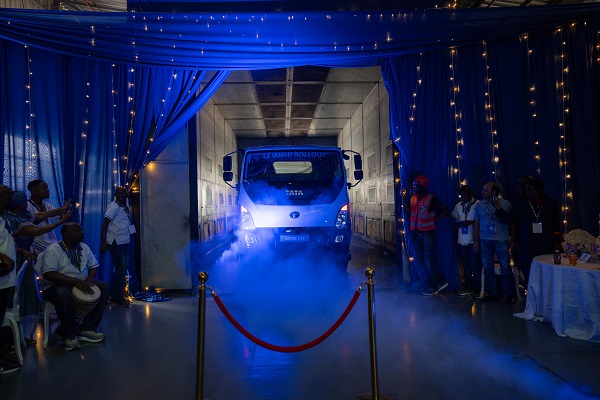
Tata Africa in partnership with Tata Motors’ recent milestone was marked by the rollout of the Ultra T.14, a vehicle that reflects the company’s current direction and priorities.
“The Ultra T.14, which marked the 12,000th vehicle milestone, is a strong indication of our direction,” Luther says. “It reflects our focus on delivering solutions that combine efficiency, durability, and consistent operational performance.”
The Ultra platform itself is set to expand, with additional models already in development.
“We are also continuing to expand the Ultra platform, with additional models previewed at the event,” he reveals. “The emphasis is not only on introducing new products but on ensuring they are aligned with real-world customer requirements.”
This alignment remains central to Tata Motors’ product strategy, with ongoing feedback playing a critical role.
“Ongoing market feedback remains central to how the portfolio evolves, ensuring that future developments are both relevant and practical.”
Building long-term partnerships
Beyond products and platforms, Tata Motors’ approach is ultimately anchored in relationships - particularly in a market where trust and reliability are paramount.
“Customer relationships are fundamental to our approach,” Luther emphasises. “Customers define the requirement, and our role is to translate that into effective, practical transport solutions.”
This requires sustained engagement and a clear understanding of how fleets operate in real-world conditions.
“This means staying closely engaged with how fleets operate and ensuring that the necessary support structures are consistently in place,” he says.
It also highlights the importance of collaboration across the value chain, from channel partners to suppliers.
“Collaboration with channel partners and suppliers is also critical to delivering and maintaining these solutions in the market.”
Importantly, Luther views this as an ongoing process rather than a fixed outcome.
“We view improvement as a continuous process. Feedback is actively incorporated into both product and support enhancements, which helps build long-term trust,” he concludes. “Customers value knowing that their input is heard and that they are supported in a meaningful and consistent way.”
Tata Africa’s trajectory offers a unique perspective - one centred on consistency, localisation, and a deep connection to customer needs.
The 12 000-vehicle milestone is not positioned as an endpoint, but as a marker along a longer journey. One that continues to be shaped by the realities of the African market, and by a clear focus on enabling the movement of goods, supporting businesses, and strengthening the ecosystems in which those businesses operate.