Government subsidies are the lifeblood of the bus and rail services in the country, but the taxi industry, which transports the majority of South Africans, is currently not subsidised as the country aims to create an efficient intermodal public transport sector.
Malijeng Ngqaleni, deputy director-general: Intergovernmental Relations speaking on the first plenary session of the 35th Southern African Transport Conference (SATC) reflected on the challenges of the country’s public transport sector.
The underlying theme of her presentation was the role that the fiscal system played in addressing the challenges of integrating the public transport system.
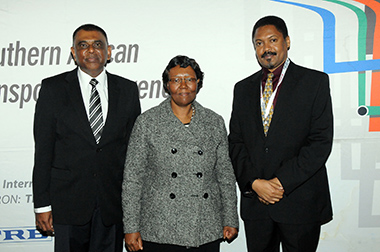 From left: Kenny Kistan, Malijeng Ngqaleni and James Maina at SATC2106.
Ngqaleni outlined one of the main reasons why an efficient public transport is important to the country by saying “The main point is to remember that public transport is essential to creating and growing competitive economies. This in turn is critical for poverty alleviation and also for environmental issues in reducing both carbon emissions and fuel consumption.”
She added that public transport is a challenge for the majority of users, but more so for the poor. “More than 60% of households spend on average 20% of their income monthly on transport. It can be as high as 31% in the rural areas. This is still the case despite of state subsidies to public transport operators increasing annually.”
Bus transport is currently the biggest beneficiary of government subsidies with 48%, metro rail receives 29%, Gautrain 15%, and Bus Rapid Transport 8%. She noted that it is the middle classes who benefit the most from government subsidies.
The transport of choice for the majority of South Africans, the taxi industry does not receive any government subsidies. “Even though this is the most efficient mode of transport in terms of serving the population, the taxi industry became successful without any government subsidies,” she notes.
Asked if government was considering subsidising the taxi industry because it is used by 67% of the population, she states it is highly unlikely in the foreseeable future.
“Currently none of our current modes of public transport are shining examples of efficiency. Some, like provincial buses are clearly unsustainable due to their high operating costs. While the mini bus taxi industry looks good on paper, it has very high social costs aligned to it. In fact, public transport subsidies are a worldwide problem and not unique to South Africa,” she explains.
The most pressing challenges facing South Africa are the inefficiencies within the different public transport modes. This is not creating benefits to the economy in terms of economy or affordability along with access to jobs and new business opportunities, Ngqaleni notes.
Another big challenge is that many people live far away from their places of work. This dates back to how residential areas were designed in pre-democracy days. Another issue of key importance is ensuring that enough people use the public transport system during non-peak hour times.
Ngqaleni outlines how the government can improve the role of public transport. “Firstly,” she says, “is to rethink how money is spent in designing infrastructure. Because of the important role that public transport plays, different government departments need to work together in aligning and integrating plans and operations.
“Well planned transport systems that guide all public transport investments, needs to be implemented for the South Africa to achieve a better transport system with the limited financial resources at hand. It should ultimately lead to an intermodal transport system aligning all the different modes of public transport in the country. This is the key for improving the passenger experience,” Ngqaleni enthused in her conclusion.
The SATC ends on Thursday 7 July and over the next three days African transport professionals will discuss pertinent issues relevant to Africa. Topics under discussion are: road infrastructure, rural transport, traffic engineering, urban and public transport, traffic management, and safety, security, freight and logistics.
Critical workshops discussing road safety audits and Integrated Public Transport Networks (IPTN) are also taking place along with a conference on Access Management. At the IPTN workshop find out how Uber is expanding the way commuters use public transport with a new approach to first-and-last-mile trips.
Without proper solutions to move people and freight, economies will remain stagnant. This can in turn adversely affect everyone on the continent. The main aim of SATC is to respond positively to the challenges and needs of transport users.
The informative topics being discussed will impact road freight operators, those involved in road safety and provision and maintenance of infrastructure as well as everyone involved in the public transport sector.