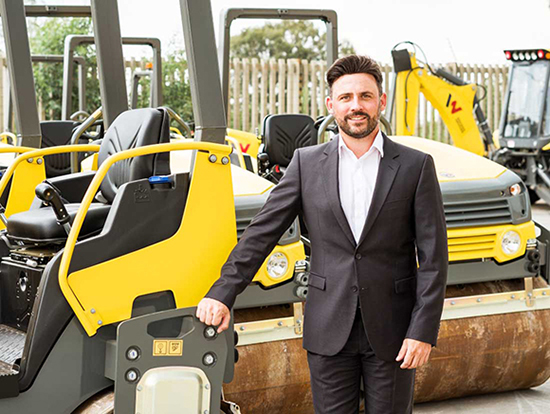
Dennis Vietze was appointed as Managing Director of Wacker Neuson sub-Saharan Africa in June 2017. In the financial year 2017/2018 the company grew by 10%, regained market share and cemented at least one of its business units as a market leader in the region. Construction World asked Vietze – a German native who has had 17 years’ experience in sales and marketing, and who has been instrumental in this turnaround – how he is bringing renewed energy and success to the brand.
What is the unique selling point of Wacker Neuson?
Quality and service. We are a premium manufacturer of construction equipment and even though this comes at a premium, customers also know that quality and service are inherent to the brand. We have a dual brand strategy whereby we offer premium and value lines: Instead of losing the customer to a less expensive Eastern brand, we offer them an entry level machine and later attempt to promote them to a premium line machine – thereby keeping the customer in the Wacker Neuson brand.
What gives Wacker Neuson construction equipment and compact machines the edge over brands that offer similar products?
Wacker Neuson is a premium manufacturer, it has a nationwide footprint, with professional back-up service that takes cognisance of the size of the country so as to minimise downtime. We are, in addition, customer-centric driven.
Describe Wacker Neuson’s approach to marketing?
For most, a marketing mix consists of four elements: products, pricing, place, and promotion. I prefer to extend this to a marketing mix that consists of seven elements and therefore add people, process and physical facilities. With ‘people’ I mean having the right people for the job; with ‘processes’ I refer to everything needed before and after a new product is launched and with ‘physical facilities’ I mean having stock available on the yard for potential customers.
I was a tough task when I took over in June 2017, but my target was to streamline all the marketing and business activities into these seven elements.
How important are dealers in your total marketing plan?
Dealers are vital. When I took over, Wacker Neuson had a direct sales approach: there were 12 area sales representatives for a country that is roughly 3,5 times the size of Germany where we had 120 sales representatives together with dealerships in a hybrid model.
Even though South Africa, as opposed to Europe, is a very different market with challenging cultural conditions, it is – at the end of the day – still about a customer expecting service. For this reason I changed the sales structure to an indirect sales structure whereby we establish dealers in the different territories. These dealers are responsible for service, sales, and backup should Wacker Neuson itself not be able to be present in a certain territory.
In June 2017 we had 18 randomly chosen dealers who were selected without any structure. Now we have 10 dealers in the country – which means that dealers are situated roughly 300 km apart. If it is not a Wacker Neuson dealer, one of our own sales representatives, territory managers or field service technicians is out to feel the pulse of the customer’s needs and interacting with them.
How do you go about selecting dealers?
Dealers must fit into the Wacker Neuson marketing structure and strategy. Whether they approach us or vice versa, I want to see commitment from such a dealer. Wacker Neuson, as a brand, has status. If a dealer wants to deal with Wacker Neuson, it needs to get my buy-in. I will need to see a long-term business plan – at least for three years, but a five year business plan will be even better as this feeds into Wacker Neuson’s intention of growing its market over a longer term.
We do not offer equipment on consignment to dealers as this does not bring any pressure to perform into the dealership. We rather want to see a ‘shop floor plan’ whereby we assist dealers with extended payment terms on Wacker Neuson Equipment. We also supply machines that have to be turned around in three months or be sent back at the dealer’s cost.
What is your dealership footprint at the moment?
We currently have 10 dealers in South Africa and six dealers in sub-Saharan Africa. By the end of 2019, we will extend our footprint to Mauritius, Seychelles, Ethiopia, Kenya, Tanzania and Zambia.
How do you assist customers in achieving maximum uptime?
Aftersales service is crucial. If a machine is failing, we need to make a plan. Someone will travel to site from Johannesburg, Durban or Cape Town. Our dealers are currently being brought up to the Wacker Neuson standards.
We are currently working on a new service strategy that will be launched on 1 May. My aim is to reach a 48 turnaround time. In line with this we have appointed a National Service Manager.
What are your strategic plans for the Wacker Neuson brand in sub-Saharan Africa?
We have three strategic plans. From a product perspective we want to keep the market leadership in Soil and Asphalt Compaction. This is our strategic business unit where we increased market share dramatically from 2017 to 2018. We are the market leader in rammers, ride on rollers and pedestrian rollers.
Secondly, we want to increase our market share in our Excavation business unit. In this business unit we have various excavators in the 1,5 to 15 ton class. The biggest market in South Africa is between the 1,5 and 5 ton classes. Here we currently have a market share of about 30% – albeit in a very limited market.
Lastly, technology is a strategic plan. I want to use telematics successfully to warn customers proactively when a service is due, so they do not lose out on their warranty, and at the same time give them the chance to become active with us.
In an effort to save cost, delays and travel time, I want to introduce Vuzix lenses with which we will troubleshoot problems before a technician travels to a breakdown. This will allow head office, via the internet, to ‘look through the eyes’ of a technician while he inspects a machine remotely.
What is your role as MD and what have your challenges and successes been?
I try to show, through my management style, what I expect of employees. I am not a micromanager. I motivate people and try to find the right pace. Internationally, but especially locally, Wacker Neuson lost some of its brand equity over the last few years. This is something I learnt when I was out in the field 80% of my time in the months after I joined.
Since becoming the MD in June 2017, there has been a turnaround. We have gained back the lost market share. People are showing trust in the company, in me and in my team. However, I am not single player. All I can do is introduce the structure and facilitate changes. My team has to make it happen. I am still there – I am not only interested in the end result. I come from a sales background, so want to feel the sales pulse and want to share the 17 years of experience I have gained.
There has been a significant turnaround over the last two years. We had a growth rate of 10% from 2017 to 2018 – in a volatile market. In 2019, when everyone is talking of the severe downturn, we had a good start. We exceed budget for the first quarter by 8%.
Personally it has also been a challenge. I had intercultural training before moving here – I came to a new country where I would always be a foreigner. The first few months I spent listening, getting close to customers so I could get a better understanding of the cultural differences. The Institute of Directors Southern Africa proposed a course in BEE as I have a commitment to the country to create jobs. People seem to trust me – and this has stood the company’s good stead. The size of the country made expanding Wacker Neuson’s footprint a challenge – but it is also an advantage.
In your view, what is the medium to long-term outlook for the construction industry locally and in Southern Africa?
I am quite positive. As a company we have planted the seeds and we are seeing the first plants coming up. In fact, I am going to extend my visa for another five years. The board in Germany is satisfied with my performance. I believe in SA, see a fruitful future and want to be a part of that. I want to be here with my team to harvest – and not just to plant the seeds.