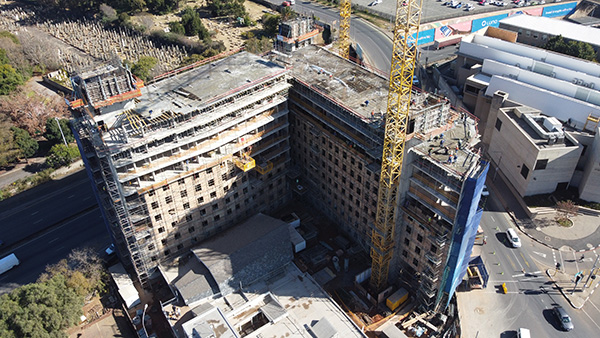
Apex Studios is a 13-storey building that is rapidly rising right next to the busy M1 highway in Braamfontein, Johannesburg. Concor, known for its stellar track record in the construction industry, is building this 13-storey building that will house 899 students upon completion. It is located opposite the University of the Witwatersrand’s South Gate and Concor is working with developer Growthpoint Properties. Construction World visited the site in June and spoke to MacDonald Ngobese, Concor’s Site Agent about the challenges on this landmark project, the importance of sequencing and why this project is the perfect example of how a fast track project should be run.
Scope
The project commenced on 15 November 2021 and has a practical completion date of end November this year – a mere 11 months later. “The scope is for 13 floors of student accommodation. The building has a brick façade with aluminium windows and each floor has four, three and two bedroom units. “There are 312 of these units (27 per floor) that will house 899 students. It is a conventional concrete structure with a basement for our plant area. Each floor comprises exposed columns, sheer and brick walls for the finishes,” Ngobese explains. The units have its own shared kitchen as well as a shower and toilet. The scope of the work includes full fit-out, right through to joinery.
The project is on the site where the old Doves funeral parlour used to be. It is bordered on the west by the M1, the north by Enoch Sontonga Avenue and the east by De Korte Street. “Concor is repurposing the former east and west chapels of the funeral parlour into the new building as a cafeteria and student study area,” says Ngobese. These were classified as heritage buildings and had to be retained.
There are various contractual milestones and the first was, despite scope changes, met by the end of July 2022. The milestone dates do not mean commissioning or services must be completed, but that everything must be ready for final coat paint,” says Ngobese.
“We commenced with foundations in December 2021. The duration for the structure is eight months – from basement to the 13th floor. Our first slab was poured on 11 February and we aim to complete the structure four weeks ahead of schedule. This allows us to start with the finishes earlier. It is a fast track programme where all the time we win will be used,” Ngobese explains.
Vital sequencing
On a fast track project such as this, the sequence in which the project progresses is vital. “Once we have done the concrete works, it is followed by the brickwork, then the services and finally this is followed by the finishes. We started this from the first floor, steadily going up a floor at a time. When the structure is completed, the structural team will assist with the finishing,” says Ngobese.
Challenges
“The biggest challenge at the beginning of the project,” says Ngobese, “was coming out of the ground.” He says that Concor did not get a full handover of the site from the bulk earthworks contractor as it had to contend with unusually high rainfall. “Portions of the site were handed over to us. This was challenging on an already confined space and made it difficult to establish the site appropriately from the beginning and changed the sequence of our work.”
Concor mitigated the delays caused by the heavy seasonal rains by electing to work into the traditional builder’s shutdown so that they could make up lost time. “We worked until 22 December and commenced again on 3 January,” says Ngobese.
“We were supposed to start work from the basement. The below ground work was broken into four portions but we had to adapt our sequencing because of conditions that arose on site,” Ngobese explains.
“Flexibility has been vital for this project. When a section was open, the team started there. We managed to mitigate many of the delays and the structure has caught up to the baseline programme,” says Ngobese.
In addition, ground conditions necessitated changes in the scope for the foundations. “The pile caps had to be bigger than what we had tendered for and the piles had to reach depths of between 3 and 5 metres (as opposed to the expected 1,5 m) which caused delays.” To mitigate this delay Ngobese says that Concor doubled its resources on site for the foundations.
Overcoming the location challenges
The project borders the M1 highway to the west. “This is a high risk area and the site is in close proximity to it. As a result, all our work started from the western façade. We installed our brickwork scaffolding early, something we do at a later stage on less risky projects. It offers protection between the perimeter of the building and the M1 highway,” Ngobese elaborates.
Shade netting covers the entire western façade as a safety precaution to prevent matter from falling onto this M1. “Shade netting comes in 3 m sections and these were stitched together. The practice was used to great effect on some of Concor’s other projects.”
In addition, the heavily trafficked Enoch Sontonga Avenue and De Korte Streets border the site to the north and east. “This necessitated extra flagmen to assist with deliveries and traffic control. We have wayleaves on De Korte Street and on Enoch Sontonga Avenue.”
The importance of sequencing
Ngobese explains that concrete is poured daily for columns and sheer walls. “At least two floor slabs are poured per week. Our turnaround time for these pours was 11 days, but it has been brought down to eight days.”
Lafarge is supplying the 6 200 m3 of concrete that is required by the project. The columns have a strength of 60 MPa and require a special concrete mix to reach full strength after seven days. “The sheer walls are 40 MPa and the slabs 25 MPa,” says Ngobese.
Part of the project specifications was the removal of back propping on the slabs. “It works on a 100, 75 and 25% back propping ratio. When we are busy with a live deck, 100% of back propping remains on that floor for four days after casting or until it reaches 60% of the required 25 MPa as specified by the structural engineer. We can then reduce the slab back propping to the two floors below to 75% and 25% respectively and only then can we commence with brickwork.” Some 1,5 million bricks (including face bricks) will be required by the project.
Steel fixing has to be done in the small the lay down area on Enoch Sontonga Avenue. “The project requires 960 tons of steel. Normally we pour our columns from floor to floor, but on this project it was an engineering specification that all our columns had to be double lift – two floors. This saves us a day on steel fixing and also reduces the slab pouring time. It is also cost saving as it reduces the amount of splicing on the columns,” Ngobese explains.
Two of Concor’s tower cranes have been erected on site to help deal with space constraints and to expedite the movement of materials in the interests of the fast pace of construction. The bigger of the two has a 60 m jib and can reach right around the site. The smaller crane has a 40 m jib and is used predominantly to lift material onto floors. Both these cranes can only move materials within the constraint of the footprint of the site.
Since March these cranes are operated 24/7. “The nightshift team loads the materials that will be needed by subcontractors onto the floors. Between 6:00 and 7:00 the crane is allocated to the plastering subcontractor and during the day the crane is used exclusively for the concrete works,” says Ngobese.
There are currently 300 people on site and at peak times it will be 400 to 500. The 40 subcontractors working on this bustling site will increase as finishing gains momentum.
Ngobese says that time is the biggest risk-factor on this project. “Resources are key. It is a fast track project. We have to ensure that all subcontractors have the resources that they agreed to provide in order for them to work on multiple floors at the same time.”
The successful completion of fast track projects relies on having a highly skilled and experienced core team on site that closely manages subcontractors to keep to the construction programme. “In addition, quality is everyone’s responsibility. It may affect our timing if work has to be rectified after it was done,” he says.
“These kinds of projects also require constant and in-depth communication with all stakeholders, from the client, professional team to the local authorities,” says Ngobese.
Environment and safety
Whilst the building is not going to become a green star rated building, Concor, as an environmentally conscious contractor, takes great care to dispose of rubble through one of its subcontractors.
“In addition,” says Ngobese, “dust suppression and noise reduction are important.”
For such a fast paced site, the safety record of no LTIs is no mean feat. “Safety is paramount for Concor,” Ngobese concludes