Concrete is a central component of the Willowton Group’s expansion of its Isando plant, where Johannesburg-based contractor Lemay is working with leading construction materials company AfriSam on a new sunflower seed intake facility.
Underway since June 2023, the project began with the construction of a large 30 m by 90 m bunker with 11,5 m high walls, topped with a 5 m steel structure. This was after Lemay completed the necessary excavations and bulk earthworks. The bunker houses two conveyor channels for the seed husks returning to the bunker after the seeds have been pressed for oil. According to Lemay Contract Manager Kobus van der Westhuizen, the company’s scope includes various concrete works, the steel structure, walkways, gantry beams and access staircase.
“The bunker is connected to the cleaning tower and off-load seed pit by a lean-to canopy,” explains van der Westhuizen. “This allows the trucks carrying sunflower seeds to enter the premises and report to a weighbridge, before offloading the seeds into the pit.”
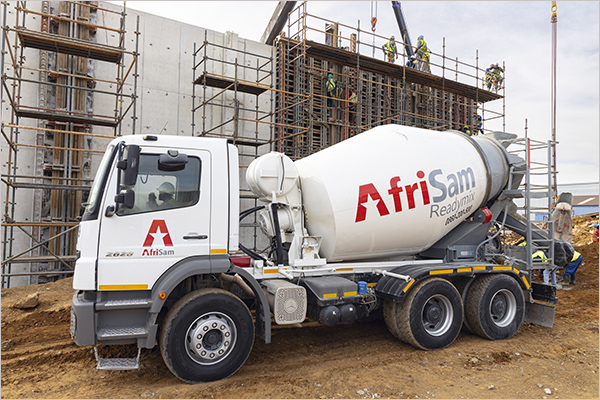
Partnering with AfriSam, Lemay was supplied with readymix concrete from AfriSam’s nearby plant in Spartan. AfriSam also provided Lemay with the recommended 35 MPa pump mix, which was signed off by the project’s engineers. The total concrete volume needed for constructing the bunker was approximately 1,500 m3.
Lemay also constructed a 24 m high cleaning tower, comprising a 12 m concrete structure with two floors and 12 m of steelwork with platforms. This is fed by conveyor from the pit.
“The concrete work also included the bases for four silos, with diameters of 26 m each and used a total of about 700 m3 of concrete,” he says. “Conveyors on gantries transport the seeds to the existing plant for processing.”
Hardstands consuming about 2,300 m3 of concrete have been constructed over the area between the new installations, along with a weighbridge, ablution block and transformer room. There is also a boundary wall with concrete columns along the west side of the customer’s premises, adjoining Diesel Road.
“We have been responsible for all the concrete work, and have relied on AfriSam for the readymix supply,” he says. “There are also various aspects of steelwork that we conducted.”
Paul Baggott, Business Development Executive at Lemay, highlights that as a 9GB contractor the company has built its success on a history of high quality general building projects.
“We are proud of having a depth of experience in engineering construction and multi-storey structures,” says Baggott. “These include processing facilities, bottling plants and shopping centres, in addition to a large variety of residential, commercial and industrial buildings – with concrete making up an important aspect of most contracts.”
At the Willowton site, the bunker includes 38 concrete bases and columns, 19 along the south side and 19 along the north. The walls for the bunker were 230 cm reinforced concrete structures, constructed from a beam on the bases on the north, east and west sides. Cast in single pours, this required the use of mobile cranes – as well as high frequency pokers due to the limited space on either side of the reinforcing bars.
“The design called for considerable reinforcing to allow for a narrower wall that uses less concrete,” he explains. “We used a mix with a 13mm stone – instead of our usual 25 mm – to allow more effective flow into the restricted space.”
The single pour delivered a monolithic result with no vertical joints in the wall, which aims to reduce the risk of water seepage and corrosion. The concrete bases comprised a circular footing with a 2,2 m wall of 600 mm thickness. A conveyor channel runs through the middle of the structure.
Van der Westhuizen says he was pleased to be able to rely on AfriSam, who consistently delivered a high quality product – with the 35 MPa mix regularly reaching 45 MPa strengths.
Among the challenges, he points out, was that the water table was relatively close to surface – just 2,5 m below natural ground level. In terms of concrete admixtures, this factor affected the choice of mix for the cleaning tower, as well as a for a 7,5 m deep lift pit.
“The high water table, as well as the summer rains, meant that we had to continuously pump water from the site,” he says. “With the amount of groundwater present around the completed construction, we decided to use a waterproofing admixture in the concrete as an added precaution.”
Space on the site was confined, especially as an existing hardstand had to be demolished, crushed and stored as a 4,500 m3 stockpile of G5 fill. Excavating to depths of 7,5 m had to be done in stages, extending well beyond the concrete footprint. Apart from the bunker, most of the concrete could be pumped using a 35 m capacity boom pump to accommodate space limitations.