Work is underway by GVK-Siya Zama to restore and structurally reinforce critical sections of Charlotte Maxeke Johannesburg Academic Hospital, one of South Africa’s most significant academic health institutions. The project is part of a programme to reinstate services and improve fire safety compliance.
The hospital’s history is closely linked to Johannesburg’s development. The land was donated in 1915 by Otto Beit, and in 1968 the site was announced as the city’s new academic teaching hospital. The main structure opened in 1979 after 81 months of construction. Today, the hospital operates with more than 1 000 usable beds and over 4 000 support staff.
On 17 April 2021, a fire in the parking structure caused significant structural damage, including the failure of a column and a partial collapse affecting level 3 and higher floors. Emergency works stabilised the building through shear walls, carbon fibre wrapping, column jacketing, and back propping.
In 2024, GVK-Siya Zama was appointed to repair the fire-damaged sections of Blocks 4 and 5 North, taking site on 2 September of that year. This work forms part of a broader remedial initiative led by the Development Bank of Southern Africa and the Gauteng Department of Health to restore the hospital to full operational capacity.
The project is divided into two key construction zones.
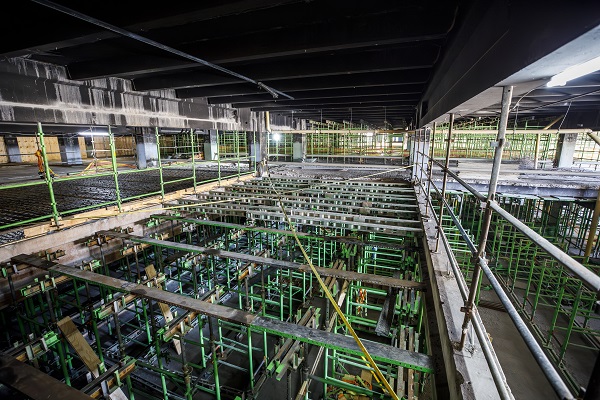
Between gridlines 21–23, deconstruction and reconstruction are required due to the 2021 fire, which resulted in the settlement of a primary concrete support column. This area requires new prefabricated steel girders, precast concrete column sections, and floor panels. A second zone involves the removal of damaged floor panels, the recasting of in-situ slabs, the addition of steel support columns to support fire-impacted beams, and the strengthening of existing columns through concrete jackets and carbon fibre reinforcement.
Work spans levels 1 to 5 of the front tower in Blocks 4 and 5 North, with controlled deconstruction of fire-damaged concrete structures to prevent further instability. Precast floor panels, primary beams, and façade elements weighing between 4.5 and 16 tons have been removed using a 20-ton tower crane. Approximately 2,500 square metres of compromised slabs have been demolished. Repairs to columns and beams are underway, alongside installation of micro piles, pile caps, pad footings, and new structural steel support columns. Levels 3 and 4 slabs are being recast before reconstruction progresses to level 6.
Because the works interface with live hospital operations, demolition and reconstruction are carefully sequenced. All activities proceed under approved method statements and safe work procedures endorsed by structural engineers and health and safety teams, with controls for access management, traffic coordination, deep excavations, and confined spaces.
Beyond structural reinstatement, the programme includes strip-out and reinstatement works; new compliant fire doors; upgrades to hydrants and hose reels; repairs to the smoke extraction system; rebuilding part of the Oncology area on level 4; reinstating parking levels 2, 3, and 4; and establishing a new ICU on level 6.
“Working within an active academic hospital carries a different level of responsibility. Every phase of this project, from controlled deconstruction of damaged structural elements to installation of new shear walls, column strengthening, and recast slabs, must be sequenced to protect both the building’s integrity and the safety of the people it serves. Our role is not simply to repair what was damaged, but to reinstate these areas to a compliant, structurally resilient standard that supports long-term clinical operations and future readiness,” says Jabu Serithi, Managing Director at GVK-Siya Zama.
“The objective should be to return these hospital areas to full use while ensuring compliance with required safety standards. For an institution that has served Johannesburg for decades, this would safeguard its ability to continue delivering complex care and training future specialists”, concludes Serithi.