A far-reaching upgrade is underway to an important water canal in Blaauwberg near Cape Town, where contractor CSV Construction is partnering with AfriSam for the large volumes of rock and construction material necessary for the project.
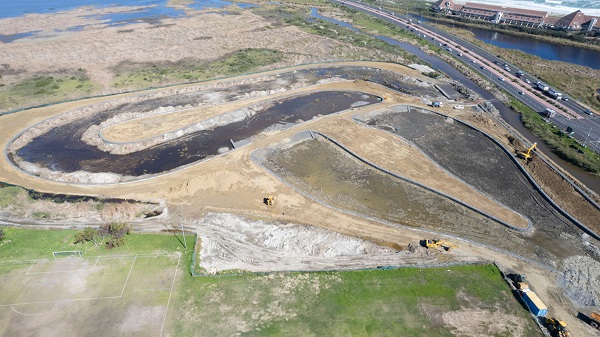
The upgrade to the Bayside Canal outfall system will make an important contribution to the natural environment, and will help reduce the risks and impacts of flooding in this fast-growing area of the Western Cape. The existing canal is the only stormwater outfall culvert for the local catchment area which includes a large portion of fast-developing suburbs such as Tableview, West Beach, Parklands and Sunningdale. According to Alex Pospech, Contracts Manager at CSV Construction, the existing stormwater capacity is insufficient and is compromised by extensive reed growth downstream of the canal outlet.
“The upgrade will have multiple benefits, among which is to safeguard the Rietvlei Wetland Reserve, which is a significant local site for water sport and birdlife,” says Pospech. “It will also better accommodate the water flows from high-order storm events and reduce the risk of flooding in this low lying area.”
Key elements of the project, which is located on the inland side of the raised R27 roadway known as the West Coast Road, include the upgrade of the existing stormwater canal and the construction of a bypass canal. He highlights that the marshy conditions and the engineering design requires unusually large volumes of rock and overburden. For this reason, CSV Construction turned to AfriSam, who was the only construction material specialist in the area with the capacity to deliver.
Stormwater from the Bayside Canal currently flows into reed beds in the northern section of Rietvlei, and has been naturally treated to a large extent. The advantage of these reed beds is they allow suspended solids in the stormwater to settle out, and for excess nutrients to be absorbed by the root systems. The upgraded and formalised stormwater treatment system therefore needs to maintain this natural function while substantially raising its capacity. It also needs to allow for easier maintenance and periodic clearing of litter.
“The design includes two 140 metres long primary sedimentation ponds which will allow heavier suspended matter to settle out,” he says, “while the 460 metre long secondary treatment canal will ensure that finer suspended matter also drops out of suspension as the water passes through.”
After passing through the sedimentation ponds, stormwater will flow over a weir into a secondary treatment canal, allowing for the uptake of nutrients and physical filtration of pollutants by the reeds. A new bypass channel of almost 600 metres is also being developed along the eastern boundary of the R27 to bypass the primary and secondary ponds and drain freely directly to Rietvlei when the water level in the Bayside Canal exceeds the weir level of 2.9m MSL.
CSV Construction was handed the site in November in 2023, and earthmoving machines were busy from January 2024. With construction activity taking place directly in the path of a flowing water course, the project has been scheduled around the Cape’s rainy season in winter. The bulk of the work has been planned to take place during the dry summer months. Pospech points out that, during the winter months of 2024, there were occasions when the entire seven hectare site was submerged – although an efficient pumping regime allowed work to resume on the higher levels. Temporary berms were also constructed to mitigate the regular surges of water flow that would follow each rainfall.
“In Phase 1 of the project, we cleared reeds and removed sludge, importing pioneer material – or dump rock – from AfriSam to stabilise the access road and gabion areas,” explains Pospech. “The gabion baskets, which are mostly 1 metre by 1 metre by 3 metre in size, were then constructed, after which AfriSam also supplied a clayey overburden material of the appropriate plasticity index.”
The work involves extensive earthworks, with some 45,000 m3 being excavated down to depths of 1 to 1,5 metres. Clearing of reed beds has been conducted using long-boom excavators and articulated dump trucks, which stockpiled the material to drain before reloading onto trucks for removal from site.
Earthworks prepare the way for 12 000 m3 of dump rock for stabilisation – to be covered by around 20 000 m3 of overburden. About 15 000 tonnes of large stones of up to 200 mm in size are being delivered for the gabion baskets.
The contract is also making use of 3 500 m3 of G4 material, which is stabilised with cement. According to Ian Trimmel, Territory Sales Manager for AfriSam, the range of material required for the project is sourced from the company’s nearby Peninsula quarry.
“Material such as dump rock can add complexity to the supply logistics,” says Trimmel. “Not all trucks can accommodate the size and impact of dump rock, for example, and we have adjusted our arrangements to ensure that trucks could navigate the quarry to collect certain materials.”
As part of AfriSam’s commitment to the project, a dedicated gabion stone plant was established. Traditionally, this size of stone is usually hand-picked from dumps. However, the large volumes required by this project meant that AfriSam had to produce and deliver on an industrial scale.
Pospech highlights that the project has generated considerable work for local small businesses, such as the packing of gabion baskets and laying of Reno mattresses – which remains a manual task. CSV Construction also arranged for additional training of subcontractors in these skills. There have been a range of benefits for other local stakeholders, too, such as the adjacent soccer club – for whom a protective berm was constructed.
With a second and third phase of the project planned for the 2025/6 and 2026/7 summers respectively, the challenge is to concentrate the effort when rains and water levels do not disrupt construction activity, he reiterates.
“When the dry weather arrives, we have to push activity hard – and this acceleration in construction programme relies on receiving a rapid supply of rock and other material,” he says. “We therefore appreciate AfriSam’s considerable production capacity, and their efforts to meet our material requirements.”
CSV Construction works in close consultation with Lukhozi Consulting Engineers as Employer’s Agent responsible for contract administration and construction monitoring for the City of Cape Town, and BVi Consulting Engineers, who are responsible for the design.