Siemens Smart Infrastructure has launched a new, comprehensive portfolio of direct current (dc) protection and switching solutions, consolidating its position as a pioneer in this dc era. The new solutions, which include the SENTRON 3QD2 semiconductor circuit breaker and the SIRIUS 3RF5 solid-state switching device, are designed to meet the growing demand for sustainable, efficient, and reliable low-voltage power distribution and industrial switching technology.
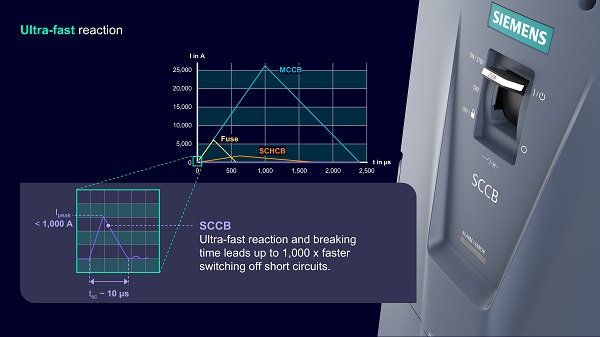
The SENTRON 3QD2 semiconductor circuit breaker enables ultra-fast interruption of short circuits, in the microsecond range.
Integrated in power distribution systems such as SIVACON S8 low-voltage switchboard and SIVACON 8PS busbar trunking systems, these solutions are particularly crucial for high-performance applications such as data centres, especially AI Factories, production facilities and battery storage systems, as well as for the integration of renewable energies.
The shift from widely used ac (alternating current) systems towards dc technology is a key step in the global energy transition. Renewable energy sources like photovoltaics (PV) and battery storage systems generate or store electricity as direct current. By reducing conversion losses (dc to ac) and enabling the direct integration of renewable energy sources, dc systems offer a more efficient and sustainable alternative to traditional ac grids. Siemens is at the forefront of this transformation and committed to research and development, as demonstrated by its active participation in initiatives like the Open Direct Current Alliance (ODCA) and Current/OS.
The SENTRON 3QD2 semiconductor circuit breaker is one of the innovations in the new portfolio. Based on semiconductor technology and smart protection algorithms, it enables ultra-fast interruption of short circuits in the microsecond range up to 1 000 times faster than conventional systems. This is mandatory for dc grids and offers a significant increase in protection and system availability.
“With the consistent development of our pioneering semiconductor switching technology, we enable a new level of electrical safety for the dc era,” said Andreas Matthé, CEO of Electrical Products at Siemens. The parameterizable SENTRON 3QD2 combines protection, switching, monitoring, and energy management in a single compact and multifunctional unit, replacing multiple components and saving significant space. Being maintenance-free with no mechanical wear parts, the SENTRON 3QD2 delivers a long service life and supports maximum plant availability, making it ideal for critical infrastructure.
“Our new dc portfolio equips customers with solutions that enhance energy efficiency and enable them to build a more resilient, future-ready infrastructure. It contributes to the decarbonisation of industries and reflects our commitment to creating technologies with purpose," Matthé added.
Complementing the SENTRON 3QD2 is the new SIRIUS 3RF5 solid-state switching device, the first of its kind for dc applications. It is designed for high-frequency switching of resistive loads, offering a low-wear and durable solution that enhances the efficiency and availability of industrial plants. The SIRIUS 3RF5 also carries the Siemens EcoTech Label, highlighting its sustainable and transparent product design.
Together with the SIVACON S8 low-voltage switchboard (with Siemens EcoTech Label), SIVACON 8PS busbar trunking systems as well as integrated dc protection and switching devices, Siemens is paving the way for new dc solutions, supporting a high level of reliability and efficiency in production or infrastructure.
The advantages of dc solutions extend beyond individual products. Implementing dc grids, customers can achieve significant cost and material savings. For example, in a manufacturing setting where robots are used, applying dc technology combined with energy recuperation and storage can reduce peak power demand by up to 80%, leading to substantial cost reductions. Furthermore, dc systems eliminate the need for reactive power compensation and require less copper in cabling, resulting in up to 50% material savings and a smaller environmental footprint.
For more information visit: www.siemens.com