Large industrial, commercial or retail operations can have maximum demand charges applied to their electricity bills. Product Manager at ElectroMechanica (EM), Artur Socha, warns such operations to look out for extra demand charges on their utility bills.
He also points out that an improved power factor relates to immediate savings on the demand charges. Even sites that have switched to renewable energy sources still need to take the power factor into account.
To estimate the savings that can be realised by installing a power factor correction system, leading supplier EM has an online power factor correction calculator. This enables customers that are being penalised with maximum demand charges on their electricity bills to determine potential savings.
Socha explains: The power factor is the ratio of actual power (known as active power) used in a circuit, expressed in kW, to the mains power drawn, expressed in kVA. Power factor correction is a mechanism to reduce operating costs associated with electricity consumption. Some of the key advantages are reduced kVA charges, improved plant efficiency and network voltage and reduced overloading of cables, switchgear and transformers.
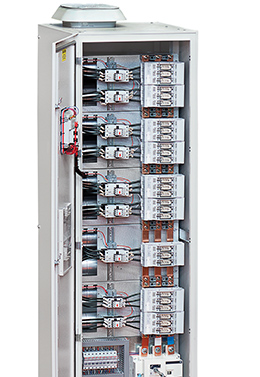
EM can assemble complete power factor systems, with the option of thyristor (fast switching) or traditional contactor switching or a hybrid of both. Combined with active harmonic filters, also available from EM, it provides complete solutions for all aspects related to its customers’ power factor and power quality requirements.
In addition, EM has a number of accredited partners to ensure customer service and technical backup and support are always on hand.
Two main products play a key role in power-factor correction: the Lovato DCRG power-factor correction controllers and Electronicon three-phase cylindrical capacitors. Features include expansion slots for additional steps or communication modules, the capability to operate with several units interconnected in master-slave mode, a quick current transformer (CT) programming function and automatic identification of the direction of the CT current flow. The DCRG8 reacts to load conditions continuously.
For more information visit: www.em.co.za