The manufacturing of primary and secondary metal products are among the key industries in the modern world.
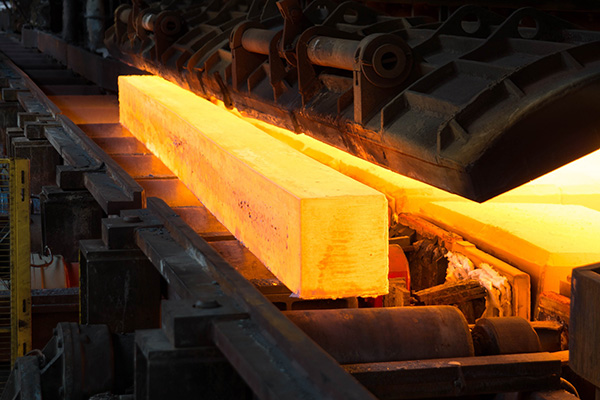
In the steel industry, continuous thermal imaging can provide useful data for plant operators looking to optimise reheat and rolling processes.
They are also among the most energy intensive. Improving energy- and production- efficiencies, and ensuring the quality of materials for OEMs, are priorities for the sector. In this regard, continuous thermal imaging can provide useful data for plant operators looking to optimise their production processes.
Recording the reheat process
Monitoring variables such as temperature, speed, thickness, and other dimensional measurements is critical in ensuring metal slabs (and other products) maintain their metallurgical properties during the reheat and rolling processes. A continuous thermal imaging solution, such as the ThermoView TV40, can record the temperature gradient across metal slabs coming out of the reheat furnace. This provides a clear snapshot of the reheat process – including a detailed view of how the product is heated across different points – to ensure temperature uniformity is achieved. With a clearer view of the reheat process, and therefore better understanding and control of the furnace, the operator can make adjustments as needed to optimise energy efficiency – saving energy related costs in the long run.
Increasing process visibility
When paired with other measurement instruments, continuous thermal imaging can provide more insights into metal processing. Pyrometers have long been used to assess metal temperatures accurately throughout the manufacturing process, due to their reliability and the fact that they provide for non-contact measurement.
A temperature pyrometer may be enough, but it takes only a single spot measurement. A repeatable measurement in one location may be adequate in some applications, but this is not always the case and there is then a risk of sending bad product onward, potentially reaching the OEM or end customer. By combining the accuracy of the pyrometer with thermal imaging’s comprehensive view and recorded data, plant operators can create a temperature monitoring solution that allows for tighter process control, and thus improved quality, as well as ensuring the product meets industry standards set by OEMs. Additionally, in this pairing of thermal imaging with a pyrometer, it is relatively easy to make emissivity adjustments or offsets to display temperatures in the thermal imaging software, making it more in line with the pyrometer’s accuracy and providing further insights into the process.
As production equipment and sensor technology continue to advance, more methods for process data collection are becoming available. With solutions like continuous thermal imaging and infrared pyrometers, plant operators can obtain accurate, up-to-date data to optimise processes, ensure product quality, improve production efficiency, and save on energy related costs.
For more information visit: www.randci.co.za