Mining companies around the world are rethinking their conventional truck shovel mining methods as a result of the rising costs of labour, fuel and consumables, as well as more stringent governmental regulations and taxation schemes related to greenhouse gases (CO2 emissions). In addition, mines and plants have to find ways to process large tonnages of low-grade ore at low costs and in an energy-efficient manner to overcome the many hurdles triggered by a sluggish global economy and low commodity prices, as well as the challenge of depleting higher-grade orebodies.
 According to Dr. Wilfred Barkhuizen, Manager of Minerals Processing, Power and Energy at thyssenkrupp South Africa, these challenges are accelerating low operational costs and equipment efficiency to the top of most mines and plants’ priority lists.
“The design of efficient and cost-effective comminution systems requires specific experience,” he says. “thyssenkrupp has more than 100 years of experience in crushing technology, engineering and design. Continued investment in R&D and close customer co-operation have resulted in state-of-the-art crushing plants that are energy efficient and economical to operate.”
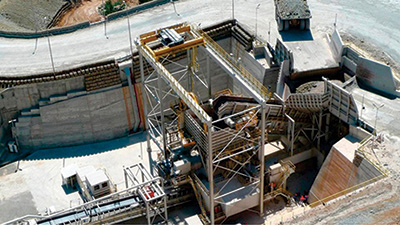
He explains that semi-mobile crushing plants (SMCP) vary in design and capacity to offer different equipment solutions for diverse commodity applications, with output delivery ranging between 200 t/h to 12 000 t/h, depending on the requirement. There are currently approximately 257 thyssenkrupp SMCP installations in operation globally.
“We can supply a SMCP for most in-pit mineral mining applications, depending on the pit planning design,” adds thyssenkrupp Minerals Processing Product Manager, Demitri Kokoroyanis. thyssenkrupp’s cost-effective in-pit semi-mobile crushing solutions are well suited for coal and ore applications and can lead to significantly reduced operating and capital expenditure (Opex and Capex). “In terms of Opex savings, our in-pit crushing and conveying (IPCC) systems reduce the requirement for intermittent materials transport; fewer trucks lower diesel consumption, greenhouse gases (CO2 emissions), fleet maintenance costs and labour.”
The plant’s support on pontoons is designed to accommodate all static and dynamic loads and only requires a base allowing for certain ground pressure. In most cases, a bed of compacted gravel is all that is required to ensure a suitable foundation, with the gravel bed acting as a buffer. This makes the plants particularly suitable for mine sites affected by frequent seismic activity. As a result, costly civil work can be eliminated or substantial savings can be realised compared with common stationary crushing plants, Kokoroyanis says.
“Another benefit is the ability of the SMCP’s to be moved by transport crawlers or self-propelled modular transporters. Usually, after being stationed in one place for a number of years, it can be moved in the mine closer to the actual excavation spot to minimise truck haulage distances. Our specialist mine planning service offers advice to customers on how best to incorporate an IPCC system.”
He adds that the machinery is not overly complex and the main system can be connected to – and be controlled from – the operation room. This facilitates equipment monitoring by semi-skilled operators. The IPCC system also has a feature that enables it to connect to the global 24/7 service centre in Germany which allows for constant system monitoring.
The slowdown in large new projects has paved the way for an increase in upgrades and optimisation of existing plants. Kokoroyanis and Dr. Barkhuizen say that despite the current state of the mining industry, neither sales nor interest in SMCPs and IPCCs has waned and that they have seen a significant increase in interest in some mining areas on the African continent.