



Mining and aggregate processing equipment is used for a number of different reasons, from separation and washing to dewatering. However, regardless of the aggregate product’s final application, be it construction material or road surfacing, the property a customer is most interested in is the average particle size.
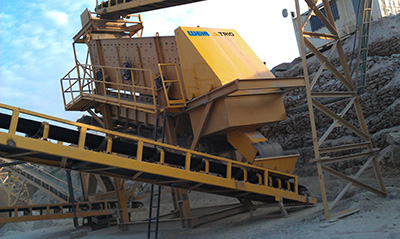 Separating and sizing the wide range of particle sizes generated by crushing equipment is one of the most important functions after the milling process, and screens play a large part in the operation, says Corné Kleyn, Product Manager Screens at Weir Minerals Africa.
“The role played by screens is central to the quarrying process. There has been a trend towards increasingly large units being installed at bigger quarries as operators look to increase their output. However, regardless of how big a screen may be, and what volume of material is passing through it, it is vital that it operates efficiently,” he says.
Efficiency is defined differently according to screen function. Screens fall into two main categories; separating screens – those that split the mixture into grades according to particle size – and dewatering screens – those that remove water from the final mixture so it can be easily stored and transported.
The objective for separation screens is for the maximum number of the particles that are small enough to pass through the apertures in the screen medium to do so. In contrast, the design of dewatering screens ensures that the majority of the fine particles that could pass through the apertures are retained so that the screen does not change the composition of mixture when the water is removed.
“It is very difficult for any separating screen to be 100% efficient, as this would mean that every single particle in the mixture small enough to fit through the screen would find its way and pass through one of the apertures in the screen medium. In reality, this is never the case – some fine particles will always be retained,” Kleyn explains.
The process that helps to ensure a separating screen operates efficiently is called stratification. This describes the ease with which smaller particles are able to fall between the gaps in larger particles in order to find their way towards the apertures in the medium at the base of the bed of material.
There are a number of ways of increasing the efficiency of a separating screen. One option is to reduce throughput. However, Kleyn says that depending on output demands, this is not always a viable option.
Increasing the speed at which the screen vibrates can speed up stratification and reduce the depth of the bed, but there is a compromise to be made, as speeding up the oscillation will reduce the life of the bearings within the exciters, calling for increased maintenance. The amplitude of the vibration also needs careful consideration. While it can improve stratification, too much travel can cause finer material to bounce along the screen, reducing the probability of it finding its way through an aperture.
The size of the apertures in the screen medium is another important consideration. A proportion of the fine particles will always be retained in the oversize output and therefore the appropriate slot size to deliver a mixture of a given specification might be slightly larger than the actual separation grade required.
For dewatering screens, the challenge is less complicated. The high level of particle retention which is desirable for these screens is achieved by encouraging a much deeper bed of material on the screen, and this is done by ensuring a steep positive incline, with material held behind a discharge weir.
“To ensure that the right screen is selected for any given application – one that will deliver required levels of efficiency at a high level of output – it is essential to understand the dynamics of the specific slurry in question. There is no one-size-fits-all solution,” says Kleyn.
“Before a manufacturer supplies a screen that will meet production targets, they will need detailed information on production tonnage, the type of material, the shape and size of the particles, whether the feed is delivered in a slurry and, if so, what the concentration is. A good equipment manufacturer should be happy to visit customer sites and consult on which products will perform well in any given application.”