The Department of Science and Innovation (DSI) on 19th August 2020 unveiled seven hydrogen fuel cell systems which are being used as the primary power source for the field hospital established at 1 Military Hospital in Pretoria as part of the government's response to Covid-19.
The project is a public-private partnership between the DSI, the Department of Public Works and Infrastructure (DPWI), the Department of Defence (DoD), local companies Bambili Energy and HyPlat, and international companies PowerCell Sweden, Horizon Fuel Cell Technologies (Singapore) and Element 1 Corporation (United States). Further contributions, in the form of methanol and hydrogen fuel for the fuel cell units, were received from Air Products South Africa, Protea Chemicals and Sasol.
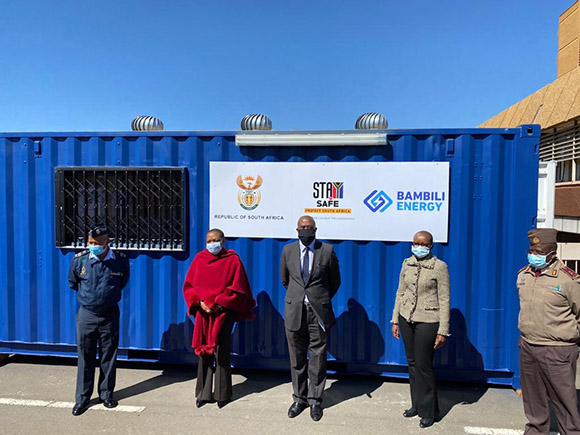
The DSI and partners recently unveiled the hydrogen fuel cell systems at the field hospital at 1 Military Hospital in Pretoria.
Bambili Energy focuses on the hydrogen economy, providing solutions to complement various forms of alternative energy, and is committed to commercialising intellectual property developed through the Hydrogen South Africa (HySA) programme.
The Covid-19 pandemic has highlighted the need to respond with speed and flexibility, particularly in providing high care facilities for those who need them most. Containerised hydrogen fuel cells can be deployed at short notice to provide a clean source of energy, even when the need is only temporary.
The support provided to 1 Military Hospital will be complemented by hands-on training to ensure that the skills required to operate and manage the fuel cell systems are institutionalised within government. The first two phases of training will focus on officials from the DoD and DPWI, while the third phase will involve unemployed TVET college graduates with N4 electrical and light and heavy current qualifications.
Hydrogen fuel cell technology is globally recognised for its potential to decarbonise the energy and transport sectors. Hydrogen fuel cells produce electricity by means of a chemical reaction, using hydrogen as the basic fuel together with platinum-based catalysts. They are efficient, reliable, safe and quiet, ensuring a non-intrusive standby or primary power solution. Modular in nature, they can be deployed rapidly and scaled up easily as the need arises, and maintenance costs are relatively low.
Speaking at the launch, DSI Director-General, Dr Phil Mjwara said that partnerships like this will enable government to take alternative energy sources to rural areas and contribute to growing the country's green economy. Mjwara said Bambili Energy is already working on an initiative to take hydrogen fuels cells to rural areas in the Eastern Cape and KwaZulu-Natal. “This is the start, and the idea is to roll out the project to various parts of South Africa," he said.
Bambili Energy CEO, Zanele Mavuso expressed excitement at leading the deployment of the fuel cell systems to contribute to government's response to the Covid-19 pandemic. "This is also an opportunity to demonstrate the potential role alternative energy sources can play in our everyday lives, given South Africa's growing energy challenges," Mavuso said.
Among the further contributions received from other industrial companies, Sasol, with its experience in the production and handling of hydrogen which it uses to produce liquid fuels, fuel gas and chemicals, will donate 10 000 litres of methanol and 600 kg of hydrogen monthly until April 2021. This will help to power the field facility.
The company’s Human Resources and Corporate Affairs Executive Vice President, Charlotte Mokoena said, "We are deliberately pursuing renewable energy sources through technology, innovation and collaboration, and sustainably produced hydrogen is integral to reducing our carbon footprint across our operations.”
For more information visit: https://www.sanews.gov.za/