Intra-regional collaboration, increased use of renewables and optimised infrastructure are among the solutions to Africa’s power shortfall, delegates heard at the opening of POWER-GEN & DistribuTECH Africa 2016 in Sandton on Tuesday 19 July 2016.
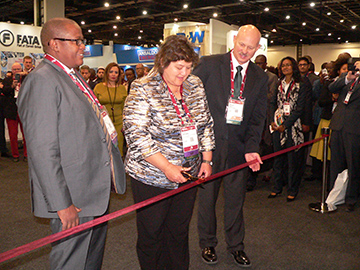 Group Chief Executive, Eskom, Brian Molefe and William Price, Country Manager at Enel Green Power South Africa, look on as Lynne Brown, South African Minister of Public Enterprises, cuts the ribbon... opening the POWER-GEN & DistribuTECH Africa Exhibition in Sandton on 19 July 2016.
During the opening session of the fourth annual POWER-GEN & DistribuTECH Africa, keynote speakers noted that Africa had the greatest concentration of households without electricity in the world; with 10 African countries having over 75% of their populations unconnected to power.
Lynne Brown, South African Minister of Public Enterprises, said: “The current electricity deficit in Africa is quite alarming. This lack of electricity access remains one of the biggest barriers to development and prosperity and continues to trap millions of people in poverty.”
In her opening address, the Minister noted that the use of renewable energy sources was increasing, but said that the early stages of South Africa’s Independent Power Producer programme had highlighted constraints in alignment of the national grid to new renewable energy sources. Major investment would be required in the transmission grids to ensure renewables delivered on their potential, she said.
Brown noted that while South Africa’s power supply and demand side management had remained stable over most of the past year, surging demand and ageing infrastructure meant there was pressure on the government to consider power generation technologies that could meet future demand affordably and with a low carbon footprint. The government was looking to a mix of coal-fired, nuclear, natural gas and hydro power, supplemented by renewables such as wind and solar.
“However, for baseload generation, there are still only two real options – coal and nuclear. Future development requires assessments of COP 21 guidelines and overall lifecycle costs. There is growing consensus that future cost comparisons will favour nuclear over fossil. However, more research is required,” she said.
In line with this, the minister announced that as part of the second phase of the Eskom Power Plant Engineering Institute (EPPEI) programme, Eskom would establish a specialisation centre focusing on nuclear technology. Eskom signed its second five-year, R170 M EPPEI funding agreement with South African universities during the conference proceedings this morning. The EPPEI programme funds eight Eskom specialisation centres at six universities.
William Price, Country Manager at Enel Green Power South Africa, noted that a changing environment demanded creative and innovative approaches to power generation and distribution. “Africa has an abundance of renewable resources available, but availability is not the only consideration,” he said. “Political stability, appropriate regulatory environments and government support for public private partnership structures are also factors investors consider,” he noted. “We need to focus on how we use renewable and smart technologies and make the consumer the centre of the energy value chain.”
George Njenga, Regional Executive at GE Steam Power Systems, Sub-Sahara Africa said: “Africa’s resource irony is we have abundant oil and gas, sunshine, wind and vast coal reserves, yet Africa is still power starved.”
Enquiries: Visit http://www.powergenafrica.com/index.html