In its annual media address Consulting Engineers South Africa (CESA) flagged South Africa’s deepening national infrastructure maintenance crisis as a matter of critical concern that it hopes will receive clear and decisive attention in President Cyril Ramaphosa’s State of the Nation Address, scheduled for 12 February 2026.
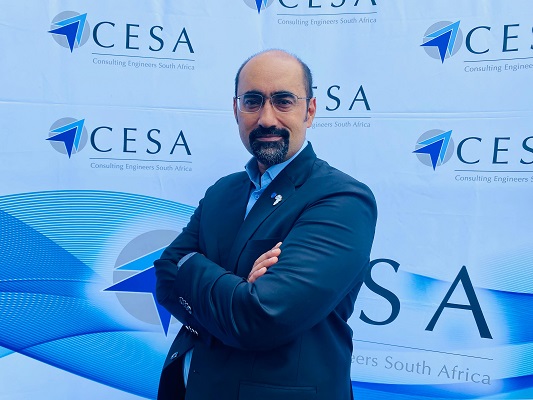
Dr Vishal Haripersad, President of CESA.
The current and worsening infrastructure maintenance backlog results from years of underinvestment, reactive asset management and a growing shortage of engineering skills. Speaking to the media, CESA President Dr Vishal Haripersad made the point that the country’s infrastructure challenges are no longer abstract policy concerns but are being felt daily by citizens, businesses and government [as we all know]. “What we are facing should be recognised for what it is: a national infrastructure maintenance crisis,” Dr Haripersad said.
Yet, he said, South Africa has not lost its engineering capability. “Where expertise is respected, where planning is sound, and where maintenance is prioritised, infrastructure still works. Across the country, there are projects – often less visible, often underreported – where collaboration between engineers, clients, and communities has delivered reliable services, safer systems, and long-term value. These examples remind us that when engineering judgment is placed at the centre, outcomes improve. The challenge now is whether we choose to replicate this approach at scale.”
Noting government’s commitment to invest more than R1 trillion in public infrastructure over the next three years, which is welcomed, Haripersad cautioned that funding alone will not reverse the decline unless longstanding structural issues are addressed and investment materialises into projects delivered – including maintenance alongside new build projects.
He highlighted that over the past decade, infrastructure investment has averaged just 15.7% of GDP, according to the Government Technical Advisory Centre – well below the 30% target set out in the National Development Plan (NDP). With less than four years remaining to 2030 for us to reach the NDP goals, the gap between ambition and reality is widening. Haripersad continued, quoting from the National Planning Commission’s report: ‘Advisory on NDP Implementation Priorities for 2024-2029 MTDP’, which states that “the failure to grow the economy not only missed the NDP targets but also resulted in a reversal of earlier improvements in the share of the population living below the lower-bound poverty line, and significantly reduced the prospect of the targets for poverty or inequality being achieved by 2030.”
The report notes declining GDP per capita growth, unemployment at 33.9% – over 45% among youth – and persistently low public and private investment levels. It suggests that these trends reflect job creation constraints, weak business confidence and infrastructure deficiencies.
All of this is compounded by a culture of reactive asset management. Haripersad made the point that many local and provincial authorities continue to manage assets reactively, responding only when systems fail. For example, Minister of Public Works and Infrastructure Dean Macpherson has estimated the maintenance backlog at R30 billion, affecting more than 56 000 state-owned properties.
Nowhere is the crisis more visible than in the water sector, Dr Haripersad said. Earlier this year, Parliament was informed that R400 billion is required to rehabilitate South Africa’s water and sanitation systems. “For many communities, the impact is already clear – not because water does not exist, but because ageing infrastructure can no longer deliver it reliably,” he added.
Recent flooding in Limpopo and Mpumalanga, and wildfires across several provinces, have further highlighted the consequences of a largely reactive approach to infrastructure risk. Haripersad said these events underscore the urgent need for proactive assessment, maintenance and building in resilience, particularly in the context of climate change.
Looking to the renewed planned infrastructure spending of over R1 trillion in the medium term, as highlighted by National Treasury and mentioned earlier, CESA will continue to call for credible multi-year project pipelines, accelerated approvals, and enforced timely payments to stabilise workloads and counter persistent cancellations and delays. This will see real infrastructure built on the ground.
Haripersad said, “As a profession. we must reclaim the role of our engineering expertise, and accountability in both the public and private sector space as the foundation of development.
He outlined the theme that will guide his presidency: “If not engineers, then who? Reclaiming our purpose, Securing our future.” Drawing on the principle of ubuntu, he emphasised that engineering is not only a technical profession, but a shared responsibility grounded in accountability to society.
Haripersad highlighted South Africa’s severe engineering skills shortage, with roughly one engineer for every 3 100 people, compared to significantly higher ratios in developed economies (around one engineer for every 300 people), according to the Engineering Council of South Africa. This equates to a shortage of more than 60 000 engineering professionals. Haripersad described this as “a failure not just of policy, but of collective will”, calling for stronger investment in STEM education, mentorship and structured professional development.
For CESA and the engineering community, a further continuing and related concern relates to procurement systems that prioritise the lowest upfront cost over quality, longevity and social benefit. Haripersad warned that this “price-only” mentality endangers infrastructure and communities – and forces professionals into unsustainable procurement cycles simply to remain operational. From such a position, there is little scope to support upskilling, mentorship and continuing professional development.
Another key concern for CESA is the integrity and governance in infrastructure delivery. Procurement-related corruption, weak oversight and delayed enforcement continue to undermine public confidence and compromise outcomes. Haripersad emphasised that restoring trust requires ethical conduct, transparency, enforcement and improved site safety.
In closing Haripersad said engineers need to be meaningfully represented at decision-making tables across government and public institutions and he appealed to those institutions to recognise the value that engineers can bring to the table – and to make space for them there. “If we are serious about infrastructure delivery, good governance and value for money, engineers need to be involved upfront in the decision-making forums – as well as on site,” Haripersad said.
“As a nation, we must decide whether we are ready to stand for accountability, build capability, deliver real value and uphold integrity,” he said. “Our collective future depends on it.”
For more information visit: www.cesa.co.za