ACTOM, one of South Africa’s leading engineering and manufacturing groups, has long recognised that a strong technical skills pipeline is essential – for its own operations and for the future of the country’s engineering sector. This led the company to take a more hands-on approach to skills development, identifying learners early – school-going youngsters with the interest and aptitude – and guiding them towards becoming qualified artisans or engineers.
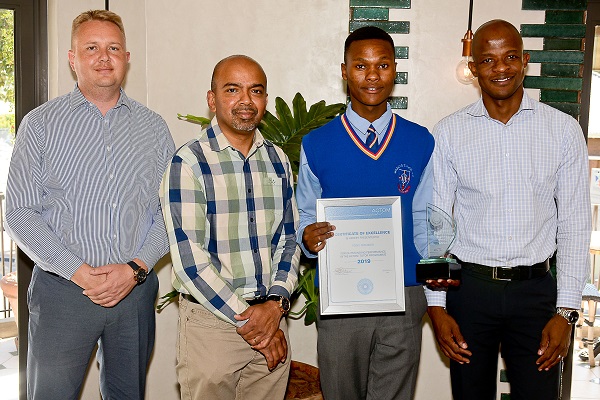
From left: Jaco Opperman, Principal at Katlehong Engineering School, Mervyn Naidoo, Group CEO at ACTOM, Tony Mfubesi, and Sylvester Makamu, Group HR Executive Director, ACTOM.
Intervening earlier
ACTOM’s involvement in education began with a maths and science tutoring programme for matric learners. “Although well intentioned, we discovered that by Grades 11 and 12, many learners had already dropped pure mathematics or physical science, limiting their access to technical careers and tertiary studies,” says Sylvester Makamu, Group HR Executive Director at ACTOM.
This sparked a shift in strategy. “We decided to intervene earlier, at Grade 9, because this is when learners are still choosing subjects, gaining confidence, and deciding whether maths and science feel achievable. Engaging them at this stage, we can prevent their disengagement from the subjects before it begins and keep future career pathways open.”
A structured journey
The programme begins with close collaboration with schools. Each participating school identifies the top 20 learners who are then invited to join the ACTOM Maths and Science Tutoring Programme. Participants receive additional lessons, study guides, calculators, and ACTOM-branded kits which signal that they are part of a special initiative.
Beyond material support, learners regularly engage with artisans, technicians, and engineers who provide mentorship and career guidance. “We maintain continuous engagement, checking that learners are staying on track and inspiring them with real-life examples of career success,” Makamu notes.
After completing school, learners can pursue one of two paths: an artisan apprenticeship at ACTOM’s training centre, or university studies for those aiming to become engineers. ACTOM covers costs for tuition, accommodation, and study materials, and during university holidays, learners gain practical experience at ACTOM factories. This approach ensures continuity from early intervention to career entry.
Real impact, real stories
The programme has already produced measurable results. “When we first engaged with Tony Mfubesi as a student, he had little hope. Peer pressure and life circumstances distracted him from his goals, but with personal engagement and mentorship, he completed his matric, trained as an artisan, and is now employed full-time with ACTOM. He is incredibly loyal to the company because this programme has given him more than a job. It gave him a lifelong opportunity,” says Makamu.
Mfubesi reflects on his journey. “Before joining ACTOM I struggled to afford school transport while supporting my unemployed mother; I even sold sweets to make ends meet. ACTOM gave me engineering skills, discipline and an employment opportunity. Today I can support my mother, and I’m grateful for the chance.”
Beyond individual success stories, the initiative has strengthened the broader skills pipeline. ACTOM now benefits from a larger pool of qualified artisans and engineers and the wider industry sees more stability in critical technical roles. “When skilled employees are available and loyal, it reduces industry staff turnover and helps sustain growth,” Makamu highlights.
Addressing broader challenges
The programme does not come without challenges. Many learners come from socio-economically disadvantaged backgrounds, some from children-headed households. ACTOM addresses these barriers through personal engagement, career guidance, and practical interventions such as providing study materials and access to social support professionals.
For ACTOM, the programme is about more than workforce development. “A skilled company is an empowered company,” Makamu says. “We train people to serve as employees but also for entrepreneurship. If we cannot employ them, they can still create opportunities for themselves. This changes the dynamics of job creation and contributes to a sustainable skills base for South Africa.”
The ACTOM Maths and Science Tutoring Programme demonstrates the power of early and sustained intervention, led by people. Investing in learners from Grade 9 onwards, ACTOM is preparing its own talent pipeline and contributing to the development of artisans and engineers who will strengthen the country’s industrial future.
For more information visit: www.actom.co.za