The start of the construction on a R1.2 billion,75 MW solar power plant at Lethabo Power Station in the Free State marks the first step in integrating utility-scale renewable generation within Eskom’s existing coal-fired power station fleet infrastructure.
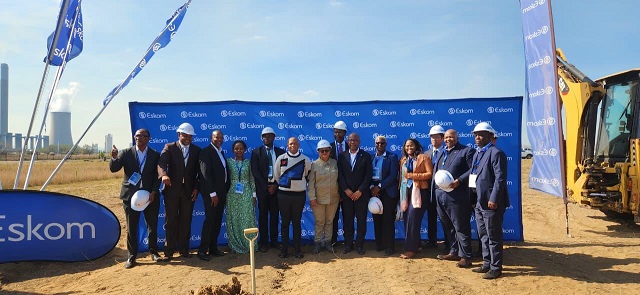
The sod-turning ceremony for the new solar power plant was attended by Minister Kgosientsho Ramokgopa, representatives of provincial and local government, Chairman of the Eskom Board Mteto Nyati and board members, Eskom GCE Dan Marokane and members of the executive team.
Once completed, the plant is expected to generate around 147 GWh of electricity annually, equivalent to supplying power to an estimated 60 000 households. As well as adding to energy generation, the project will create local economic opportunities and contribute to skills development, both key aspects of the construction and operational phases.
The sod turning ceremony on 27 May 2026 was attended by a delegation including Minister of Electricity and Energy, Dr Kgosientsho Ramokgopa; Premier of the Free State, Maqueen Letsoha–Mathae; Premier of Gauteng, Panyaza Lesufi; Executive Mayor of Metsimaholo, Cllr Jack Malindi; Executive Mayor of the Midvaal Local Municipality, Cllr Peter Teixeira; Eskom Board Chairman, Mteto Nyati; and from the Eskom executive team: Group Chief Executive, Dan Marokane; Group Executive for Generation, Bheki Nxumalo, Group Executive for Renewables, Rivoningo Mnisi; plus Eskom’s Lethabo Power Station General Manager, Karabo Rakgolela and members of the Eskom Board.
At the ceremony, Eskom’s Group Chief Executive, Dan Marokane said: “Last week we celebrated 365 days without load shedding, as a result of the focused delivery over the past three years of the generation recovery plan by our skilled employees. Now that we have established a stable electricity platform for the South African economy to grow, we can enable the integration of renewable energy sources as required by the 2025 Integrated Resource Plan, to maintain future energy security.
“We are playing our part in bringing online the new generation capacity required, drawing on the deep technical and institutional capability of our employees, built over decades of public investment, that remains a critical part of our national capacity to deliver cleaner sources of energy,” Marokane said.
Eskom Group Executive for Generation, Bheki Nxumalo added: “Bringing this solar plant into the Lethabo Power Station site affirms our deliberate strategy to optimise existing assets as we accelerate new, lower-carbon generation capacity.
“Our coal‑fired operations remain central to grid stability, and we are strengthening that foundation by integrating renewable capacity on the same footprint. By leveraging established transmission infrastructure, grid connections and deep operational expertise, we can deploy new generation at pace and at scale, without compromising system reliability. This is how we aim to build forward, maintaining a strong, stable baseload and, in parallel, systematically expanding South Africa’s energy mix,” Nxumalo said.
Eskom Group Executive for Renewables, Rivoningo Mnisi noted: “The Lethabo solar power plant represents a significant milestone in Eskom Green’s renewable energy pipeline and forms part of the utility’s broader strategy to diversify the generation mix, support South Africa’s Just Energy Transition objectives and provide customers with lower-carbon electricity.
“Leveraging existing power station infrastructure, this project demonstrates the practical integration of renewable energy technology within our existing coal-fired power station fleet infrastructure and signals Eskom’s continued commitment to strengthening security of supply as we transition towards a lower-carbon future,” Mnisi said.
Renewable energy plans
The Lethabo 75 MW Solar power project forms part of Eskom’s broader pipeline of renewable energy and storage initiatives currently under development. It is one of 17 high‑priority projects that will be implemented across Eskom’s existing coal‑fired power station footprint, with construction expected to commence between now and 2028. Collectively, these projects are planned to deliver around 6 GW of new capacity by 2030.
These developments will be located at selected power stations, including Arnot, Duvha, Majuba, Tutuka, Lethabo, Komati, Kendal, Kusile, Hendrina, Camden and Grootvlei, making use of existing infrastructure to accelerate deployment, reduce costs and strengthen grid resilience.
The Lethabo project also forms part of Eskom’s construction‑ready pipeline of at least 2 GW of renewable energy and pumped storage projects progressing during 2026. Funding for these projects has been provisioned within Eskom’s approved capital expenditure programme and will be financed through on‑balance sheet funding, in line with National Treasury debt relief conditions, without relying on additional project finance borrowing.
Utility-scale green electricity
Beyond the initial repurposing and repowering pipeline to be built within Eskom’s existing power station infrastructure, Eskom Green will adopt a proactive growth strategy that extends outside of Eskom-owned land and existing decommissioning sites. The initial anchor projects provide a critical foundation for Eskom Green’s long-term value creation, which will expand into new geographic and technological opportunities.
Eskom Green will pursue partnerships, co-development opportunities and strategic acquisitions of advanced-stage development projects and operating renewable assets located in high-resource areas with superior wind and solar irradiation.
This approach will enable the business to optimise its generation portfolio, diversify its revenue base, and ensure alignment with customer load profiles, balancing technologies such as pumped-storage, wind, PV, BESS and other alternatives such as green hydrogen.
Eskom Green aims to provide a fit-for-purpose structure to facilitate utility-scale renewables through public-private partnerships, leveraging Eskom’s existing footprint and system knowledge. The proposed funding framework will limit recourse to the Eskom balance sheet, using project finance principles for the renewable energy projects through dedicated Special Purpose Vehicles (SPVs). This is intended to advance Eskom’s pipeline of more than 32 GW of cost-competitive renewable energy and storage projects by 2040, to diversify its energy mix as part of the emissions reduction strategy and enable customers to decarbonise over the life of their operations.
For more information visit: www.eskom.co.za