Having stabilised the national electricity supply system – achieving by mid-May 2026, 365 days without load shedding – Eskom is forging ahead with its strategic energy diversification plans. Towards the end of May we saw the start of construction on the 75 MW solar power plant within the site perimeter of Eskom’s Lethabo Power Station in the Free State. Last week, on 5 June 2026, Eskom and Zululand Energy Terminal jointly announced the signing of the Heads of Agreement establishing the framework for a long-term strategic partnership to support South Africa’s gas-to-power programme. Among other things, this will see the development of Eskom’s Richards Bay 3 000 MW Gas-to-Power Project, to be built and operated in the Richards Bay Industrial Development Zone, in KwaZulu-Natal.
On 9 June, Eskom Holdings formally launched Eskom Green, which it plans to build into an agile, utility-scale renewable energy business to support 24/7 supply and help decarbonise the grid. As a new business unit within Eskom, Eskom Green is structured to accelerate the development of renewable energy projects and support larger power user customers in achieving their decarbonisation and energy transition objectives. The business is based on global benchmarking research that the utility conducted across more than 20 utilities. The insights gained indicate that the development of renewable energy projects requires agile decision-making, access to diverse sources of capital, partnership-based delivery models, and bankable project structures. These differ materially from Eskom’s legacy vertically integrated generation model. Hence Eskom Green will pursue a different operational approach than that traditionally followed by the holding company.
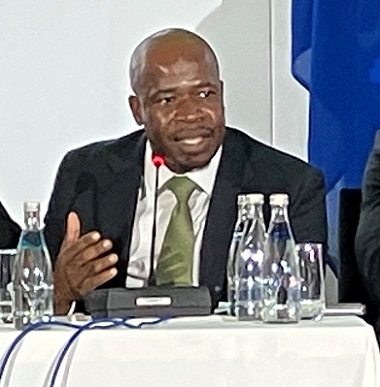
Group Executive for Eskom Renewables, Rivoningo Mnisi, said at the launch: “In Eskom Green we aim to accelerate the renewable energy options available to South Africa’s industries, enabling them to decarbonise and transition industrial and productive capacity to maintain export competitiveness. The business will enable customers to lower their carbon footprint inherent in their energy consumption,” he said.
Eskom Group Chief Executive, Dan Marokane, emphasised: “Today’s announcement is not only about carbon content compliance but about delivering leading-edge solutions, at scale, to enable our customers to implement their decarbonisation strategies.
“Eskom Green is built on decades of power generation skills and expertise the nation has invested in, and it reflects the successful adaptation to new technologies within Eskom. We have been playing in this space for some time – now we are putting a stake in the ground. This is a development that South Africa can be proud of,” Marokane said.
Currently part of Eskom Holdings, Eskom Green, as a business unit, will also be part of the organisation’s unbundling strategy. In due course it will be separated from Eskom to become a wholly owned subsidiary with an independent board, subject to the necessary governance, regulatory and shareholder approvals.
For customers
Eskom Green aims to establish contracts with customers that will source their core renewable energy requirements from it and it will take responsibility for delivering against those requirements using its own renewable generation, supplemented by storage and firming arrangements that support round-the-clock supply where the customer needs it.
The business states that the pricing determination will be clear and transparent where the wholesale tariff is passed through to the customer, at cost. The network, wheeling and other regulated wholesale charges levied by the transmission and distribution operators will not be absorbed by Eskom Green and are not marked up. The charges will be presented as a distinct line item separate from the price of energy that Eskom Green generates and sells. This way, the customer has full transparency on what is paid for energy and what is paid for network use.
In its foundation phase, the business will target large industrial demand in mining and manufacturing through Section 34 IRP allocations and direct bilateral Power Purchase Agreements (PPAs) to provide decarbonisation solutions.
Under a take-or-pay structure, the customer will commit to a fixed volume and pay the agreed price whether or not the energy is consumed, giving Eskom Green the firm revenue base to anchor the envisaged Special Purpose Vehicles (SPVs) that will be entered into to finance the projects. As the Eskom Green portfolio scales, aggregation, ancillary services and wholesale market participation will become part of the service offering. In terms of technology, the pipeline is weighted to solar PV with supporting Battery Energy Storage System (BESS), pumped storage and wind, to provide the asset base from which an initial 2 GW operational target can be delivered.
The second phase of the offering will serve the Eskom Distribution market, leading customer network through the eDX Edge offering, as well as the South African Wholesale Electricity Market (SAWEM) as it develops, the Southern African Power Pool (SAPP), and municipalities.
In line with IRP 2025
Eskom Green is positioned as a collaborative and complementary player in the sector. It plans to work alongside private sector participants to help close the generation capacity gap identified in the Integrated Resource Plan (IRP) 2025. By strengthening coordination across the sector, South Africa’s energy supply can be collectively secured, emissions reduction targets advanced, and the large-scale decarbonisation solutions required by industrial customers can be delivered rapidly.
The IRP 2025 estimates that for every 10 GW of renewables, 6 GW of dispatchable power is required (60%). This points to the ongoing need for baseload energy, as well as battery energy storage, pumped hydro capacity, and gas-to-power availability.
In line with the IRP 2025, Eskom Green’s contribution is essential to delivering on the overall renewable build targets of 5.6 GW by 2030, 21 GW by 2035, and 32 GW by 2040. This has been a key consideration in Eskom’s decision to enter the utility-scale renewable energy market.
Eskom Green aims to have about 6 GW of carbon-free electricity available up to 2030, as a result of Eskom’s existing pipeline of renewables and storage initiatives currently under development.
Over the longer term, by 2040, Eskom Green aims to deliver 32 GW of utility-scale renewable energy. It will leverage Eskom’s existing infrastructure, engineering expertise and system knowledge to support faster deployment, improve cost efficiencies, and strengthen grid resilience.
Fit-for-purpose
As a ring-fenced, wholly owned subsidiary, Eskom Green provides a fit-for-purpose institutional mechanism to enable:
- Dedicated focus on renewable energy development and delivery
- Improved bankability through ring-fenced financial and governance structures
- Access to private and concessional capital through project-level SPVs
- Greater flexibility to partner with experienced private sector participants, and
- Faster and more commercially responsive decision-making within defined governance frameworks.
This approach is consistent with international best practice, where state-owned utilities have established dedicated renewable energy platforms to scale up delivery while managing balance-sheet, governance, and market-participation risks.
Eskom is engaging with the relevant authorities regarding the governance, funding and regulatory approvals required to support the long-term implementation of Eskom Green.
For more information visit: www.eskom.co.za