More than a decade after installation, Weba Chute Systems’ custom-engineered transfer chutes at the Palabora Copper Mine continue to perform reliably with minimal maintenance, thanks to an innovative design tailored to high-impact underground conditions.
Click to download and read pdf
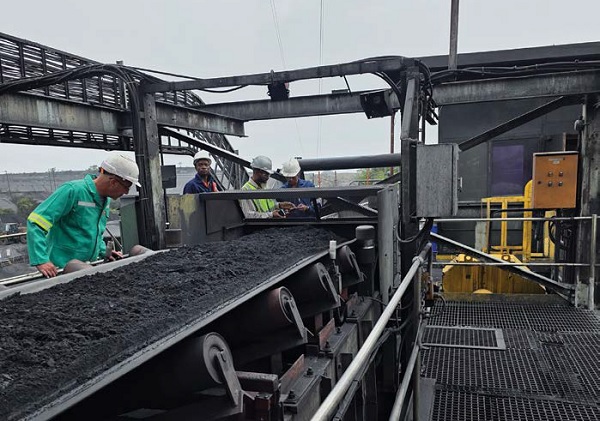
A Weba Chute Systems field advisor inspects a conveyor transfer point in operation, underpinning the company’s ongoing commitment to ensuring optimal material flow and performance across all installations.
Highlighting the company’s dominance in engineered flow control solutions that prioritise durability, efficiency and operational sustainability, the custom-engineered transfer chutes supplied by Weba Chute Systems for Palabora Mining Company’s (PMC) Copper Mine continue to operate with virtually no maintenance.
Located in Limpopo Province, South Africa, PMC’s underground block-cave operation required a specialised approach to materials handling. The original scope of supply needed Weba Chute Systems to design and install transfer chute systems capable of handling coarse copper ore up to 220 mm after crushing within a high-capacity conveyor network operating at belt speeds of 3 to 4 m/s. The systems were specified for a throughput of around
5 000 t/h, servicing 20 production cross-cuts and 320 drawpoints in a compact mining footprint 650 m below surface.
The Weba Chute Systems solution was unique due to its alignment with the site’s operating realities. “We didn’t just supply chutes,” Mark Baller, Managing Director at Weba Chute Systems, says. “We delivered an engineered flow control solution. We carefully analysed the fragmentation profile, belt speeds, spatial constraints and impact zones, and designed systems that optimised flow while protecting infrastructure,” he explains.
At the heart of Weba Chute Systems’ success is its patented ‘super tube’ design, which controls the direction, velocity and impact of material as it flows through the chute. Unlike conventional chutes, so often generic in design and prone to wear, blockages and dust, Weba’s transfer point solutions are engineered using Discrete Element Method (DEM) simulations to model and optimise flow behaviour. This reduces turbulence, prevents build-up and dramatically limits wear on liner surfaces.
Durability was further ensured through strategic material selection. High-impact zones were lined with high-chromium cast iron and ceramics, while structural components were fabricated from high-strength steel using precision welding and advanced surface treatments. The result, Baller says, is a system that has withstood over a decade of harsh underground operation with only minor spares required.
“Our 2025 site inspection confirmed the Weba Chutes at PMC are still in excellent condition,” he says. “The customer feedback has been outstanding, and they have reported significantly reduced spillage and dust, improved flow control and no unplanned downtime from chute failure.”
This performance has not gone unnoticed in the mining sector. Weba Chute Systems is actively leveraging the PMC success story to support new underground projects, especially in block-cave mines, where controlled material flow and long-term reliability are critical. Through technical presentations, case studies, and field demonstrations, Weba Chute Systems continues to expand its footprint across commodity industries, including gold, platinum and iron ore.
“PMC is a notable benchmark project for us,” Baller notes. “It proves that when you engineer for the application, performance and longevity follow. We are proud to be helping mines around the world shift from reactive maintenance to engineered reliability.”