MCA visits the Benoni facilities of WEG Turbine Services to meet Alastair Gerrard, Executive for Energy systems, for an introduction to WEG’s comprehensive steam turbine-related supply, installation and long-term service offering now available to operators across Africa.
Click to download and read pdf
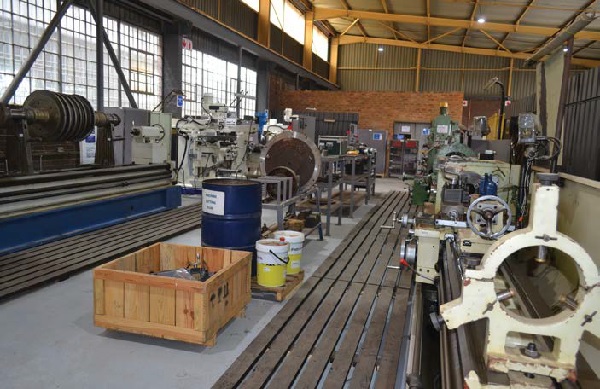
WEG’s turbine facility in Benoni consolidates the company’s steam turbine solutions, from managing the supply of new WEG turbines, gearboxes and generators to offering a comprehensive range of after-sales services.
Following the February 2024 acquisition by WEG of the Benoni-based service facilities of RTS, Rotating Technologies and Services, a leading provider of engineering, maintenance and repair services for steam turbines, centrifugal and reciprocal compressors, gearboxes and other related equipment, WEG has established itself as an OEM and servicing provider for steam-turbine and generator solutions across the lifecycle of its own and other brands.
“Before the acquisition, RTS was a local partner for servicing our WEG steam turbines for the sub-Saharan African region, and we worked closely with them to install, manage and service WEG turbine installations. Incorporating RTS into WEG’s thermal energy business enables us to offer an expanded set of solutions for operators of steam turbine generator sets and mechanical drives across sub-Saharan Africa, from installation to long-term preventative maintenance and remote monitoring, followed by plant upgrades and replacements,” he adds.
“What we've done here in Benoni is to consolidate our steam turbine solutions offering, from supplying new WEG turbines, gearboxes and generators, to a comprehensive range of aftersales services, which are all now managed from this facility,” says Alastair Gerrard.
Explaining the strategy underpinning the RTS acquisition, he says that WEG’s thermal energy business is made up of a solutions team, which deals with supplying new equipment designed according to a customer’s specification or need; and the turbine services side, which looks after the installation of new equipment, as well as the after sales servicing, either through service level agreements signed with customers, or on a quote, receive and order basis.
“WEG in Brazil has a strong servicing background. What we lacked here in Africa was the ability to do our own installations and our own servicing. We were offering the equipment and then working with third parties to deliver these services. But whoever manages servicing, not only controls the supply of spares, but also stands a far better chance of securing new orders for machines,” Gerrard argues.
“By servicing steam turbines from any OEM, we develop knowledge of the client’s machines and applications. We can understand the environment and the challenges, and collect a history of machines across the market. When a turbine is no longer economical to repair, service and usage data enable us to quickly put together a custom replacement solution that meets the client's specific needs.
“This is why we decided to get into services: to access the market at a different level, to understand what's out there over time, and eventually, to look at replacing existing machines with WEG solutions. When we sell a WEG solution, we have the resources to offer industry-leading value-added services. We don't just dump and run; we reassure the client that we'll walk the road with them throughout the machine's lifecycle and beyond,” he tells MCA.
Lifecycles and turbine service needs
Typical steam turbines, says Gerrard, are designed to operate continuously for 24 hours a day and 365 days a year. At least once every 10 000 operating hours (or 12-14 months), they need to be brought down for a service intervention, though.
“The first service, at about 12 months, is a simple inspection service, where we look at the emergency stop valve (ESV) at the front of the turbine where the steam comes in. We clean the ESV to ensure it's operating correctly, conduct an overall health check of the machine, and review the operator logs for incidents that may suggest further work is needed.
“Then, after another 10 000 hours of operation, we do a minor overhaul that involves a little bit more. We use borescopes to inspect the turbine casing, the condition of the blades, rotors, and other internal components without opening the machine. This cycle repeats in years three and four, but in the fifth or sixth year, after about 40 000 hours of operation, we perform a major overhaul that involves opening the casing.
“The timing of interventions depends on several factors, such as the quality of the steam that's been put through the turbine. If poor, then the period between interventions needs to be shortened. And if any problems are picked up, then we obviously need to intervene early to avoid potential catastrophic failures,” he advises.
He says the advantage of a turbine is that it runs continuously without needing to be stopped and restarted. It takes two days for a typical turbine to cool before any work can be done on it, and several hours to return it to temperature before it can be reloaded. “While turbines are a continuous power solution designed for minimum intervention, they still need to be properly and regularly maintained to guarantee maximum efficiency, reliability and life,” Gerrard points out.
“We have turbines in the power generation industry that have been producing power for over 40 years. What we supply are smaller, industrial versions of these turbines, which puts us in the market for sugar, pulp and paper and petrochemical applications,” he says.
Waste-to-energy applications
Waste-to-energy applications have become very exciting for us in recent times. Here, WEG targets the 200-800 kW range for plants with access to a waste stream that can be burned to generate energy.
Some operations generate leftover wood from furniture manufacturing, medical waste from hospitals, or food waste from hotels, all of which can be used to create steam and, via a turbine, generate power. “Furthermore, we are also active in the sugar industry, where sugar plants have long been using bagasse, and paper mills that use biomass to create power,” he notes. WEG has a comprehensive market presence and extensive experience in both the sugar and pulp and paper industries, which we can leverage to develop the sub-Saharan African market,” says Gerrard.
The changing market
Gerrard is seeing significant shifts in the market. “When we started this business, it was acceptable for OEMs to have a third party doing installations and services, with the OEM only responsible for the supervision. Now, clients want the OEM to take full responsibility for an installation and the after-market servicing of the assets.”
This makes sense, he says. Steam turbine systems are high-value, technically complex systems. Turbine engineering is a precise science with a specialised skill set required for servicing, and it isn’t easy to find specialist turbine engineers.
While turbines are simple in that they turn the rotor using steam, he continues, the intricacy of sealing, blade designs and steam quality makes them highly complex. WEG has sophisticated software tools that enable the development of turbine designs that best fit the application. “We have experience in a wide range of client processes, including the use of waste process steam, optimising the performance of the machines clients already have, and upgrading and optimising fuel efficiency,” he notes.
“And now, we can also offer long-term services for these turbine systems, whether the client is using a WEG system or any other brand, no matter how old. Many of the machines in Africa have been running without proper support. OEMs, ownership, and personnel have changed, and operators often don’t even have drawings for their machines.
“We can scan all the parts of a machine to create the CAD manufacturing drawings, which enables us to remanufacture OEM-quality spares for anyone’s machines, facilitating proper after-market support and promoting increased machine operational life-cycles.
“We are planning further capital investments in modern machinery and tooling to improve our local servicing capabilities. And anything we can’t do here yet can be done by WEG in Brazil,” concludes Gerrard.