Dennis Williams, Commercial Director of steam and boiler operations and maintenance service provider, Associated Energy Services (AES), highlights the opportunities available to thermal energy users to optimise condensate return (CR) and waste heat recovery, while preventing system contamination.
Click to download and read pdf
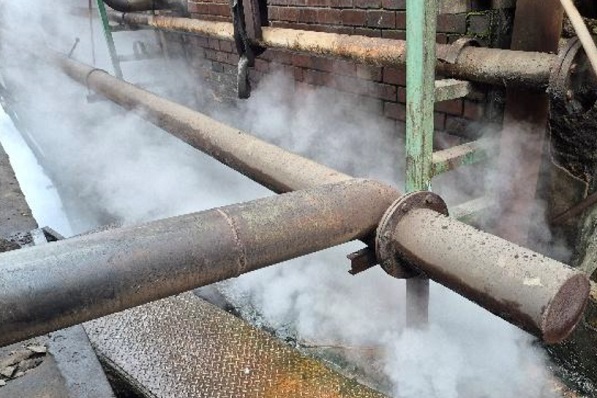
Wasted condensate from the steam trap is discharging to the ground.
“Steam quality is the responsibility of AES on sites it manages, and this includes protecting the boiler assets and the quality of steam supply to ensure optimised plant and boiler operations.
Although managing condensate return is officially outside AES’s remit, Williams says the company often provides its own and specialist third-party insights: “Our limit is receipt of condensate at the hot well in the boiler house. The client must manage the collection and return of condensate because this is integral to the use of steam and should, therefore, be controlled by production personnel as it impacts plant operation,” he advises.
The client’s steam usage system determines both the quality and amount of condensate available. If steam is used via direct injection, no condensate can be recovered; if it is an indirect heat source, in coils or heating jackets, for example, condensate can be extracted.
Key factors such as conductivity, hardness and temperature all determine quality, Williams explains: “Total Dissolved Solids (TDS) and hardness stem from the contamination of steam/condensate circuits in the client’s facility, such as leaking heat exchangers or coils. This results in product ingress into the steam/condensate circuit. It can also come from heating and cooling plenums, where there is no rinse cycle after the cooling cycle. Condensate is then contaminated with cooling water that is high in TDS and hardness.”
The higher return rates of hot, high-quality condensate assist in optimising steam generation as follows:
All sensible heat (temperature) returned saves on fuel inputs, as the energy input is related to the difference between the condensate temperature and the steam temperature (including phase change energy). More heat returned means less fuel used.
The higher percentage of CR requires less make-up water to account for the CR losses, as well as the use of less fuel to heat the make-up water from ambient temperature to boiler steam temperature (including phase change energy)
A higher percentage of CR also means lower TDS compared to make-up water, and therefore less blow-down to maintain boiler TDS, less fuel input energy, less water costs and less water treatment
However, if TDS is out of specification, the condensate cannot be used and must be dumped, as it will foul the boiler heat exchange surfaces, increase fuel consumption, and potentially damage the boiler pressure parts, Williams warns.
Partnering with clients to optimise condensate return
AES works closely with clients to optimise CR systems. Williams uses an AES food sector client as an example: “As our client has no fundamental technical understanding of the heat exchange systems within its facility, it cannot determine the percentage condensate return that can be achieved. AES and third-party-assisted plant tours provided technical guidance and isolated sections to determine condensate return flows, revealing potential condensate contamination. The client identified several process units as requiring attention. This is an ongoing process.”
Economics of condensate return
At another industrial manufacturing site, AES identified process issues in heating and cooling cycles that are resulting in high TDS and hardness in the condensate returned, making it unusable at the boiler house: “We proposed a control system designed to allow for a post-cooling cycle flush. This will ensure that high TDS and hardness are flushed before steam is introduced, thereby providing a clean CR. The expected savings are approximately R6 000 per month for every 1% improvement in the CR to the hot well. With a potential upper limit of 80%, significant savings can be achieved.
In short, the higher the temperature at which condensate is received, the better the energy saving. This justifies investment in the recovery process.
Williams recommends analysing where and how energy is used, and identifying best-matched applications: “Where energy benefits are low, lower-grade energy uses, such as cleaning water, typically at 60 °C, should be substituted. By using the recovered low-temperature CR, less water is needed, together with less steam to heat the cleaning water,” he explains.
‘Return’ to solutions
Williams observes that while some challenges are transitory, others can be severe and costly, such as introducing contaminated or high TDS CR into the boiler steam system: “If left unattended, this causes boiler fouling and plant failure. Contamination can lead to boiler control issues – fluctuating water-level and boiler trips – and even carry-over of water slugs into the steam range, which can potentially cause water hammer and line damage.”
The solution is proper design, layout and planning of condensate recovery systems: “Designs differ between plants. For example, a high-speed paper machine versus a heating coil on a cooker vessel. Regular maintenance of heat-exchange equipment and testing of both CR and product for signs of leaks between the steam and product spaces are also critical. This is why, at AES, we prioritise preventing system deterioration and managing feedwater chemistry.
“Clear and timely communication between AES and our clients is critical in managing expectations and in achieving the best results. It is a partnership,” Williams concludes.