The WARMAN® DWU (dirty water unit) is a high-head hybrid pump for mine dewatering applications that combines the efficiency of a clear-water pump with the robustness of a WARMAN® slurry pump. Marnus Koorts, General Manager for OEM Products at Weir in Africa, highlights the features and niche uses of this locally manufactured workhorse.
Click to download and read pdf
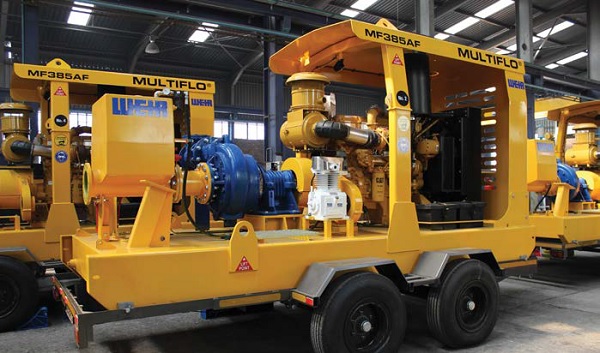
The WARMAN DWU pumps can be interfaced with diesel engines on trailer or skid-mounted pontoon barges.
Manufactured in South Africa for global mine dewatering applications, the WARMAN® DWU pump is noted for its high efficiency, with high-chrome components that provide excellent wear characteristics and solids handling of dirty water with specific gravities (SGs) up to 1.05.
“The WARMAN DWU pump serves a market that is under-serviced, in my view,” says Marnus Koorts, General Manager for OEM Products at Weir in Africa. “It fits into a niche between high-efficiency clear-water pumps and wear-resistant mill circuit slurry pumps, and I don't believe there is another product that fits this niche quite as well,” he says, adding that it is particularly well-suited to the harsh mining environment.
In general, he says there is a significant divide between slurry-pump and clear-water pump providers. Slurry pumps generally focus on wear life and maximising solids-handling capacity, while clear-water pump providers concentrate on energy efficiency and discharge head. “Our DWU sits between this divide, designed for mining environments where the water is not clean, but neither is it slurry. Clear-water pumps have tighter tolerances and a wider range of materials of construction because they don’t have to resist abrasive wear. On the other end of the spectrum, slurry pumps are generally less efficient, primarily because wider tolerances are needed to reduce wear rates.
“Clear-water pumps are machined to achieve the tolerances necessary for efficiency, while slurry pumps are cast and skimmed to get the material composition needed for abrasive resistance,” he explains, adding that this leads to an inherently rougher finish, which leads to lower comparative efficiencies.
Additionally, while slurry pumps are more robust, they are not generally required to pump high heads: a cyclone feed pump typically operates with a pressure head of 30 m or less. “But for dewatering from a deep mineshaft or pit, water may have to be lifted hundreds of metres in a single stage to transfer it away from where it has settled. Minimising the number of pumps installed to achieve the high discharge heads required is where the WARMAN DWU unit shines,” Koorts points out.
Underground water is generally quite clean at the source, but as it flows into a mine or pit workings, fine dust particles or solid residue from mining activities can contaminate the fluid. The water used to cool the drill bits, for example, is often sourced from open underground dams, so it is not clean; it contains small but significant levels of suspended solids. Mineshafts also experience ongoing water seepage, so there is a need to continuously drain water from access and production areas.
“Some of our deep mines are 3 000 m deep, so high-head or multistage pumps are needed to get that water out. Traditionally, high-head clear-water pumps have been used to remove this water, but suspended solids and raised SGs cause these pumps to wear out very quickly. This leads to high refurbishment or replacement costs. So Weir has designed a hybrid, the WARMAN DWU pump, that delivers the efficiency and high head benefits of a clear-water pump, but with the additional wear benefits of our slurry pumps,” says Koorts.
At the start of the WARMAN® DWU pump design, Weir’s range of high-chrome, corrosion- and wear-resistant alloys, most notably AO5 and A11, is used. Well proven in the WARMAN® range of slurry pumps, these materials are also ideal for extending the life of WARMAN® DWU pumps. From a reliability and extended-life perspective, WARMAN® DWU pumps also feature a robust ‘bulked-out’ bearing assembly design that delivers the harsh-environment benefits embedded in WARMAN® slurry pumps: substantial radial and axial force handling, abrasive slurry handling, and reduced maintenance downtime for bearing replacements.
“This gives the WARMAN DWU pump the longer wear life, but these pumps also offer efficiency performance that is far closer to that of clear-water pumps. This is a fantastic product for a wide range of dewatering applications, most notably underground,” Koorts adds.
In addition, the WARMAN DWU pump competes with traditional clearwater pumps in high-head pumping applications. It can accommodate heads of around 140 m in a single stage while achieving flow rates of
100-1 000 m3/h, depending on the pump size chosen.
The DWU pump features a high-pressure casing capable of withstanding up to
7 000 kPa (1,000 psi). This enables pumps to be connected in series in a multistage arrangement, allowing a much higher total discharge lift to be achieved, potentially up to 480 m of head from a multistage configuration. “The benefit is that we can install WARMAN DWU pumps in one pump station on one level, minimising installation, management and maintenance requirements.
“We can also place pumps on different levels, each pumping directly into the next pump 140 m above, for example,” Koorts explains. “Either way, he adds, using a WARMAN DWU pump means that fewer pumps are needed to achieve the necessary dewatering, and they will last longer.”
Engineered to order
“While a client might ask us for a solution for moving water from where it shouldn't be to a disposal or reuse location, we at Weir are strong in engineered-to-order solutions, because every mine site is different and every installation has to be customised to suit the need. It's also essential to understand, with the client, not only what the problem is now, but where dewatering will be required in five years. Are the pits going to be deeper?
How do we locate the pumping units so that they can be fit for the life of the mine?”
“So many clients have pumping solutions for different stages. And we know that in a year or two, this will change. We prefer to plan the best way forward from the start to minimise the number of changes required as mining progresses,” Koorts tells MCA.
While land-based, electric motor-driven WARMAN® DWU pumps are most common in underground mines, these pumps can also be interfaced with diesel engines or mounted on pontoon barges. “We can interface to almost anything, underground or above ground. As well as pontoon barges, we can manufacture skid-mounted, trailer-mounted, or any other preferred format,” he says.
Maintenance features
As with WARMAN® slurry pumps, a core design principle of the WARMAN® DWU pump is ease of maintenance. “We have applied our learning from slurry pumps to the WARMAN® DWU pump as well, so whenever maintenance is required, which is not often, it has been made easier: the motor can easily be decoupled, the bearings are easier to remove, and we can offer service exchanges, where we can remove a pump and replace it with a standby unit or one we have repaired earlier,” Koorts tells MCA.
“For anyone still using a clear-water pump for removing dirty water, the WARMAN DWU pump is a fantastic solution. It is sure to deliver a substantially better total cost of ownership than a clear-water pump solution, and these pumps remain efficient for longer, are far easier to maintain, offer a much longer life and use far fewer consumables.
“In comparison, using a clear-water pump for dewatering dirty water is a bad idea,” he concludes.