Following the successful South African-hosted International Coal Preparation Congress (ICPC 2025) last year, MCA meets Ernst Bekker and Frikkie Enslin, who highlight South Africa's key role in advancing coal-processing technology.
Click to download and read pdf
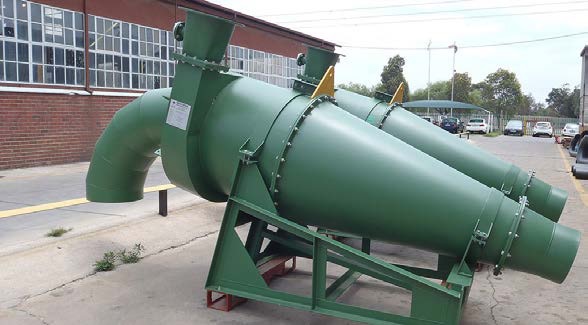
Multotec’s dense medium cyclones are the equipment of choice for coal preparation, iron ore upgrading, and the pre-concentration of diamonds, metalliferous, and industrial minerals.
At the South African-hosted 21st International Coal Preparation Congress (ICPC 2025) last year, the foremost international event for researchers and industry leaders in the coal preparation industry, Frikkie Enslin, Product Manager for Cyclones at Multotec; and Ernst Bekker, the company’s Cyclones Process Equipment Specialist in South Africa, presented a paper about South Africa’s role in advancing dense medium separation (DMS) technologies for the coal industry.
Entitled ‘Beyond Bessemer: the past, present, and future of dense medium separation in the coal industry’, the paper traces the development and evolution of DMS equipment in the coal industry, beginning with Sir Henry Bessemer's 1858 patent.
“This conference makes one appreciate the fact that we still need coal, and while many of those who need to hear this don't attend, it's a good networking opportunity to share future trends and identify core priorities for today’s coal industry, bringing people up to speed in terms of the latest developments,“ begins Multotec’s Ernst Bekker.
Bessemer holds many patents in his name, including a lesser-known invention for a gravity-based process to concentrate minerals. “In his laboratory, Bessemer noticed that he could manipulate the density of a liquid to control which particles float and which sink. As metallurgists, we are manipulators of natural properties, and his observation has assisted us for over 150 years in becoming better and better manipulators of dense media technologies for coal separation,” he adds.
Early coal separation technologies
In the early days, coal separation relied on handpicking, where workers, often young boys, would stand beside a table or a slow-moving belt and physically remove rocks, shale, and other impurities from lumps of coal on the line. With declining ore grades, smaller liberation sizes, shifts in economic scales, and new technologies, however, hand sorting quickly fell out of practice.
An early technology was simple jigging, in which a coal-and-rock mix in a basket was submerged in water and then shaken up and down. Higher-density material sinks faster than the lower-density coal, causing the coal to migrate to the top and the heavy impurities to the bottom of the heap.
“More sophisticated jig washers are still a popular choice for coal beneficiation today, because of their relative simplicity and low operational costs. They are more efficient in treating coarser particle sizes, though, and liberation plays a major role in raising separation efficiency,” notes Frikkie Enslin.
During the operation of early forms of jig washers, it was observed that a concentration of fine-grained heavy minerals formed a semi-stable suspension that behaved like a heavy fluid, causing low-density material to float, regardless of particle size.
“This observation led to the deliberate inclusion of semi-suspended fines in the water used in jig washers. The concept was further developed with the introduction of trough-and-cone washers, eventually leading to the emergence of the first commercial dense-medium washing process, known as the Chance process or ‘sand flotation process of coal washing’,” Enslin explains.
Chance's separator paved the way for the development of other processes using different separating media, such as the Conklin process using fine magnetite and water, the de Vooys process employing finely ground barite (BaSO4) and loess (fine-grained silt), and the Wuensch process that used natural fine clay and slate. “In addition to these processes, attempts were made to commercialise the use of saturated salts and organic liquids as dense media, such as a saturated solution of calcium chloride (the Lessing process), and chlorinated hydrocarbons (the DuPont process).
In the early 1930s, significant developments in dense medium technology took place in the Netherlands, with the enhancement of De Vooy’s process into the renowned Barvoys’ process, and the introduction of new methods by Tromp that used finely ground magnetite or pyrite. “The breakthrough in modern dense medium separation came from the work of Staatsmijnen in Linburg, where the first dense medium separator was installed in a commercial plant in 1937, sparking global interest in DMS methods.
Developed in the mid-1900s, a key South African DMS invention was the Norwalt Washer, a bath-type washer with the feed introduced into the middle of the vessel. The bath was fitted with stirring arms, which whisked the floats off to the edge of the vessel whilst the sinks collected at the bottom. Scrapers at the bottom transport the sinks to an exit point into a sealed elevator that continuously removes the discarded material. “These are no longer used, but they were quite popular from the 1950s to the 1970s. So we in South Africa have long had clever people making significant contributions to global DMS development,” Ernst Bekker points out.
“I've never seen one, but the literature and the people I spoke to suggest that this development pushed the boundaries of efficiency with respect to dense medium recovery efficiency and energy consumption,” says Enslin.
“Today, we still use ground magnetite to make a dense medium. For coal, because we cut at a relatively low density, magnetite is ideal. For other higher-density minerals, such as diamonds and iron ore, we use ferrosilicon (FeSi),” he notes.
“Within each dense media type, there are also different grades based on their particle size distributions and shape. Magnetite can have a fine, medium, or coarse particle distribution, which can each be chosen to optimise cut points to best suit the composition of the coal being cleaned,” he explains.
The dense medium cyclone (DMC)
According to popular accounts, the DMC was first identified around 1939 by the Dutch State Mines (DSM) in the Netherlands, when a hydrocyclone used to process loess in a dense medium circuit for coal cleaning became clogged. During cleaning, a significant amount of clean coal was found in the vortex finder, indicating that it was being concentrated in the cyclone's overflow, prompting further research and development that culminated in DSM's patenting of its DMC in 1942.
DSM established a subsidiary, Stamicarbon, which licensed the technology along with a design manual for its licensees, the DSM bible. “Despite improvements over the years, a modern DSM cyclone still looks very similar to the original design published in the DSM bible,” says Enslin.
Despite the many DMS technologies now on the market, he continues, the humble dense medium cyclone is still the technology of choice in the vast majority of coal-handling and processing plants. Enslin quotes Tim Napier-Munn, the minerals engineer, professor and author of Statistics for Mineral Engineers, who said: “It is difficult to see a serious competitor for the DMC in the foreseeable future in the processing of bulk commodities such as coal and iron ore.”
Napier-Munn’s reasons include:
- Efficient separations at a specific density.
- The wide particle size that can be treated.
- High tonnage throughput for a relatively small footprint.
- A mature technology with relatively straightforward operation.
With larger DMS cyclones up to 1.45 m in diameter now available to efficiently wash coarser coal particles, the need for DMS baths is also waning, notes Enslin.
Fines separation and SA’s contribution
“Back in 1949, under PJ van der Walt at the Fuel Research Institute of South Africa, we were one of the very first countries to investigate fines separation using DMCs, and we still have some of these original fines DMC plants in South Africa today. As a result of this work, we can get higher efficiencies from DMS separation than any other conventional fines processing technology,” Enslin tells MCA.
“South Africa’s coal has a notoriously high ash content, along with high percentages of near-density material in the mix. So, despite the high efficiency of DMS processes in general, the finely dispersed mineral particles in our coal require us to constantly weigh separation efficiency against the economic value of recovering the fines.
“Coal mining regions in South Africa, India, China and certain parts of Australia tend to mine coal seams inevitably with rock mixed in. To liberate the coal particles, we crush the rock to break it apart and release the coal. At this point, we have lumps of coal and lumps of rock, and that's where the dense medium separation comes in.
But with our coal, we often need to crush it finer to achieve the required liberation, typically to a size fraction +1.0 mm,” he explains.
“For many years, our dense medium cyclones have been suitable for use to separate particle size fractions down to +2.0 mm. To further improve efficiency, the -2.0 mm discards would be sent to spirals, teeter-bed/fluidised-bed separators, or similar units for further beneficiation. But we have discovered that even this fine fraction can be processed using a dense-medium cyclone. It does present challenges on the plant design side, but we have proved that it is possible,” adds Frikkie Enslin.
“Multotec continues to play a leading global role in advancing DMC technology, building increasingly efficient plants that can treat fine fraction material. So instead of sending fines through an additional separation process, such as spirals, the dense medium cyclone plant can deliver higher efficiency fines separation directly,” says Bekker.
“And while dense-medium cyclone plants are expensive to build and magnetite is costly, the value of the fine size fraction often makes dense-medium separation a cost- and resource-efficient way to go, particularly for the coal ore bodies we have in the southern hemisphere,” he concludes.
A key takeaway, according to Bekker, is that although dense medium cyclone design has remained largely unchanged over the years, our understanding of the separating mechanism and the interaction between the cyclone and the overall process has improved. This understanding is helping to provide better recommendations for selecting cyclone units and the overall process, benefiting clients.
This understanding also helps determine where dense medium separation is the best option and where other separation processes could be more economical, which can only be done by understanding the advantages and limitations of dense medium cyclones and the dense medium separation process.