Cora Gold Limited, the West African focused gold company, has commenced drilling at the highly prospective Madina Foulbé Permit, located in eastern Senegal within the prolific Kedougou-Kenieba Inlier gold region, which historically has seen over 50-million ounces of gold discovered.
Bert Monro, CEO of Cora Gold, says, “Located in one of the most prolific gold regions in Africa, we are very excited to be drilling at Madina Foulbé. Historical and more recent exploration results have given our team on the ground confidence ahead of undertaking the drilling campaign – the first time Cora has drilled this permit. We look forward to updating shareholders with progress on the drilling campaign in due course. Furthermore, we will be keeping costs and our carbon footprint down at the camp having installed a small solar hybrid power system, which we plan to roll out across our other camps in the future.
“Following the announcement dated 25 March 2020, the company remains cognisant of Covid-19; we are continuing exploration programmes, at this time, but have adapted our operations appropriately.”
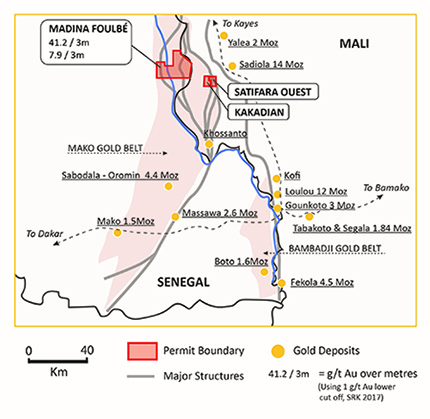
The company holds three permits encompassing 317 km² within the Diangounte Project Area in western Mali / eastern Senegal, within the Kedougou-Kenieba Inlier (also known as the Kenieba Window), which historically has seen over 50-million ounces of gold discovered.
The Madina Foulbé Permit in eastern Senegal, one of the three permits, encompasses an area of 260 km² and has been subject to early stage exploration by its former owners, including regional soil geochemistry and about 1 750 m of shallow, reconnaissance, RAB drilling using a lightweight drill. The results of that work have led Cora to identify two priority targets:
- Tambor – prospect underlain by a granite with intensely developed sheeted quartz veins, over which a large soil geochemical anomaly extends 2 500m by 500 m (threshold >50 ppb Au). Previous RAB drilling on wide spaced fences, comprising 59 mainly vertical holes and completed to a vertical depth of only 12 m to 15 m due to the hardness of the granite, identified structures with potential widths ranging up to 300 m. Strong anomalous gold values (>100 ppb Au) were recorded from most of the holes, including 41,2 g/t Au over 3m and 7,9 g/t Au over 3 m.
- Madina – prospect underlain by a shear zone between granites and volcanic rocks and is outlined by a soil geochemical anomaly extending 2 000 m by 400 m (>50 ppb Au). 45 shallow, vertical, reconnaissance RAB drill holes, all with depths of less than 21 m, were completed over the central 600 m of the prospect on broadly spaced fences. Broad zones of anomalous gold values were returned (>100 ppb Au), which included 3 m at 1,9 g/t Au and 3m at 1,6 g/t Au.
The company considers that the indication of broad zones of gold mineralisation within a large soil geochemical anomaly is highly significant and believes that the shallow vertical drilling into vertical structures failed to properly test the gold potential. Accordingly, it has commenced a 2 000 m RC drill programme to test mineralisation at depth. Drilling should be completed during April 2020 with results expected in Q2 2020.
To power the camp at the permit, the company has installed a mobile solar hybrid power operation; solar panels will charge batteries in the day to power the camp from 10pm-5am when there is a lighter power requirement.
The project has around a three-month payback period offering both a cost and CO2 saving. This is the company’s first unit, but it plans to roll out similar units across all its exploration camps in time once the trial has been successfully run for this drill campaign. This is a small but important step in the way the company operates and, as it looks to grow significantly in the future, it is the outlook it would take on running larger operations.