Steenkampskraal Monazite Mine (SMM) recently held a ceremonial soil-turning event to mark the official start of construction on its new monazite processing plant.
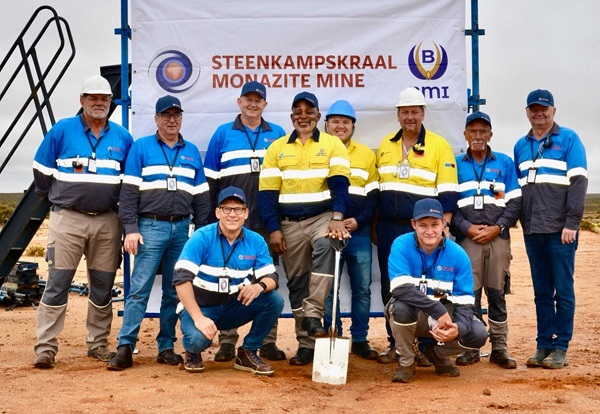
The milestone advances the mine’s phased development plan and positions South Africa to become a producer of high-grade monazite concentrate, a critical feedstock for rare earth elements essential to renewable energy, electronics, medical and defense technologies amongst numerous others.
The announcement builds on recent operational achievements at the site. SMM has successfully commissioned its on-site laboratory and, for the first time in more than 60 years, produced monazite concentrate from its metallurgical circuit.
“The initial product has demonstrated approximately 50% total rare earth oxide (TREO) content, confirming the high-grade nature of the deposit. In parallel, the mine’s hydrometallurgical laboratory circuit is currently undergoing optimisation. Early results have been encouraging, with production of mixed rare earth carbonate (MREC) and cracked thorium anticipated in the near term,” said Graham Soden, CEO of SMM.
The monazite processing plant facility, located close to the existing underground decline shaft exit, will receive monazite-rich ore directly via a purpose-built conveyor belt system. Ore will be transported from underground workings to the surface plant for initial concentration using a proven gravity separation and flotation technology.
The monazite processing plant has been designed to achieve an annual steady-state output of approximately 13 400 tonnes per annum of monazite concentrate containing more than 50% total rare earth oxides (TREO). During the initial ramp-up period, production will start at around 6 600 tonnes per annum, increasing to full capacity toward the end of the first year, Soden said.
“This phase will use proven gravity separation and flotation technology, optimised through modern refinements and pilot testing by the Saskatchewan Research Council and Mintek. The process flow draws on the successful methods used during Anglo American’s historic operations at Steenkampskraal between 1952 and 1963. It has been adapted for modern environmental standards and incorporates a multi-gravity separation circuit, currently under evaluation for enhanced recovery efficiency.
“The processing plant will receive feedstock from both historic surface stockpiles and underground ore, minimising initial capital expenditure and operational risk. This approach provides early revenue generation while refurbishment of underground infrastructure continues in parallel. The design also includes a front-end comminution and milling circuit, ensuring consistent feed quality to the concentrator and allowing for optimal grade control.
“Phase 1 forms the foundation for subsequent processing stages, including hydrometallurgical treatment, oxide separation and product manufacturing, all of which will be undertaken within South Africa to maximise local beneficiation and value retention,” Soden said.
SMM Executive Chairperson Prof Enock Mathebula added: “This phase represents the practical realisation of our strategy to re-establish Steenkampskraal as a globally significant source of rare earth materials.
“We are leveraging proven metallurgical processes, supported by modern technology and strong compliance standards, to ensure a sustainable and efficient operation that benefits both the national economy and local communities.
“The soil-turning event is more than a construction milestone, it is the foundation of Steenkampskraal’s commercial future. By establishing dedicated ore transport and processing infrastructure, we are creating South Africa’s first dedicated monazite concentration facility. This concentrate represents our initial revenue-generating product and will serve as feedstock for subsequent value-adding stages, including mixed rare earth carbonate and thorium production.
“The soil-turning demonstrates our commitment to rapid, responsible development. With funding secured and construction now underway, we are on track to establish a revenue-generating process before the end of 2026. This will not only generate early cash flow but also create jobs, support local communities and contribute to South Africa’s critical minerals strategy. Offtake discussions for the concentrate are already advanced with international partners.
“The Steenkampskraal deposit is recognised as one of the highest-grade rare earth and thorium resources globally, with a NI 43-101 compliant current resource of 665,000 tonnes at 14.5% TREO and significant co-products including thorium (2.14%). The spade-ready project benefits from fully developed underground and surface infrastructure, full regulatory licensing and an experienced mining partner, Bora Mining Investments (BMI),” Prof Mathebula added.
“SMM remains committed to sustainable practices, including environmental rehabilitation, community skills development and compliance with all nuclear and environmental regulations,” he concluded.
About Steenkampskraal Monazite Mine (SMM)
Steenkampskraal Monazite Mine, located in the Western Cape, is a spade-ready rare earth and thorium project owned by Steenkampskraal Holdings in partnership with Bora Mining Investments. With one of the world’s highest-grade monazite deposits, SMM is advancing a phased development plan to produce monazite concentrate, mixed rare earth carbonates, thorium, and ultimately separated rare earth oxides. The project is fully permitted and poised to play a strategic role in global critical minerals supply chains.