Working next to the main haulroad of a well-known iron ore mine and sequencing construction activity around its blasting programme are just two of the challenges Murray & Roberts Infrastructure has to overcome on one of its current contracts.
However, this leading South African construction company, which forms part of Murray & Roberts Construction, has ample experience working in mines’ ‘red zones’ in the Northern Cape. Since 2005, it has earned an enviable reputation for being able to deliver quality infrastructure in these demanding environments; this includes Kumba Sishen iron ore mine, where it has been involved on a number of projects.
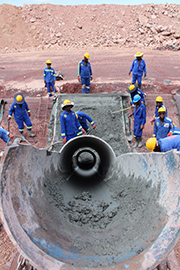
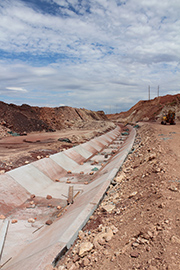
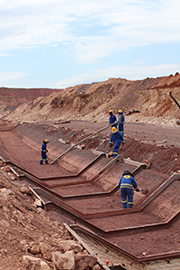
From left to right: A novel chute system has allowed the contractor to do away with a mobile crane and boost productivity; Bolstering resources on the site has seen the contractor exceed its initial production requirements; and The concrete-lined canal is 4,6 km long, with the width of its base varying between 2,0 to 3,0 m.
The latest contract at this mine is the relocation of a section of the G80 canal and its related infrastructure. This forms part of Kumba’s environmental management plan for Sishen, with the canal used to collect run-off surface water to be reused elsewhere in the operation.
Tiaan Krugel, contracts manager of Murray & Roberts Infrastructure, says the concrete-lined canal is 4,6 km long, with the width of its base varying between 2,0 m to 3,0 m. Connected to the build is a gravel road running alongside the canal over three newly-constructed cast in-situ culverts. A steel water pipeline is also being laid along the length of the canal.
Blasting at the mine takes place twice a week. When this happens, the contractor has to evacuate the site before 12:00, denting its production scheduling. “We initially planned to achieve a production target of 150 m a week. Although we were aware of the blasting scheduling when we tendered, it took us a bit longer to achieve the desired level of production,” says Krugel.
An additional 32 workers were introduced to the existing team to make up for lost time when blasting was done; a very effective strategy with production peaking at about 183 m/day.
Working next to the primary haulroad means that there is a lot of interfacing with the mine on this project, calling for careful planning. While processes such as these can be managed, the Murray & Roberts Infrastructure team also had to be prepared to think on its feet to cope with unforeseen events. Such an event occurred in January 2015 when a crack formed in the pit high wall alongside the canal and prevented further construction of the canal for approximately 950 m. The contractor only regained access to this portion in June.
Its ability to think outside of the box came to the fore again when it introduced a novel chute system to place concrete in sections of the drain that are deeper than 2,0 m and beyond the reach of a readymix truck. The polyvinyl chloride chute allows teams to dispense concrete directly from the truck, doing away with the need for a mobile crane and therefore boosting productivity.
Jerome Govender, executive chairman of Murray & Roberts Construction, says that work is expected to be completed shortly when the entire team will mobilise to another project to commence work on a new road construction project. He adds that given the position of the work in a mining environment, he is extremely pleased that the project’s safety performance has been excellent with zero lost time injuries experienced.