ACTOM, Africa’s largest manufacturer, repairer and distributor of electro-mechanical equipment, has completed the acquisition of JUEL Batteries, signalling its expansion into the lithium‑ion battery energy‑storage market.
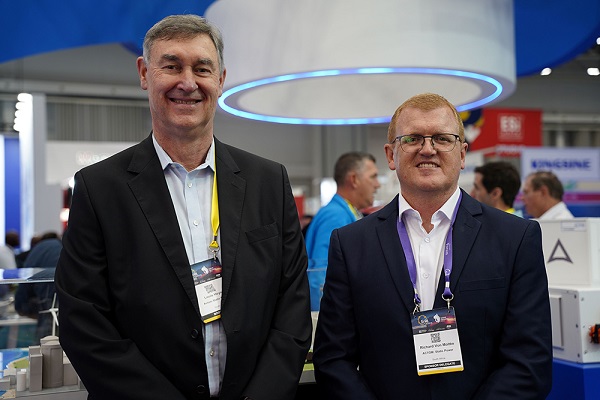
From left: Dr Louis Heins, Managing Director of ACTOM Static Energy and Richard von Moltke, General Manager of ACTOM Static Power.
Richard von Moltke, General Manager at Static Power (a division of ACTOM), explains that the company has operated in the battery sector for more than 56 years, with a primary focus on industrial lead-acid and nickel-cadmium (NiCd) technologies.
“For many decades, these technologies served the market well, but over the past five or six years, as lithium-ion entered the mainstream, it became clear that a major transition was underway, even within our industrial sector. Customers were moving away from traditional lead-acid and NiCd solutions, and we needed to evolve with that shift,” he explains.
“Recognising the need to stay competitive and support our existing business, we knew it was essential to introduce a lithium‑ion battery offering. This prompted an intensive evaluation process, during which JUEL Batteries (based in Johannesburg) quickly distinguished themselves. Their engineering discipline, rigour, and technical depth were clearly operating at a different level.”
Exceptional quality
He notes that JUEL Batteries’ products are exceptionally well‑designed, both mechanically and electrically, with their robustness, attention to detail and engineering integrity standing out in the market.
“Last year, they developed a solution tailored to our 110V industrial needs, and it immediately proved a strong fit for our existing standby‑power market. It supports the natural transition our customers are making from lead‑acid and NiCd to lithium,” von Moltke states.
Beyond that, we recognised a much larger opportunity to expand into the broader lithium-ion market, particularly the industrial and utility-scale battery energy storage (BESS) systems. In essence, this acquisition enables us to serve our traditional market more effectively and positions us for growth in the rapidly expanding energy-storage sector. It meets today’s needs and opens the door to tomorrow’s opportunities.
Following the acquisition, JUEL Batteries will be rebranded as ACTOM Static Energy, which will become an extension of ACTOM’s existing Static Power business unit.
ACTOM has already invested in additional manufacturing and assembly equipment, and the plant has been relocated to the ACTOM Power Transformers facility in Pretoria West. The site is well suited to this type of business, with heavy-duty infrastructure and state-of-the-art test facilities.
Boosting capacity
“The new equipment we’ve purchased will increase production capacity tenfold and provide additional space for future expansion, positioning us to scale quickly as demand grows. Over the long term, this will enable us to make a substantial impact on the South African market, both in standby power and in the rapidly expanding energy‑storage sector,” says von Moltke.
He notes that one of the major advantages of this acquisition is the increase in local content for battery energy‑storage solutions. Because less than 50% of the final battery value is imported, ACTOM’s exposure to exchange‑rate volatility will be significantly lower than that of fully assembled systems imported.
The acquisition also enables ACTOM Static Energy to participate across the full market spectrum – from residential systems to commercial and industrial (C&I) applications, with utility-scale solutions to follow.
“Beyond storage, the acquisition also strengthens our Static Power business by expanding our battery capabilities for standby applications, including large UPS systems. It is an extension of our current portfolio, enabling us to support both traditional standby needs and the fast-growing energy-storage market. In the broader energy-storage market, bankability is key. With ACTOM’s balance sheet and 123 years’ history in South Africa, ACTOM will provide the necessary comfort to our customers, whom we would rather refer to as energy partners,” von Moltke concludes.