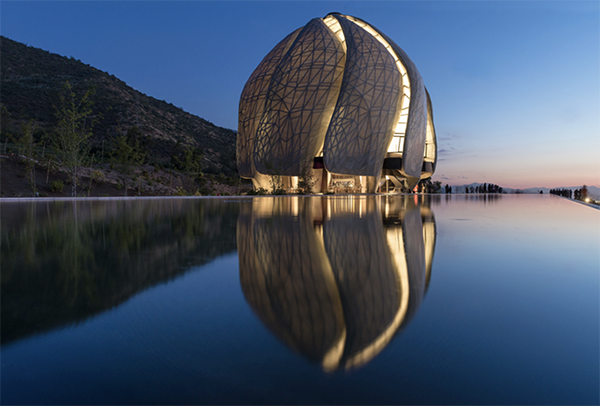
 The Santiago Bahá’í House of Worship in Chile uses architecture to highlight the importance of light in our lives. Set against the backdrop of the famous Andes Mountain range in the South American city of Santiago, Chile, the nine-sided marble house of worship commissioned by the Bahá’í community welcomes hundreds of thousands of visitors every year. These visitors can be split into two groups: Religious followers who are looking for a space to practice whatever faith they follow, and those who appreciate architecture and clever use of natural and artificial light.
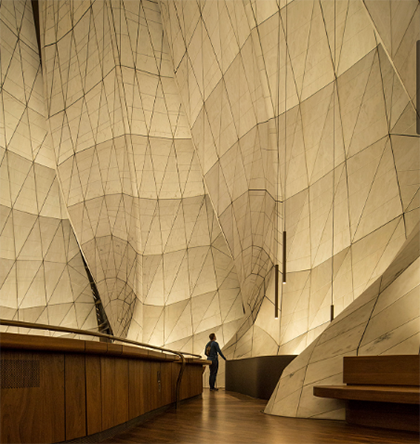 The temple measures 30m high and 30m in diameter, with opaque and clear glass covering the domed building. “We took the Bahá’í’s concept and transformed it into this magnificent house of worship,” explains architect Siamak Hariri from Hariri Pontarini Architects in Toronto, Canada. Speaking to archdaily.com, he says, “The Bahá’í community follows the concept of unity, that all the world’s religions are truly one and have a common aspect. Because of this, the plan was deceptively simple: A sacred circular structure. The vision began with the concept of light – to design a building that would become alive with light as if it were radiating from within.”
The lighting technology used within the temple is simple, explains the architect. “We opted for subtle lighting styles. This is a space of worship, so we have used toned-down lighting systems that add to the openness of the main atrium space.” The temple seats just 600 people, with delicate chandeliers lighting the central point of the temple floor. “Light is the embodiment of this community, so we have used diffused-light chandeliers that provide more of a glow than direct light,” explains Hariri. “We opted for recessed downlights with a warm colour temperature for a more cosy, united sense of being. The mezzanine level is low to the main floor, so we installed LED light fittings that provide enough light for worshippers and guests while also not being too hot. The temple was designed and built to feel open and give the feeling of ethereal peace, so we had to be intelligent with our use of illumination.”
One of the mandates when the temple was commissioned was that it be built to last at least 400 years, which Hariri says “provided its own set of problems. Santiago sits on an earthquake hotspot, so we spent a lot of time investigating new technology and building principles when designing the temple. In doing that, we found new ways to use light during the day and at night”. When the sun sets, warm white tones light up the temple from the inside, giving visitors a gorgeous façade to look at from the temple-side peace pool.
“The arches that make up the dome appear like sails thanks to the curved steel and aluminium superstructure. We then used a combination of glass textures, depths and finishing styles to complete what some people refer to as the ‘petals’. These are the primary source of sunlight during the day.”
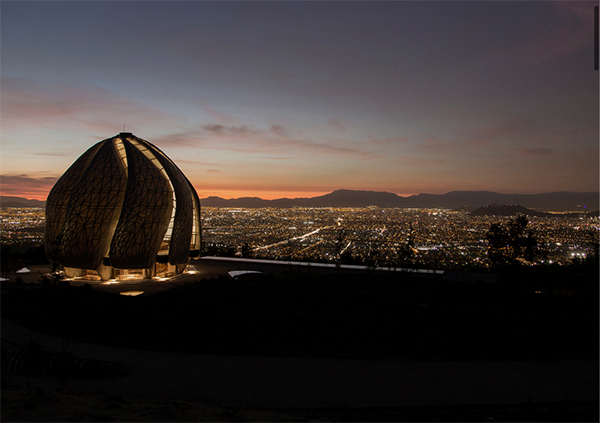
Then at night, when the interior’s lights are switched on, these petals are illuminated with the most delicate of warm hues. This is set against the dark backdrop of the mountainside behind the temple, and it can be seen from across the city,” adds the architect.
Each of the nine wings consists of more than 1 120 individual pieces of glass. “We were originally going to use alabaster as the cladding material on the temple, but there were significant issues when we tested the material against the environmental demands of the region. We went on a four-year journey with glass artisan Jeff Goodman from Toronto to develop a new type of glass cladding. We now have a glass that is imbued with subtle variations in translucency, which creates a truly amazing display when artificial light is shone through it,” says Hariri, concluding, “This is a project that comes along once in a lifetime, and I think that we have created a space of reflection where guests can find both a renewed sense of spiritualism and a new source of ‘light’ and inspiration in their world.”