Hazardous area or explosion proof lighting is one of the most challenging sectors in the lighting industry. Often requiring the ability to perform in extremely harsh environments, safety is paramount. Consequently the sector is relatively slow to adapt to new technologies and use of rigorously tested, and proven, products is necessary.
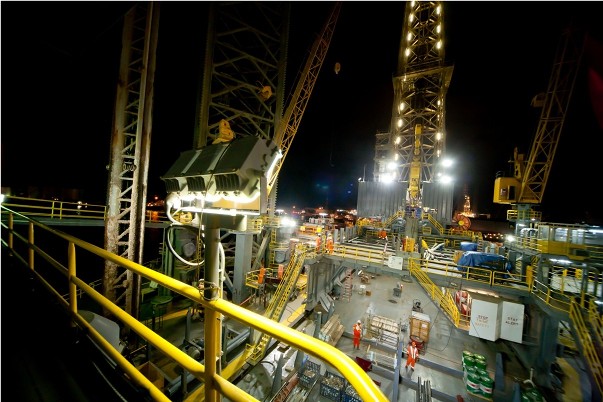
Hazardous area lighting gives you safe illumination in areas where conventional lighting products cannot be used, either due to safety concerns or a lack of access for maintenance. Common applications include:
• Zone 0 lighting in areas at high risk of explosion.
• Outdoor lighting for docks, oil rigs and other exposed locations.
• Signal lighting for heli pads and bulkheads.
• Inspection lighting for tanks and enclosed areas.
• Emergency lighting for fire exits and escape routes.
Other applications take advantage of hazardous area lighting for its wide range of operating conditions, for example, in locations that experience a high temperature range or frequent sub-zero weather.
Source lumens vs. delivered lumens
When selecting a luminaire for use in a hazardous area, there are lots of different factors to consider. The lumen output (or power) of the luminaire is one of these important considerations. But are all lumen output figures comparable?
Source lumens: The ‘source lumens’ value is the total amount of light the luminaire emits at source, before it is transmitted through any lens or diffuser. Lumens are lost with every reflection, refraction or absorption through each material the light passes through, resulting in the value of ‘delivered lumens’ being less than the stated, emitted figure. The output can also be blocked or dispersed due to the luminaire’s mechanical build interrupting the light flow, particularly at the extremities of the beam angle.
Delivered lumens: ‘Delivered lumens’ is the most accurate measure of how the luminaire will perform once installed. It is the actual amount of light delivered on scene, taking into account all barriers such as lenses, housing, and any filtering effects.
Which figure is used by hazardous area lighting manufacturers?
There is a large degree of uncertainty when comparing lumen output figures from different manufacturers. The ‘delivered’ value is considered the more equitable figure to use, but with no official standard to follow, there is nothing to say that this is the value all manufacturers are using. Identifying which figure is being used can often be very unclear and difficult to identify. This is especially true if photometric files (which give a true reflection of performance) are not readily available. Imagine the scenario; you are specifying lighting for a project and are choosing between two luminaires from different manufacturers. Unbeknownst to you, each manufacturer has calculated the lumen output value in different ways; luminaire A is using ‘source lumens’ and luminaire B is using ‘delivered lumens’. On paper, the performance of two luminaires may seem similar, but the reality is likely to be very different. As a customer, do you query the ‘delivered lumens’ figure when purchasing a luminaire?
Cold storage and freezing rooms
The struggle between light and cold is an on-going issue in the cold storage industry. Since fluorescent lighting does not perform well in cold conditions, businesses have had to install a greater number of low-efficiency luminaires in order to comply with lighting needs. Going forward, LED lighting, which thrives in such environments, is the solution. Temperatures in cold stores range from 0 to 15 degrees while freezing rooms can go as low as -40 degrees Celsius. Therefore, lamps, operating gear and luminaires need to meet higher requirements for operating conditions. With conventional luminaires fitted with HID and HPS light sources, energy consumption is high, as is the heat production.
Also, lamp shifts are frequent, start-up times are long and hence sensor control systems are less suitable. LED light sources, on the other hand, consume less energy, need no lamp replacement, produce less heat and ignite immediately. They also lose less light compared to many conventional light sources. Finally, the low ambient temperature increases LED light source and operating gear lifetimes significantly. With LEDs, lighting quality is no longer compromised, it is enhanced. Standard illuminance requirements in cold stores are low, but more light would make labels and storage documents easier to read. Luminaires in damp areas need a high IP rating and should be maintenance-friendly.
Chemical facilities
Chemical engineering facilities provide particularly harsh environments and a variety of work tasks. High temperatures, dusty environments and the presence of damaging gases may pose challenges to the lighting installation. Chemical processes are often fully automated and require constant surveillance. A proper vertical illumination is therefore needed for monitoring. Where screens are present, care should be taken to avoid unwanted glare and reflections. Illuminance requirements vary with the presence of people. Remote-controlled facilities require less light than constantly manned workplaces. In areas where substances are mixed, grinded or pulverised, luminaires need to be dust-protected. Open containers need to be well illuminated. Some facilities may involve explosive substances, whereby explosion-protected luminaires are needed. Where soiling is prevalent, enclosed luminaires are needed. Such luminaires offer long-term protection and are resistant to dust, moisture, chemicals, mechanical stresses and extreme ambient temperatures. Nevertheless, the plastic materials used
in the enclosures have varying chemical resistance and should fit the application. One should also take care that the gases present do not reduce the lifetime of LED light sources. This is mitigated by selecting durable LED and control gear components. Linear luminaire systems are suited for ceiling heights up to 15 m. Above 6 m, high-bay luminaires with narrow or medium beam reflectors are an alternative. Where the general lighting is not enough to aid the task at hand, dimmable workplace luminaires give extra illuminance.
Identifying hazardous areas
A hazardous area can be defined as any location where there is risk of an explosion. But every hazardous area is different and each has specific requirements depending on the nature of the atmosphere and the elements that are present. Fundamentally, for an explosion to take place, flammable or explosive gases, vapours, mists or dusts will be present. Then, the level of risk of an explosion is based on the frequency and duration of the occurrence of an explosive atmosphere. This level of risk is represented by classifying the hazardous area as Zone 0, Zone 1 or Zone 2 (for gas, vapour and mist atmospheres) or Zone 21 or Zone 22 for dust atmospheres. Below we will look at what defines Zone 0, Zone 1 and Zone 2 hazardous area classifications and the considerations for specifying lighting into each area. But first, we must consider what is likely to cause an explosion in the first place. There are three necessary components for an explosion to occur;
- Flammable Substance – this needs to be present in a relatively high quantity to produce an explosive mixture (e.g. gas, vapours, mists and dusts).
- Oxygen – oxygen is required in high quantities and in combination with the flammable substance to produce an explosive atmosphere.
- Ignition Source – a spark or high heat must also be present.
Where there is potential for an explosive atmosphere, special precautions are needed to prevent fires and explosions. Electronic equipment, including lighting, needs to be purpose designed for use in hazardous areas to prevent a spark occurring and igniting any flammable substances. Although every application is different, for the ease of monitoring and specification each hazardous area is classified as a particular level or “zone”. As a result, all hazardous area equipment must be designed with hazardous area zone classifications in mind, as the “zone” governs the level of protection and precaution required. It is essential to know which zone you are working in, so that you can specify the most appropriate equipment. For gases, vapours and mists the zone classifications are recognised as Zone 0, Zone 1 and Zone 2 areas.
* Zone 0 is an area in which an explosive atmosphere is present continuously for long periods of time or will frequently occur.
* Zone 1 is an area in which an explosive atmosphere is likely to occur occasionally in normal operation. It may exist because of repair, maintenance operations, or leakage.
* Zone 2 is a place in which an explosive atmosphere is not likely to occur in normal operation but, if it does occur, will persist for a short period only. These areas only become hazardous in case of an accident or some unusual operating condition.