LEDs need less energy; that is a fact. When updated to LED, street lighting bills go down by 50%-70% and, as the price and quality of LED lighting continues to improve, costs will lower. At the same time, smart lighting has been recognised as one of the most actionable and ready-to-implement technologies for cities to transition to a low-carbon economy and peak emissions in the next decade.
Lamp posts are the ideal infrastructure for mounting smart city systems. When used for networking and monitoring, they become a sensor platform, growing efficiency even further and providing vital data for myriad urban solutions.
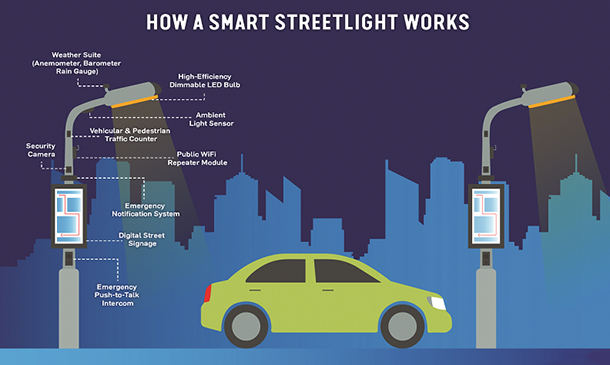
Remote on-off control, dimming, and scheduling functions are quick wins of connected street lighting, with a massive impact on energy savings and maintenance, and can be achieved through low-cost connectivity such as PLC or RF Mesh. More advanced lighting features, such as colour controls, adaptive lighting, and emergency response, require faster and more secure cellular networks.
Cellular networks allow for more robust and faster connections with lower latency, which would be needed for more critical smart city solutions. Smart street lighting with 4G LTE and 5G can provide a platform for Wi-Fi, HD Video streaming, gunshot detection, air quality monitoring, traffic management, and smart parking.
Smart street lighting as a platform
Public lighting represents one of the most commendable powered grids spread across towns and cities throughout the globe. It is the nervous system of a city, connecting over 360 million streetlights worldwide with access to power.
No wonder it is becoming a sought-after asset of the city, enabling an IoT platform that can serve many current and future urban solutions – investing now in LED lighting makes a sound move for any city aspiring to become smart. The implementation pays for itself thanks to energy and efficiency savings the new lamps generate and the benefits for increasing citizens’ security, efficiency, reductions in GHG emissions, and general well-being.
Some of the solutions that can currently be deployed together with smart street lighting upgrade include:
- Broadband connectivity.
- Traffic light controls.
- Traffic management.
- Smart parking.
- Electric vehicle charging stations.
- Air quality and noise monitoring.
- Public safety through HD video.
- Pedestrian footfall sensing.
Cities with smart street lighting
Barcelona: Barcelona published its first Lighting Masterplan in 2012, which included the use of smart LED lamp posts. The city is currently undertaking the installation of 10 000 LED streetlights across all districts. The lights contain sensors that detect movement and dim to save energy when no one is around. The smart lamp posts are remotely managed, provide free Wi-Fi across the city, and collect air and noise pollution data.
Copenhagen: The city’s lighting master plan was approved in 2014 and has implemented 20 000 LED streetlights through which it has improved energy efficiency with savings of approximately 65%. Through remote lighting management and control, the lights are dimmed when not needed and increase their strength, providing added safety when cyclists or pedestrians pass by.
Chicago: This city launched its smart lighting program in 2017 and is projected to install 270 000 LED streetlights over four years. Chicago estimates that it will save around $10 million each year. The higher quality light provided by LED technology will improve visibility and safety. The project includes a monitoring and control system that will improve maintenance, with real-time updates when outages occur.
London: The City of London, known as the Square Mile, is in the heart of Greater London UK. It is a world-leading centre for business yet its narrow streets and tall buildings make it difficult to have connectivity. The city chose to create a low spectrum RF mesh network, where each lamp post is connected through an IP and acts as a node. The conversion of around 12 500 streetlights to LED by the end of 2020 is expected to result in energy savings of at least 70% and reduced CO2 emissions and maintenance costs.
In summary, with energy usage is expected to grow by 35% in 2030, and with lighting accounting for 19% of total global usage and 30-50% of a city’s energy bill, smart street lighting represents an excellent opportunity for improvement. By reducing the need for energy, we lower our impact over the environment and climate change.
By having efficient management and maintenance of street lighting, and together with security applications, such as noise, pedestrian, gunshot detection, and HD video, streets become safer, and cities can lower their crime rates.
Applications such as traffic management and smart parking can lower congestion, adding even more to a city’s sustainability. All and all, smart street lighting offers advantages from day one, and we will see more of these networks deployed in cities around the world.