To help ensure reliability of renewable South African energy, thyssenkrupp Industrial Solutions (tkIS) has signed an MoU with Wismut to deliver Renewable Underground Pumped Hydroelectric Energy Storage (RUPHES) projects in depleted South African gold mines.
Following the successful court judgement against NERSA, industrial consumers will be paying R 1.28/kWh for electricity by April 2021. Consumers may be wondering why they should pay this in South Africa, a country that has abundant, world-class renewable resources.
These abundant renewable resources should translate into cheap renewable power. Actual agreed energy tariff with IPPs in 2016 were at R0.62/kWh for new solar and wind and current reports are that renewable energy tariffs could drop further to R0.40/kWh.
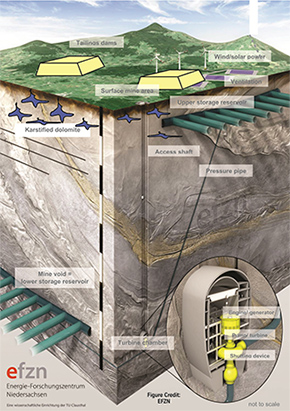
The challenge with renewables is ensuring reliability. For this customers need energy storage. Converting renewables to synthetic fuels provides a level of back-up and is likely to be part of the energy mix, specifically for green synthetic aviation fuel or heavy haulage trucks. The round-trip efficiency for conversion of electricity to hydrogen and then to back electricity, is only at around 30%, however. If using batteries or pump storage technologies, however, the round-trip efficiency is up at 80%.
Pumped storage plants last for 50 years plus, however, and the technology tried and tested, while equivalently priced batteries of lower maximum capacity have proved to last for less than 10 years.
Renewable underground pumped hydroelectric energy storage (RUPHES)
While South Africa is endowed with cheap and abundant renewable resources, the country also has the capacity for extensive underground pumped energy storage in its gold mines, many of which are either depleted or approaching end-of-life.
Gold mines are perfect for underground pumped energy storage for a number of reasons, including:
- The hard rock provides a stable geology and keeps stored water clean.
- Many gold mines are below water-rich karst aquifers that supply clean water to the mine below.
- South African gold mines are some of the deepest mines in the world, up to four kilometres deep, which allows more energy storage per unit of water.
- The gold mined in the past has already fully paid for the excavation of a large underground void space needed to store water, significantly reducing construction costs.
Building on extensive work that Professor Frank Winde undertook with a consortium including South African and other German research organisations in 2017, tkIS has signed a Memorandum of Understanding (MoU) with Wismut. When the work was originally undertaken, Winde was with the Mine Water Research Group, and he is now with Wismut in Germany.
This provides an opportunity for customers who wish to self-generate or to utilise an IPP to generate. tkIS with Wismut are now in the position to offer feasibility studies leading to full project execution for cheap reliable renewable energy. As an added benefit the revitalised mine with a RUPHES system is also able to provide clean water, indefinitely, to water scarce regions.
With power increasing to R1.28/kWh these projects present an attractive business case. tkIS has therefore engaged with IPPs and is looking to participate in the fifth Renewable Energy Independent Power Producer Procurement (REIPPP) programme.
This offers corporate partners the option to focus on their core businesses, allowing the IPP to invest in RUPHES self-generation, while benefitting from this image-enhancing environmentally friendly and sustainable technology.
- Image courtesy of EFZN.
Contacts: thyssenkrupp Industrial Solutions sub-Sahara Africa
Chemical Process Technologies Proposals
Guy Richards: senior proposal‘s engineer
Mobile: +27 060 972-9567
Landline: +27 11 236-1000
Email: info.tkissa@thyssenkrupp.com