Canyon Coal’s Khanye Colliery has achieved a major production milestone. The operation processed 204 480 tonnes in June, the highest ever processing plant throughput since the commencement of operations in January 2018. Group Project Manager at Menar Clifford Hallatt tells Munesu Shoko that this is indicative of the throughput ramp-up, which has been a gradual process to date.
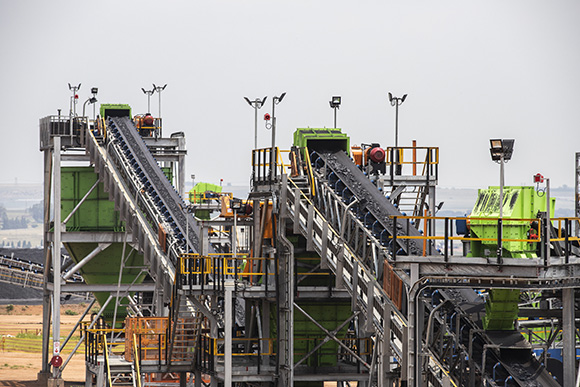
Despite the tough operational conditions imposed by the COVID-19 pandemic, Khanye Colliery posted its record plant throughput in June this year. The monthly processing plant throughput of 204 480 tonnes (t) surpassed the previous highest throughput achieved in May 2020, where the plant washed 186 342 t. This is part of the throughput ramp-up process, following the commissioning of the 400 tph large coal dense medium separator (Larcodems) plant at the start of 2019.
Commenting on the achievement in the face of the tough operating climate perpetrated by the COVID-19 pandemic, Hallatt tells Modern Mining that the experience and dedication of the on-site management team ensured that downtime and production losses were kept to a minimum.
“In addition, the mine received exemption from the Department of Minerals & Energy shortly after the announcement of the national lockdown. This aided in minimising the effects of the pandemic on production,” says Hallatt.
In terms of its health and safety protocols, Hallatt says the company was quick to draft a comprehensive policy in response to the COVID-19 pandemic. “Standard Operating Procedures were designed to execute the policy. It was communicated to all staff who fully cooperated,” he says.
“Employees were trained on COVID-19 response protocols, including screening during working hours, and they are complying. Non-compliance constitutes a work place offence. The company also provides all employees with masks and sanitisers. We monitor the situation on a daily basis. We encourage transparency and accountability at all times,” he explains.
Hallatt is proud of the fact that Canyon Coal has been able to keep its opencast mines fully operational, notwithstanding the economic shocks associated with the pandemic.
Flagship operation
Khanye Colliery is Canyon Coal’s flagship mine located in Bronkhorstspruit, Gauteng, South Africa. The mine is situated on the Wachtenbietjeskop 506 JR farm, approximately 10 km east of the town of Bronkhorstspruit.
The mine falls within the Magisterial District of Tshwane. Geologically the area is located within isolated sedimentary basins on the north-western border of the Witbank Coalfield.
Khanye commenced mining in January 2018 and is an open-pit, truck and shovel operation. The remaining Life of Mine (LoM) is 14 years at an annual Run of Mine (ROM) production target of 2,4-million tonnes per annum (Mtpa).
The mine has two processing plants, a smaller interim 110 tph DMS processing plant, and the newly built 400 tph Larcodems plant commissioned at the start of 2019. The coal is processed to the required standards, predominantly for the export market and some essential services clients domestically.
Canyon acquired the Khanye project in 2013 from a private party but it was only in December 2017 that the first boxcut was established. The mine produced its first coal for the export market in May 2018 with the ROM product being washed in a 110 tph interim DMS processing plant, which remains in use.
The permanent plant, commissioned early last year, utilises a large coal dense medium separator, with provision having been made in the plant design for a second unit to be added at a later stage. This technology was originally developed by the National Coal Board in the UK and is now well established in South Africa, having been installed at a number of coal mines. In essence, it replaces the more conventional drum and cyclone arrangement and can handle a single feed from 2 mm to 100 mm. It is particularly well suited to coal, which is slightly more brittle than usual – which is the case at Khanye.
The product destined to the export market is transported to the Bronkhorstspruit siding with road haul trucks and loaded onto trains for export via predominantly Richards Bay Coal Terminal. Initially, the product from Khanye was railed from the Forfar siding located about 26 km from the mine but Canyon Coal invested in the upgrade of the Bronkhorspruit siding, just 8 km from the mine, which was commissioned in mid-2019.
View on tech
COVID-19 has forced businesses to re-think and do things differently. For the mining industry, many believe that the pandemic reinforces the business case for mines to embrace intelligent mining through investments in technology modernisation.
Hallatt is of the view that the required technologies and supporting guidelines are still at an infancy stage, especially in South Africa. If this technology was readily in place, he says, the impact of COVID-19 on the mining industry would not have been as severe as it has been globally in recent months.
“We use technology optimally to improve safety and comply with the Department of Minerals and Energy’s safety protocols. For example, we recently procured a Collision Avoidance System (CAS) developed by Minetec Smart Mining, a technology company. The CAS is used in mining machines. After rigorous testing, the system was installed on our earthmoving equipment at Khanye,” he says.
The collision avoidance system prevents accidents by providing machine operators with early audio and visual warnings, when in close proximity to another machine or structure.
Key features of CAS include the ability to observe, detect and issue warnings to machine operators and sending notifications to field managers as well as control centres of existing problems. CAS provides substantial enhancement of the level of a driver’s awareness through its predictive detection system.
The installation follows Canyon Coal’s two years of seeking for a reliable and cost-effective CAS to get the most compatible system for its requirements. The Minetec System met Canyon Coal’s strict safety requirements following an extensive trialling period.
“A great deal of research & development is still required to see a transformation in the mining industry and the conventional mining methods being applied,” concludes Hallatt.