Greater collaboration and engagement among sector representatives, as well as wider training across the entire steel value chain in South Africa, can play a role in alleviating issues across the spectrum, including that of the availability of steel.
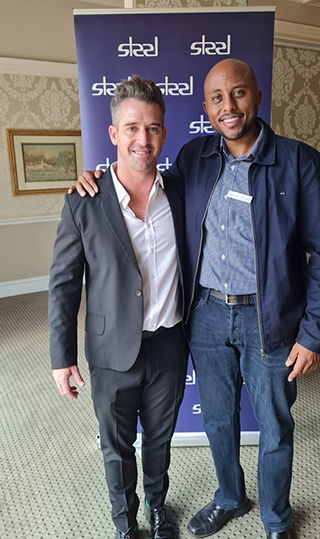 This was one of the themes of a recent industry breakfast networking session held in Johannesburg by the Southern African Institute of Steel Construction (SAISC).
The aim of the SAISC is to act as the custodian of the welfare of the steel value chain, promoting its usage and capabilities in the construction, manufacturing, mining and many other sectors; and to proactively promote the use of steel in current construction projects.
The importance of industry-wide discussion and communication
“We were enormously pleased to host this event and invite members across the steel sector to join the discussion, which included topics such as how we can all work together to sustain a stronger, greener and more effective local steel industry,” explains Amanuel Gebremeskel, the SAISC’s Chief Executive Officer (CEO).
“As the Institute, we have always taken pride in facilitating industry networking forums to promote greater communication, understanding, unity and diversity across the steel sector, thereby collaborating to solve common challenges and issues. One of the current major challenges, of course, is the availability of steel in South Africa, which is in fact not only a local but also a global issue.”
Gebremeskel opened his presentation with a brief overview of some of the challenges within the industry as they applied to specific sectors, before opening the floor to general discussion.
The critical importance of innovative research, training and ‘new thinking’
Gebremeskel highlights the importance of ongoing research and innovative ‘new thinking’ with a brief overview of new research from the United Kingdom’s University of Birmingham which offers the potential to reduce steelmaking carbon emissions by 90 percent, through devising a so-called ‘closed loop’ carbon recycling system as an adaptation for existing blast furnaces.
“This incredibly ground-breaking and exciting development - which entailed significant research - reflects the increasing importance of being able to develop a greener and more environmentally- friendly steel industry,” he notes.
“Education and training - as well as research - is critically important to ensure the future sustainability of the steel industry. In the same way that new research is able to change the chemical processes of steel-making, and to improve its environmental sustainability, so too is an increased focus on education and training - and communication. All these elements can change the outlook and prospects of the local steel industry for the better,” he enthuses.
Challenges posed to different sectors of the steel industry
Gebremeskel poses a series of challenges which he believes to be key to different sectors of the local steel industry, as follows:
- For suppliers and merchants: How best to deal with the quality of the steel material on offer, as well as the ‘internationalisation’ of the industry, and the need to follow business procedures as outlined by global parameters, specifications and compliance.
- For fabricators and erectors: How to include technical capability in the fabrication of steel as a value-add.
Gebremeskel also shared updates from the Institute on a number of different initiatives, including the relaunch of the Institute’s popular ‘Blue Book’ via a digital platform.
“Working on a digital platform will offer a more interactive resource, which will address some of the challenges experienced by different sectors of the industry,” he explains.
Early engagement with various potential stakeholders, both up and down the steel value chain, was an important topic raised by a number of delegates. It was noted that changing traditional, more linear ways of operating could play a significant role in dealing with the challenges posed by the availability of steel.