Rare earths developer, Rainbow Rare Earths has received confirmation that the Development Finance Corporation (DFC) will be the sole source of funding for the proposed $50 million investment by TechMet to acquire a direct equity stake in the Phalaborwa project.
A focus for the DFC is critical minerals, defined as those minerals that are essential to the economic or national security of the U.S. and which have a supply chain vulnerable to disruption. The DFC addresses critical mineral investment for the U.S. via its strategic stake in TechMet, which aims to assist in the development of world-class projects across the critical minerals supply chain. The projects identified by TechMet must be operated according to high standards of environmental, social and governance criteria, as well as showing the potential for excellent economic returns.
The four rare earths that will be produced at Phalaborwa - neodymium, praseodymium, dysprosium and terbium - are all designated as critical minerals further to their important role in the transition to the green economy. As vital components of permanent magnets, these rare earth elements are used within electric vehicles and wind turbines, as well as many other advanced technologies including those required for strategic defence purposes, such as guided missiles, drones, electronic displays, sonar and jet fighter engines.
This funding agreement for Phalaborwa follows a period of extensive due diligence by the DFC and TechMet into Rainbow and the project, including a site visit for DFC representatives and multiple layers of approval to ensure that the investment meets the strict criteria of a U.S. sovereign wealth fund.
Adonis Pouroulis, Chairman of Rainbow, commented: "This approval of funding from the DFC confirms that Phalaborwa offers a strategic source of the four most economically important rare earths that are vital to the green energy transition. Furthermore, Phalaborwa will use our innovative processing technique to take its material all the way through to separated rare earth oxides, unlike most rare earth projects that produce an intermediate mixed rare earth concentrate which is then sent to China for further refinement. By providing an independent and reliable source of separated rare earth oxides, Phalaborwa will help the U.S. to deliver on its goals to develop a U.S. down-stream supply-chain including specialist alloy, REE permanent magnets, drive trains, and ultimately EV/wind turbine manufacture."
Scott Nathan, CEO of the DFC, commented: "The Phalaborwa Rare Earths Project being developed by Rainbow Rare Earths represents a compelling opportunity to extract and refine four critical minerals essential to both the green energy transition and economic security. DFC is pleased to be able to support this project which will remediate the effects of legacy mining activities, boost local economic growth, and diversify the critical minerals supply chain."
Brian Menell, Chairman and CEO of TechMet, said: "Rainbow's Phalaborwa Project has an immensely exciting future and this funding gives it the potential to become one of the world's most environmentally friendly and low-cost rare earth projects anywhere.
"We congratulate Chairman Adonis Pouroulis and CEO George Bennett for the fantastic progress that the Rainbow team has made. TechMet looks forward to continuing our partnership and bringing the project to fruition. Rainbow's proprietary separation technology provides a terrific opportunity to fast-track production of the four most economically important rare earth elements essential for future supply chains for electric vehicles, wind turbines and other products vital to the energy transition."
About the Phalaborwa project
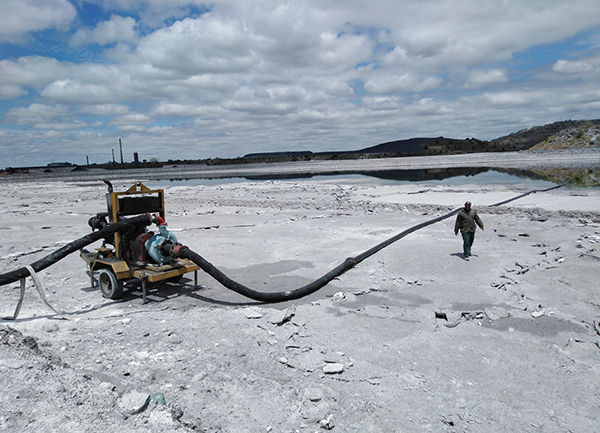
The Phalaborwa project in South Africa represents an exciting, near-term production opportunity of all four of the permanent magnet rare earths required for the green energy transition. The operation will involve the processing of phosphogypsum stacks, which are the byproduct of historic phosphoric acid production on the site, which ceased in 2014. This resource sits at surface, thereby eliminating the cost and risk of traditional mining projects.
Rainbow will be using proprietary separation technology developed by, and in conjunction with, its partner K-Technologies, Inc., which will allow for the material to be processed into separated rare earth oxides of 99.95% purity. This separation technique replaces traditional solvent extraction technology, which uses toxic and flammable solvents and diluents and requires many different stages, thereby delivering a process that is safer and more environmentally responsible, as well as reduced capital and operating costs due to a simplified flowsheet.
The project also has exceptional sustainability related opportunities as it is founded on the principles of circularity. Rainbow will be taking a waste product (the existing phosphogypsum stacks), cleaning it and extracting value from it - both via the recovery of the rare earth elements and then via the sale of the benign gypsum that is produced as the by-product of the process. Rainbow's operations will see the clean-up of the legacy environmental issues, namely the acid water on site, and will fully deplete the gypsum stacks over time, thereby allowing for a full circle environmental rehabilitation of the site.
The Phalaborwa Preliminary Economic Assessment confirmed strong base line economics for the project, which has a base case NPV10 of US$627 million[1], an average EBITDA operating margin of 75% and a payback period of < two years. Due to its comparatively low operating cost and high EBITDA margin, the project is expected to be highly cash generative across the rare earth pricing cycle.