Having acquired the Mintails assets, Pan African’s ongoing strategy to re-process historical tailings dams is expected to make the area safer and greener, while generating economic benefits for the communities and generating significant profits at current gold price levels.
Last year, Pan African Resources commissioned an independent definitive feasibility study on the Mogale Gold tailings storage facilities (TSFs), which demonstrated a compelling commercial project. In fact, it has been projected that Mintails could increase the Group’s current annual gold production by some 25%.
According to Hethen Hira, Head of Investor Relations & Communication at Pan African Resources, in November 2020, the company announced agreements to acquire the tailings assets for R50 million – approximately $3 million at the time. The assets comprised historic TSFs, or mine dumps, that were the residue from underground gold mines mined in the West Rand since the early 1900s. These assets were previously owned by Mintails Mining SA, which has been in provisional liquidation since 2018.
“We have estimated, based on historical information and confirmatory drilling work, that there are some two million ounces of low-grade gold in the TSFs, contained in around 240 mt (million tons) of material, grading at 0,3 g/t of gold,” he notes.
“Given the low amount paid for the resources and based on preliminary calculations for capital and processing costs around Pan African’s flagship existing tailings re-treatment operations at Elikhulu, in Evander, an expected return in excess of 20% is estimated. This should be even higher if the gold price increases.”
Hira adds that the company’s tailings operations are hugely profitable, given the low all-in sustaining cost (AISC) of production of around US$1 000/oz. In addition, the company anticipates a life of mine at Mintails of around 20 years, with annual production estimated to average around 50 000 oz/year. The processing plant has a design capacity of 800,000 tons per month, similar to that of Elikhulu.
“All gold companies continually look to increase their annual production and resource base. The Mintails assets are of the last remaining surface sources for gold in the country and would add some 50 000 low-cost ounces to our annual production for the next 20 years.”
More crucially, these are also mined safely, without any of the risks as involved with underground mining. And in reducing the footprint of tailings dams, there is also the added safety factor that the modern facilities will not likely be prone to structural faults that lead to dam collapses.
Fast payback
Hira reminds us that with the AISC to produce an ounce of gold from Pan African’s other tailings re-treatment facilities sitting at around US$1 000, profit margins are favourable with a gold price currently somewhere between US$1 800/oz and US$1 900/oz.
“By our estimates, the capital cost of around US$135 million can be paid back within three or four years. This will leave the remaining life of operation to contribute to further growth of the company, through acquisitions, as well as returns to shareholders through dividends.”
“Remember that underground mining generally produces gold at a cost of around $1 400/ounce, as the costs here are much higher due to the infrastructure and underground development required. However, the tailings are mined using hydraulic mining methods and a low labour requirement which significantly reduces the costs, leading to improved returns,” he says.
The company is well placed to ensure it obtains the greatest value from this project, thanks to significant experience gained in this arena already. Initially, notes Hira, the company commenced tailings re-treatment at its Barberton tailings re-treatment plant (BTRP), where there was significant historic tailings material, left over from more than 100 years of mining by previous operators.
The BTRP commenced production in 2013 and capital costs were paid back in 18 months, with the added benefit that re-treatment and consolidation of the new tailings into a modern facility, one with a smaller footprint and up-to-date safety standards, created a win-win situation for the company, the environment and the surrounding communities.
“Since then, we have acquired the Evander Gold Mines, with its abundant historic tailings deposits. Here the Elikhulu tailings retreatment operations were constructed within a record 12 months, and have an expected remaining life of mine of around 10 years. This operation was commissioned in 2018, at a cost of US$120 million, and was paid back in under three years.”
“With such experience already, Mintails was always on our radar, and an offer was made once there was clarity on the valuation, following the liquidation of the previous owners. This is one of the last remaining tailings deposits of its size, so we recognised the impact it would have for Pan African shareholders and community stakeholders, as well as the environment and the local and regional economy of the country.”
Improved safety
These historic TSFs will be reprocessed and redeposited into modern facilities with smaller footprints and according to modern deposition standards, he says, in line with the Global Industry Standard on Tailings Management (GISTM) guidelines.
“Modern reagents and safer treatment processes play a big part in our safety efforts. Thanks to the application of modern standards, we can say that the reprocessing of tailings today is much more environmentally friendly. For example, at Mintails much of the reprocessed material can be deposited underground in the mined out areas – while the new surface dams will be properly lined, negating any concerns around ground water contamination.”
This limits the danger of breaches affecting the surrounding communities, and also reduces the current levels of air and water pollution, as shown by detailed environmental studies undertaken as part of the definitive feasibility study. Mintails has permission to deposit some of the reprocessed material back into the historic mine workings, which will result in them being made inaccessible and thus also reduce the threat of illegal mining activity.
“With regard to safety processes," Hira continues, "Pan African has taken proactive measures and has conducted internal and independent external audits and studies over the past two years, to evaluate its TSF management relative to the GISTM. Subsequently, independent tailings review board (ITRB) was appointed to conduct a formal audit of the Group’s TSFs. Comprised of three suitably qualified independent members, the ITRB conducted site visits to the TSFs, followed by the issuance of an assessment report with findings being reviewed and implemented.
“Pan African prioritises effective tailings dam management across its operations. At each TSF site, a competent person within the context of a recognised tailings management company is appointed to oversee monitoring and compliance with legislation, as well as the Group’s internal codes of practice.”
In line with the GISTM recommendations, Hira points out that Pan African has appointed:
- an executive accountable for tailings management in June 2022
- a tailings facility engineer in June 2022, responsible for the robust management of the TSFs
- Barberton Mines’ engineer of record, to serve as Evander Mines’ engineer of record.
Considering that the majority of Pan African’s TSFs were constructed before the introduction of the GISTM, Hira explains that the Group has actively engaged in ongoing assessments to identify and address any compliance deficiencies to the extent reasonably practicable.
“Pan African is committed to working collaboratively with stakeholders to ensure the implementation and maintenance of statutory TSF management standards. Action plans and remedial activities identified through internal and external reviews are continually being implemented to mitigate high-risk safety and environmental concerns. With these actions, we aim to ensure safety compliance for our mining operations, employees and the surrounding communities,” he says.
Construction and impact
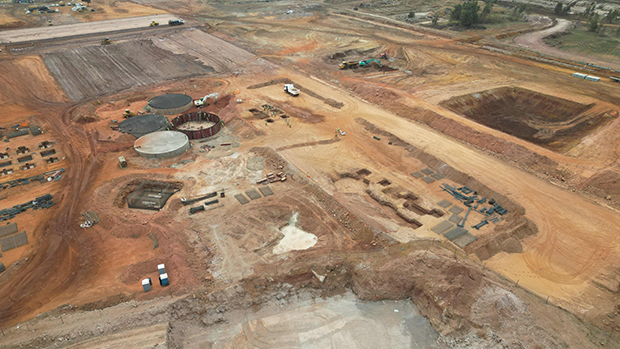
Describing the initial phase of the project, Hira states that this involved the acquisition of properties for the construction of the plant, which has a capacity to process in excess of 800 000 tonnes/month of tailings material.
“There will be nine leach tanks and related plant infrastructure, including a smelt house, which will all be highly automated. Construction commenced in July 2023 with site clearing, and it is anticipated some 300 to 400 people will be employed directly during construction. These will mainly be members of the local community, except where specialist skills are required.”
All equipment and contractors will be secured locally and the overall cost is anticipated at R2.5 billion, much of which will be spent locally and in Gauteng. All required buildings and services will be contracted to local companies. Thereafter, the plant is expected to employ up to 500 people in the operational phase for the next 20 years.
“Pan African has already commenced with an engagement process with representatives from both the local community and government, with regard to the needs in these communities. These will be formulated into our social and labour plans, where community local economic development and skills development projects are concerned. We will also commence with business incubation for local small businesses,” he adds.
“In the short term, we will look at assisting local community organisations and schools in need of assistance - where we can make an immediate positive impact. During October, the company assisted two schools in Kagiso with furniture and supplies to alleviate overcrowding and assist with learning camps for the upcoming matric examinations. Engagements are ongoing. We will also seek to implement agricultural projects as land becomes available, following rehabilitation, and replicate the success we have achieved at our blueberry farming project in Barberton, which employs up to 300 seasonal workers.”
What comes next?
Hira explains that the current life of mine is anticipated as 20 years, from the end of 2024. As explained above, there will be concurrent rehabilitation of the TSF sites, and land will become available for alternate use, such as housing or agriculture.
Environmental studies by independent consultants indicate an expected marked reduction in groundwater contamination, following the reprocessing and re-deposition of the tailings and neutralisation of acidic water through re-treatment during processing. The company is also looking at constructing a 10MW solar renewable energy plant on site.
“One of the key hindrances to the development of the project was the high anticipated cost of environmental rehabilitation, chiefly due to negligence and abandonment by the previous operators, as well as from illegal mining. Pan African has come to an agreement with the authorities on the best course of action, and will concurrently rehabilitate the contaminated footprint areas,” he says.
“Extensive consultation and studies from independent environmental consultants has revised the outstanding liability requirements. Concurrent rehabilitation will see much of the area cleaned up, with a resultant decrease in air pollution, as sand will no longer be blown from the poorly vegetated old tailings deposits. Water quality will also improve, as seepage from the new tailings will be avoided. The rehabilitated land will be made available for alternate, more productive economic land use, such as a similar agriculture project to the one established in Barberton.”
He points out that at R2.5 billion, its tailings focus is one of the largest investments to take place in Gauteng in recent times. The province has attracted minimal investments of this scale, explains Hira, and there are not many foreseeable in the near future.
“Pan African has secured this amount upfront for the construction of the project, which greatly reduces execution risk. The company also has a track record of developing tailings retreatment projects as already mentioned, and is committed to using local labour, contractors and small businesses.
“This is a further economic boon to the area, which has seen very little economic stimulus in recent times. And of course, with the operation anticipated to have a life of over 20 years, we will have time to implement a number of alternate sustainable economic initiatives, to ultimately ensure the long-term economic benefits for the entire region,” he concludes.