Of all the firms with ties to Germany, how many can trace a history back to a director who cycled across Africa to open the company doors?
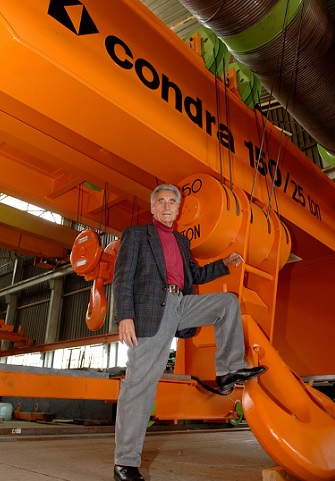
Probably only one.
Condra, which will on June 24 celebrate its diamond jubilee, owes its origin to Sepp Kleiner, who in 1959 strapped a tent and two changes of clothing onto a bicycle, and set off on a two-wheeled journey to Cape Town, travelling from Reischach, Germany, across France and Spain to North Africa, and from there southward across the continent. It took him two years.
Sepp is retired today, but the company he founded has grown to become a leading local manufacturer of cranes, hoists, end-carriages and crane components for customers worldwide, employing staff in three factories on two continents.
His journey across Africa was epic. Kleiner cycled through warring countries, across deserts and through rainforests, and followed a long, wide river on which he was arrested and sentenced to be shot as a spy.
The adventure began in November 1959, immediately after Kleiner had completed his degree in mechanical engineering. A promising career in post-war Germany was his for the taking, but the 28-year-old, originally from Mähren, was seized by wanderlust.
“It had to be Africa,” Kleiner recalls, “because Africa was still in many places undeveloped. There was the possibility of some excitement!"
Equipped with camera and pocket money (900 marks), Kleiner set off in secret. He cycled through Switzerland, then across France through Lyon and Marseilles, and along the coast into Spain. Only when he reached Barcelona did he let his parents know where he was. He arrived in Alicante, a Spanish port on the Mediterranean, on New Year’s Day 1960.
January 11 saw Kleiner dock in Algeria, where a war of independence was testing new levels of both violence and scale. Camping off-road, French soldiers arrested and detained him for questioning, but no one really knew what to do with this strange German who imagined he could cross the Sahara in the middle of a war.
“In Algiers, French Foreign Legion soldiers took bets that the guerrillas would kill me,” he recalls. “But I had no experience of guerrillas, so I didn’t think much about it and just kept on going.”
Wind and terrain proved more troublesome than the war: sand too loose for tyres, broken water wells, wild country with lions, and wind that stung and hindered movement. Kleiner hitched a lift with a convoy bound for the oasis at Tamanrasset in the south, then crossed into Nigeria, another country in the grip of war. In Ghana he stayed for a year, taking a job in a car workshop to replenish his cash, then set off again to cross Togo, Benin, Nigeria and Cameroon, which took him into the Central African Republic.
He acquired a dugout canoe, built an outrigger, strapped his bike and belongings aboard it, and set off down the Ubangi River, destination Kinshasa. This leg of the journey did not last long. He was arrested on the DRC bank, the country where secessionists had shortly before assassinated the prime minister, Patrice Lumumba. Mistaking Kleiner for a CIA spy, the military assembled a firing squad to have him shot. But luck intervened. The squad had difficulty loading their rifles, so Kleiner was released. He continued his journey, but this time on the opposite bank, a safer bet.
From Brazzaville, he went west to Pointe Noire on the Atlantic, then by ship to Angola. From that country, denied the visas he needed to continue overland, Kleiner continued by sea, arriving in Cape Town at the end of 1961. His journey had taken two years.
Liking South Africa, Kleiner settled in Johannesburg to work first for Liebherr, then Demag, both German companies. His original plan called for a return journey to Europe through East Africa, but he had by this time identified the opportunity to start Condra. The rest is history. Condra’s success today bears witness to Sepp Kleiner’s vision, and to an attitude summed up by a favourite quote he likes to share:
“To succeed, sometimes you just have to be bolder than the others,” he says.