
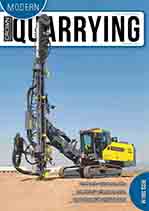
 Built to meet the demanding conditions of the African continent head on, Atlas Copco has set the benchmark in the large top hammer market with the introduction of the PowerROC T50. Launched recently at a highly-successful two-day event at Sun City – the objective of which was to 'WOW' customers – the new units have to potential to play a major role in the large top hammer market in South Africa and the African market as a whole.
Brewelskloof – a flagship operation
The Afrimat story really started with two major construction players of the time – Prima and the Lancaster Group – a history that dates back to the early 1960s. One of the first quarries owned by Prima Klipbrekers was Brewelskloof in Worcester, a quarry which has remained a flagship operation.
With its geological source being metamorphic andesite, some of Afrimat's customers demand products from Brewelskloof. Part of the hornfels range, the product is a good one – hard but not abrasive.
The final benches are in the process of completion and the focus will then be on the floor. There are three more layers to go down on the floor, the quarry has opened up with no apparent rock movement and general stability is sound.
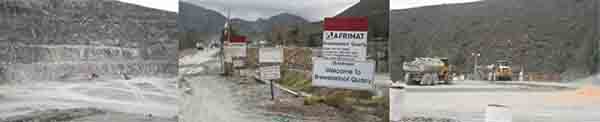
From left: The mine is carrying out the pre-split lines on the benches with future development being on the floor; entrance to Brewelskloof Quarry, in Worcester, Western Cape; and the Bell brand is evident on the quarry.
Bench crests – the risks and remedies
One of the highest risk areas in surface mining operations lies at the crest of production benches, where persons/machines could fall off the edge or the weak crest could fail, leading to potentially fatal consequences.
The DMR is currently pushing for crest protection measures, with little standardisation in the materials to be used in the construction. There is also no standardisation in the construction method required, compaction, drainage and future maintenance.
Along haul roads and especially inclined haul roads (ramps), the risk of a machine driving over the crest is significant and this risk can be reduced by the erection of a safety berm, typically the radius of the largest wheel, the edge of which should be at least 1,0 m from the crest edge.

From left: Sandy rock trap designed to stop the rolling rock threat from above and act as a barricade and even a monitoring device, if rock is trapped; size of berm to halt a heavy truck; and a mine with safety berm placed on a crest that covers the prominent tension cracks. It is so high that a person would have to stand on the loose material to see inside the void.
Mining legend passes away
William Starkey, fondly known as Bill in SA mining circles, has passed away. The son of a miner, he started out working with pit ponies in Church Gresley Colliery in South Derbyshire, England at the age of 14 – a tale he documented in his short story written in 1996 entitled 'Clinker and Me'. Sadly, Bill died peacefully in his sleep in June this year.
A certified mining electrical engineer, Bill held a UK National Certificate in Electrical Engineering, as well as a UK National Certificate in Electrical Engineering Higher. He held his position as divisional project manager for the Pyrogen brand at AST, until 2014, when he retired.
In shaft mines, ponies, horses and mules were normally stabled underground and fed on a diet with a high proportion of chopper hay and maize, coming to the surface only during the colliery's annual holiday. In Bill's short story, he looks back at his introduction to Clinker and his memories as a pony driver where he discovered the true meaning of the term 'horse sense'.
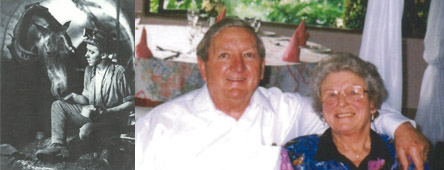
From left: The late Bill and Mrs Starkey; Clinker and Me – the memories of a coal pit pony driver.
Aspasa calls for the right to be heard
This past quarter has been a busy one for the Aggregate and Sand Producers Association (Aspasa), in terms of transport legislation, meetings with the DMR and several key workshops. The Association is developing credible, practical solutions for its members on an ongoing basis.
Aspasa is currently objecting to the mooted new traffic regulations, which it believes will have a negative impact on individual businesses, the construction industry as a whole and the country's economy. It is also seeking clarity on how occupants should be seated in the rear of vehicles – something that has caused consternation in industries across the board.
It strongly believes that quarrying operators are being over-regulated and pushed to the point where small operations become financially unviable, and are left with no option but to close their doors. It is calling for the need to be recognised as different from the mainstream mining industry.
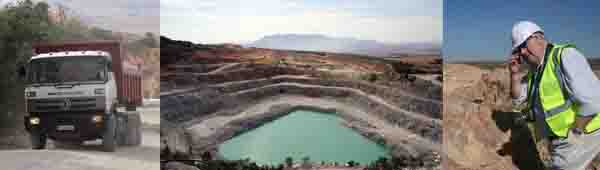
From left: Aspasa is challenging Regulation 292 in which speed limits will be reduced to 40 km/hour in urban areas; the time has come for the aggregate and sand industry to define its own sector with rules designed specifically for the small mining sector; and crushing specialist Alan Fletcher, recently addressed an Aspasa workshop on crushing optimisation.
Regular Features
Editor's Comment
Around the Industry
Supplier Spotlight
Products, Equipment and Services
Last Blast