Situated near Malmesbury in the Western Cape, AfriSam’s Rheebok Quarry has established itself as one of the region’s key aggregate suppliers, producing high-quality crushed granite for major road-building and infrastructure projects throughout the province.
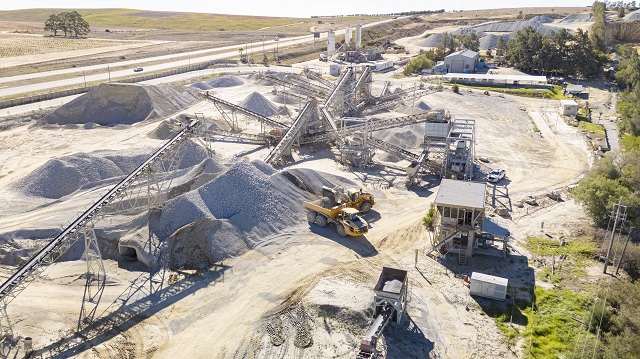
Under the leadership of Acting Quarry Manager Luca Clayton, the operation has evolved into a technically focused quarry that combines high production volumes with carefully controlled mining and processing methodologies designed specifically around the challenges of an exceptionally competent granite resource. Wilhelm du Plessis visited this quarry.
Clayton, who has spent close to three decades within the business, brings extensive operational experience to the role. Having progressed from assistant roles through maintenance, electrical work, production supervision and operational management, he possesses a strong understanding of both the mechanical and production aspects of quarrying operations.
High-demand operation supporting regional infrastructure
Rheebok Quarry traditionally produces between 250 000 t and 300 000 t of aggregate annually which includes stone, crusher sand, base, sub-base, roadstone and ballast. However, the acceleration of infrastructure activity in the Western Cape - particularly around the Malmesbury bypass and N7 upgrades - resulted in unprecedented demand during 2025. According to Clayton, the quarry exceeded 700 000 t of sales during the year, forcing the operation to move onto continuous 24-hour production schedules over four-day operating cycles in order to satisfy customer requirements.
The operation supplies material into municipal infrastructure projects as well as major SANRAL-linked road developments. The abrasive granite produced at Rheebok is particularly well suited to road construction applications because of its durability, hardness and resistance to wear.
Recent reserve evaluations indicate that the quarry retains a minimum life-of-mine estimate of approximately 30 years, with the possibility of significantly extending this as additional reserves are opened and future mining areas are developed.
Extremely competent granite creates fragmentation challenges
The defining technical characteristic of Rheebok Quarry is the nature of its granite deposit. While the rock produces excellent aggregate products, it is extremely competent and resistant to fragmentation during blasting.
This creates one of the quarry’s most significant operational constraints. Even with carefully designed blast patterns and initiation systems, the granite frequently produces oversized boulders that cannot be handled efficiently by the primary crushing circuit without additional secondary breaking.
As a result, secondary rock breaking has become a permanent and essential component of the operation rather than an occasional support activity.
Rheebok currently operates two hydraulic peckers dedicated to reducing oversized material after blasting. These machines work continuously on blasted rock piles, breaking large boulders into sizes suitable for loading and primary crushing.
The presence of the two peckers is not simply a convenience but a production necessity. Without them, excessive oversize material would quickly create bottlenecks in the load-and-haul cycle, restrict crusher feed consistency and significantly reduce plant throughput.
“The fragmentation is the biggest challenge,” explains Clayton. “Because of the type of granite, the blasts generate large boulders and the peckers therefore become critical to the operation.”
Balancing blast performance and environmental control
Blasting at Rheebok requires particularly careful engineering due to both the geology and the quarry’s proximity to surrounding infrastructure and communities.
The operation cannot simply increase powder factors aggressively in an attempt to improve fragmentation because vibration control remains a critical consideration. Blast designs therefore need to strike a balance between sufficient energy distribution for acceptable fragmentation and controlled ground vibration levels that remain within regulatory and operational limits.
Electronic initiation systems and carefully sequenced blast timing are used to optimise energy release and improve fragmentation consistency where possible. Even with refined blasting practices, the granite’s natural competency still results in substantial secondary breaking requirements.
The quarry’s drill-and-blast contractor works closely with site management to continuously refine blast designs based on observed fragmentation performance, bench conditions and downstream plant requirements.
Pit development and mining strategy
Current mining activities focus heavily on opening new working areas and exposing additional reserves for future extraction.
According to Clayton, one of the operation’s ongoing challenges is maintaining sufficient open working faces while simultaneously managing the large volumes of oversize blasted material generated during mining.
Bench development requires continuous stripping, scaling and selective loading practices. In many areas, oversized granite blocks must first be reduced by peckers before material can even be removed from the active mining zone.
The operation is also strategically pushing back selected pit sections in order to create improved access to deeper reserves and establish more efficient long-term mining layouts. These pushbacks are important not only for reserve access but also for improving operational flexibility and reducing congestion in active mining areas.
Drone-assisted survey technology has become increasingly important in this process. Rheebok uses drone mapping and photogrammetry software to conduct volumetric surveys, monitor pit progression and improve stockpile management accuracy.
Compared with conventional survey techniques, drone technology has significantly reduced the time required for volume calculations and mine planning updates while improving data accuracy.
Crushing circuit under pressure
The granite’s abrasive nature places continuous pressure on the crushing and screening plant.
Wear rates on liners, crusher components and screen media are naturally higher than at operations processing softer rock types, requiring ongoing maintenance attention and disciplined shutdown planning. Clayton says that recent plant upgrades have focused on maintaining throughput reliability while improving maintenance efficiency.
The quarry recently replaced sections of its wash plant and continues evaluating additional crushing circuit improvements aimed at increasing throughput and product flexibility.
Feed consistency remains particularly important because irregular feed sizes from oversized blasted rock can destabilise crusher performance and reduce plant efficiency. The peckers therefore play a major role not only in reducing oversize but also in maintaining more consistent crusher feed gradation.
Production growth supported by operational discipline
While Rheebok has experienced significant production growth, Clayton emphasises that operational discipline and safety management remain non-negotiable priorities.
Daily toolbox talks, production meetings, shift handovers and continuous supervisory engagement form part of the quarry’s operational culture.
Camera systems installed on equipment and within operational areas have also improved operator awareness and machine monitoring, contributing to both production efficiency and safety management.
As Rheebok Quarry continues expanding its mining areas and refining its production systems, the operation remains a strong example of how technical adaptation and disciplined quarry management can overcome difficult geological conditions.
At Rheebok, productivity is not achieved through easy mining conditions, but through engineering solutions that allow a highly competent granite resource to be mined, processed and supplied efficiently into one of South Africa’s busiest construction markets.