There are few aggregate operations in South Africa that combine production scale, technical sophistication and operational discipline as successfully as AfriSam’s Peninsula Quarry.
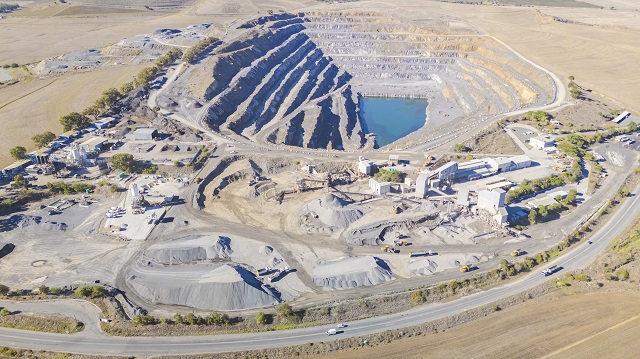
Situated approximately 25 km north of Cape Town in the Tygerberg Hills, the quarry has earned a reputation as one of the busiest and best-run aggregate operations in the country, supplying large volumes of material into the Western Cape’s asphalt, ready-mix, building and civil construction sectors. Wilhelm du Plessis visited the site and experienced this premium quarry in operation.
Despite the scale of the operation and the relentless demand placed on the site, Peninsula Quarry’s defining characteristic is not simply its output. According to Works Manager Chris Kruger, the operation is built around a no-compromise philosophy when it comes to safety, environmental management and process optimisation.
“At Peninsula Quarry, production is important, but it can never come at the expense of safety or operational discipline,” says Kruger. “Everything we do is measured against those standards.” These principles are deeply integrated into the quarry’s daily operations and influence everything from mine planning and traffic management through to crusher performance and water usage. For visitors to the quarry, the first impression is one of scale and organisation. The large open pit descends in wide, carefully engineered benches, while below, an extensive network of crushers, screens, conveyors and stockpiles operates in synchronised fashion to maintain production flow. However, behind the visible infrastructure lies an operation driven by meticulous planning, disciplined execution and continuous optimisation.
A quarry with a long history
Peninsula Quarry has been operating since 1963, following prospecting work carried out during the early 1960s on the farms Roozenboom, Welbeloond and Mont Blanc. Geological investigations identified significant deposits of hornfelsic quartzite and greywacke associated with the Malmesbury geological system. The quarry extracts what are referred to on site as “blue rock” and “brown rock”, both of which are well suited for aggregate applications due to their hardness and durability.
Mining currently progresses in a southerly direction across 11 production benches, with the southern end of the pit reaching depths of approximately 110 m. Bench heights range between 10 m and 13 m, while some bench lengths extend up to 400 m. One of the operation’s key design advantages is the long-bench layout, which allows both blue and brown rock to be mined simultaneously from the same bench.
“The bench layout gives us the flexibility to manage material flow far more efficiently,” he explains. “It allows us to optimise blending while minimising unnecessary movement of equipment.”
Large-scale production capability
Peninsula Quarry’s installed crushing and screening infrastructure is designed to produce approximately 1,2 million tonnes of aggregate annually, placing it among the country’s highest-volume hard-rock aggregate quarries. The operation runs multiple crushing circuits configured to maximise throughput while maintaining product quality and operational flexibility.
Primary Plant A consists of a 38/48 Osborn jaw crusher fed by apron feeder and supported by a Sandvik H6800 cone crusher. Material is delivered to the plant by 35 t articulated dump trucks operating at feed rates of approximately 450 t/h. Primary Plant B incorporates a 30/42 Osborn jaw crusher with vibrating grizzly feeder, together with a Sandvik CH440 cone crusher and a VSI crusher. Operating at feed rates of roughly 250 t/h to 275 t/h, this circuit produces a wide range of products including G1 to G7 layer-work materials, 20 mm concrete stone and road stone products.
The inclusion of the VSI crusher is particularly important for improving particle shape in concrete aggregate applications, where cubical stone plays a major role in achieving quality concrete performance. Further downstream, the tertiary plant includes multiple screens, Sandvik H4800 and H3800 cone crushers and a Barmac VSI crusher to produce aggregate fractions ranging from 7 mm through to 53 mm concrete stone.
Additional infrastructure includes a sand plant, washing plant and an onsite AfriSam ready-mix facility, all of which contribute towards improving product value and reducing waste.
Kruger notes that there are already plans under consideration to increase production capacity even further in response to growing market demand. “The demand for quality aggregate in the Western Cape remains strong,” he says. “We are evaluating additional modular plant solutions that will allow us to expand production capacity in a flexible and efficient manner as demand increases.”
Optimisation begins at the blast face
According to Kruger, efficient production at Peninsula Quarry starts long before material reaches the crushing plant. “Drill-and-blast design is regarded as one of the most important aspects of the operation because fragmentation quality directly influences downstream crusher performance, wear rates, fuel consumption and plant throughput,” he says.
The quarry uses 115 mm blast holes with burden and spacing parameters of approximately 3,9 m x 4,3 m and stemming lengths of 2,8 m. These blasting parameters have been refined over time to achieve optimal fragmentation for both primary crushing circuits. Oversized material can create bottlenecks throughout the processing chain, increasing wear on crushers and reducing overall efficiency. Maintaining consistent fragmentation therefore plays a major role in controlling operating costs and sustaining production levels. Kruger emphasised that Peninsula Quarry evaluates the entire production process as an integrated system rather than a series of separate activities. “What happens at the blast face ultimately affects every part of the plant downstream,” he says. “If fragmentation is consistent, the entire process becomes more efficient and more predictable.”
Technology driving productivity
Technology and data-driven operational management play a major role in maintaining Peninsula Quarry’s efficiencies. The operation continuously measures plant availability, throughput, payload performance and equipment turnaround times. Load-and-haul activities, drilling and blasting and product delivery are outsourced, but contractor performance is closely managed through service-level agreements and ongoing monitoring.
One of the more interesting operational controls is the quarry’s strict fleet-age policy. Mining and dispatch equipment are generally not permitted to exceed 15 000 operating hours, ensuring high reliability levels while reducing downtime and maintenance risks.
Within the plant itself, optimisation efforts focus heavily on crusher closed-side settings (CSS), choke feeding conditions and screen media selection. Even relatively small changes in CSS can affect product grading, recirculating loads and throughput efficiency, making precise control essential for stable production. The quarry has also introduced split-bearing arrangements in key plant areas to reduce maintenance downtime. Unlike conventional bearings, split bearings simplify replacement procedures and minimise the amount of dismantling required during maintenance shutdowns.
Process simulation software, including AggFlow, is used to model production circuits and evaluate potential improvements before modifications are implemented in the plant. Additional technologies include high-efficiency electric motors and extensive camera installations on both earthmoving equipment and plant infrastructure to improve visibility, operational monitoring and safety performance.
Safety remains the overriding priority
Despite Peninsula Quarry’s enormous production demands, safety remains the operation’s central priority. Kruger describes the quarry’s safety culture as uncompromising, particularly given the constant interaction between heavy mining equipment, contractors, plant personnel and dispatch traffic.
The operation has implemented extensive traffic management systems incorporating segregated pedestrian walkways, designated vehicle routes, controlled access points and clearly defined speed management measures. Behavioural safety initiatives form an equally important part of the quarry’s approach. Toolbox talks, safety campaigns, safety coaching programmes and management visibility initiatives are used continuously to reinforce safe working practices and identify unsafe behaviour before incidents occur.
“A quarry environment is inherently high-risk, so there can never be complacency,” says Kruger. “Safety awareness has to remain constant, whether you are in the pit, the plant or the dispatch area.” The quarry’s commitment to operational discipline extends beyond safety alone. Peninsula Quarry has achieved 100% compliance against its EMP audit requirements and received the ASPASA Environmental Award for best environmental performance at the Institute of Quarrying.
Environmental management integrated into operations
Environmental management at Peninsula Quarry is treated as a core operational function rather than a compliance exercise. The operation conducts continuous monitoring of dust fallout, water quality and boundary noise levels through formal monitoring programmes. Stormwater management infrastructure across the quarry includes diversion channels, catchment systems, settling dams and runoff control structures designed to minimise environmental impact both within and beyond the mining area. Water efficiency has become an increasingly important focus area, particularly following the severe Western Cape drought of 2017. During that period, Peninsula Quarry reduced municipal water consumption by approximately 85% by switching its ready-mix operations to the use of quarry pit water. Fuel, electricity and water consumption are all closely monitored as part of AfriSam’s broader sustainability reporting structures.
Setting the benchmark
What ultimately distinguishes Peninsula Quarry is the consistency with which every part of the operation is managed. The quarry’s ability to maintain exceptionally high production volumes while simultaneously focusing on safety, environmental stewardship, maintenance discipline and technical optimisation reflects a level of operational maturity developed over decades.
For Kruger and his team, success is not measured only in tonnes produced, but in the ability to achieve those volumes safely, efficiently and responsibly. In an industry where production pressure often challenges operational discipline, AfriSam’s Peninsula Quarry continues to demonstrate that world-class aggregate production and uncompromising operational standards can successfully coexist.